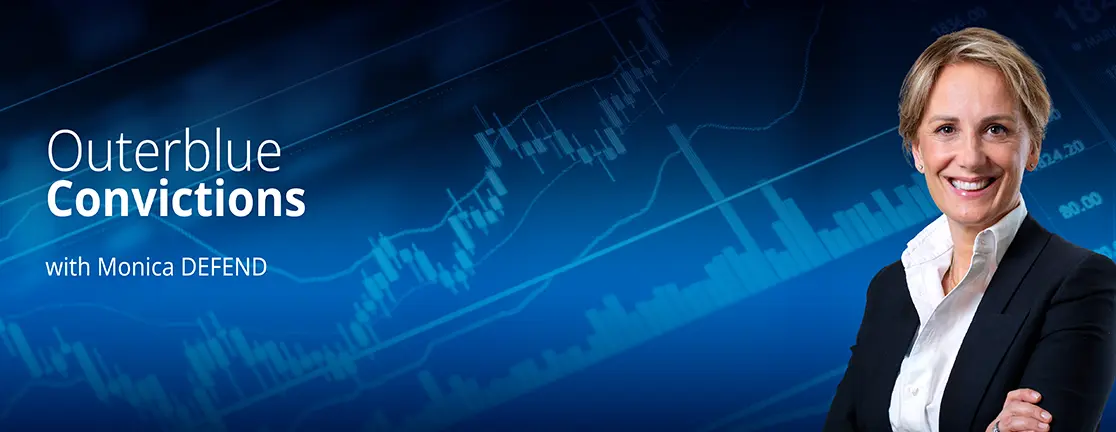
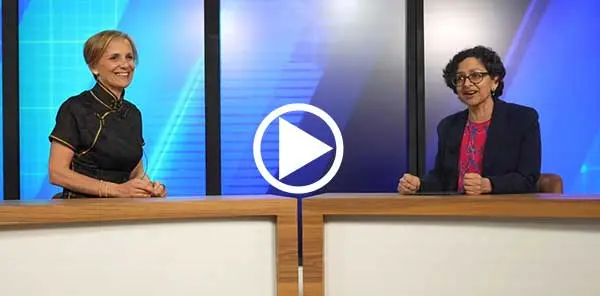
In a special edition of Outerblue Convictions, Swaha Pattanaik sits down with Monica Defend, Head of the Amundi Investment Institute, to unpack Amundi's mid-year investment outlook, The Power of Endurance.
Against a backdrop of geopolitical shocks, shifting central bank priorities and the continued strength of AI-related trades, the discussion explores why global growth may remain resilient but uneven, with fragile de-escalation abroad and broadening AI adoption continuing to shape the macro and market landscape.
Monica outlines the outlook for central banks, arguing that inflation risk is now taking centre stage across key markets as we see a more cautious stance from the Fed while the ECB continues its internal debate on its next steps. The episode explores how monetary policy in the different regions may evolve and what this might mean for the fixed income yield curve.
The discussion then turns to the fast-moving Forex market and our expectations for the different major currencies, highlighting the potential medium-term weakness of the US dollar, diversification away from USD-denominated assets and selective opportunities in sterling. Monica also addresses concentration risk in AI and the need to explore the whole AI value chain and industrial beneficiaries.
Concise, timely and highly relevant, this episode on the investment outlook for 2026 offers valuable insight for investors and asset allocators seeking to build more resilient portfolios. Tune in for expert perspectives on resilience, diversification, selectivity and the themes likely to shape the rest of 2026.
Also Available on Youtube:
Disclaimer: This podcast is only for the attention of professional investors in the financial industry. Outerblue by Amundi. Welcome to Outerblue Convictions, Market Analysis and Asset Allocation Views.
Swaha Pattanaik
Hello and welcome to this special edition of the Amundi Convictions podcast, where we will be discussing our newly published outlook for the second half of the year. I'm Swaha Pattanaik, the Head of Publishing and Digital at the Amundi Investment Institute, and it is my great pleasure to welcome Monica Defend, our usual guest star and the Head of the Institute. Hello, Monica.
Monica Defend
Thank you, Swaha.
Swaha Pattanaik
One thing we didn't anticipate when we published the last edition of the Outlook back in November was a full-blown war in the Middle East. However, the unexpected seems to be a more and more frequent occurrence in recent years. This is reflected in the title of the Outlook. which is called the Power of Endurance, as the global economy and markets have so far displayed a remarkable degree of fortitude given what's been thrown at them. Monica, you and your teams have for some time been deploying this sort of scenario-based analysis. What did you do this time and what's your central scenario and what were the other things you considered a little bit?
Monica Defend
Well, we keep on updating given what is happening and I have to be honest with you, the outlook we had in mind two weeks ago has been updated last week with the signature of the deal, but still is a base scenario where we see a fragile de-escalation on one side and on the other an improvement or a broadening of the AI, which are the two forces that we think will still be at play in the reminder of the year. With that in mind, it's a 3% GDP global growth that is really uneven, depending on how these two forces are hitting or supporting the countries we are considering.
Swaha Pattanaik
Thank you, Monica. So, if that's the rough growth outlook, how do you think the all-important central banks are going to react to what's ahead? I mean, they're facing the same amount of uncertainty all of us are.
Monica Defend
I would say that over the last weeks, including the Fed, there is much more emphasis on inflation, which is something that honestly surprises us. So they are really turning into inflation risk managers. We are not necessarily aligned with consensus. So, for example, on the Fed, we do not expect hikes this year and probably in 2027 they will be cutting rates. On the ECB is really a big debate, internal debate. I'm the one that is reluctant to remove the hike that we see in September. The reason being not only Schnabel, but Schnabel is really quite probably the most hawkish member on the council. But if I look at the inflation prints, first we see services and some second round effects in the readings. And the ECB survey on inflation is showing that inflation expectations out of three/five years still are above 2%, which means that inflation is perceived as sticky. Then we have the Bank of England with one hike in autumn. There it will depend on how the political outlook will evolve and the fiscal consistency. It is what investors will look at. The BOJ, we think they will hike. But because they are still below their natural rate, this is not seen as a restrictive monetary policy stance.
Swaha Pattanaik
Thank you. So, you were talking about your Fed view. Now, that's out of consensus, so the market consensus, say. And the market, we are all getting to grips with Kevin Warsh, the new Fed chair. What do you think flows from the out-of-consensus view in the Fed when it comes to fixed income?
Monica Defend
Well, what we have seen here today basically is a flattening of the curve, and the short end is not that clean because of this uncertainty on pricing the forward guidance. And by the way, Warsh was quite clear saying do not expect a forward guidance. So this week we have this important meeting in Portugal and everyone will be clearly focusing and analyzing each single word. Given that we do expect some risk premium to build on that sustainability and that all the initiatives, investments that will be taking place in the months to come, will require spending. We expect the long end to get higher. So, some way or the other, a steepening of the curve may be less clear now when this data dependency and the lack of clarity on how the situation will evolve, but medium term this will be a steepening of the curve, which is a global movement. It's not only the US, it's likely to be the same case in the EU, and potentially in the UK, and in Asia as well.
Swaha Pattanaik
Thank you, Monica. So I think the Fed chair, Warsh, will discover that when you speak less, every word can generate more volatility. Going to that view, what are you expecting on the FX? I mean, FX is the asset market that moves the fastest, shall we say, in reaction to geopolitics, monetary policy, everything pretty much. What are you expecting on Forex, given your views?
Monica Defend
Well, I will start with the U.S. dollar. In the short term, probably the US dollar can maintain its strength, but because of trade fear and geopolitical risk you were mentioning. But over time, we expect the US dollar to weaken on the back of this fiscal pressure, fiscal steeper curve, fiscal dominance, the fact that potentially the Fed could cut. And then there is this global appetite for investors to seek diversification out of the US dollar denominated assets. So those are the forces that, at least mid-term, encourages us to see a weaker dollar. Outside the US dollar, when we go to the Swiss franc or the Japanese yen, the usual safe haven recession trade, given the economy is resilient. Those are laggard. And then probably one out of consensus view is on the sterling, where we do expect eventually some strength to be recovered towards the end of the year. Sentiment and positioning is extremely bearish on the sterling. So we might have some resumption there.
Swaha Pattanaik
So as a UK-based employee, I'm delighted to hear that. So, you were talking about diversification a little bit earlier, and I think the diversification issue is really important, given what's been happening with the AI and AI-related trades. Could you discuss a little bit the concentration risks and how you have been thinking about mitigating those risks?
Monica Defend
Yes, well, there are risks related to concentration and valuations. This is something that is not new. It was there also last year when we talked about our outlook. What is different now is that probably the expectations in terms of cash flow are just so dramatically high that they might disappoint because those cash flows can come later than what investors are expecting. Then there is the regulation on AI that again can slow down a bit the trend. But it's something that I really enjoyed in reading the outlook. You know, every time there is an article that I find particularly interesting and this one is on AI and the value chain, where what we do is really to identify the various steps of the value chain on AI: Who is producing models, down to who is implementing the infrastructure to enable AI. Down to those like Europe on the downstream, we call it this way on the taxonomy, that are implementing AI into their industrial processes. And given how the industrial sector, in particular in Europe, in terms of market cap, has been increasing over time from 2024 to now, probably this is where we might see some opportunities for Europe.
Swaha Pattanaik
Great. Great to hear. And that's probably also picking up a little bit on the idea of how, I was going to ask, how are you thinking about building, helping clients build more resilient portfolios? So this diffusion of the AI story is probably one of them. Are there others?
Monica Defend
Well, I think really that is the moment. I mean, all these risks that we are facing to be extremely disciplined, extremely focused on portfolio construction. So we truly believe that cash has to be a strategic decision, as well as equity needs to get broader beyond AI and thinking about this evolution of the 2.0, 3.0 story on AI, as well as strategic autonomy, which again is something global, it goes beyond Europe, it goes beyond energy independence and defense. FX, as I was mentioning, really is an important component because, as you were saying, those are the asset classes that are reacting the fastest to what we are seeing on the markets. And then hedges, on hedges, it might be real assets because we are talking about inflation. It might be gold that has been challenged recently because of the repricing of the Fed expectations on rates, but it's something that given inflation risk, it's worth having. And then you have the core of the portfolio that needs to be invested into income, quality, quality carry, and thematics, as I was saying before. But really, discipline is a key word that goes beyond the narratives of the market at the moment.
Swaha Pattanaik
Thank you very much, Monica. That's a really clear overview of why we have Power of Endurance as the title of our Outlook. So do check out the Amundi Research Center to see the full Outlook publication with all the details of the forecasts and asset allocation tables from Monica's teams. And we will be back after summer with another Convictions podcast. In the meantime, we hope you have a good break and that both the sultry weather and the geopolitics calm down a little bit. Thank you.
Disclaimer: 2014-65-EU, dated 15 May 2014, as amended from time to time on markets and financial instruments, called MIFID II. Views are those of the author and not necessarily Amundi Asset Management SAF. They are subject to change and should not be relied upon as investment advice, as a security recommendation, or as an indication of trading for any Amundi products or any other security, fund units, or services. Past performance is not a guarantee or indicative of future results.