
Summary
Introduction
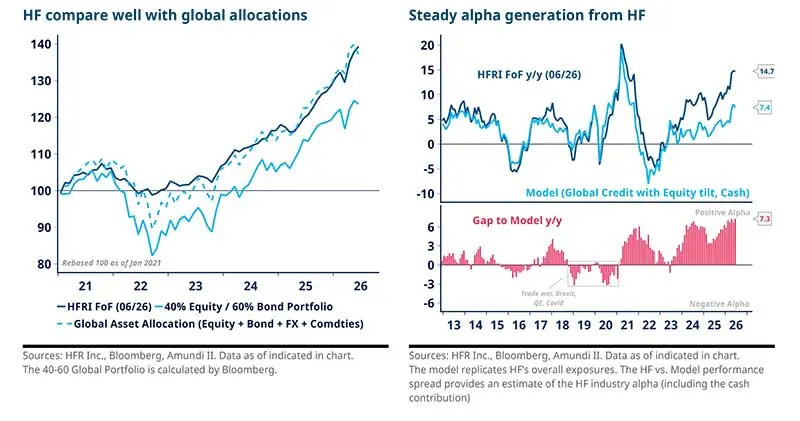
Hedge fund (HF) performance remained strong in H1 2026. Industry alpha also stayed elevated. The quality of HF returns, combined with investors’ search for diversification and the headline noise surrounding private assets, has continued to attract flows into the industry.
H2 2026 should remain supportive for HF. But this is not a regime of abundant, easy beta. It is a narrower, more selective, capex-driven market, where support exists but does not diffuse evenly across the economy or across assets. Markets are moving from broad exposure to selection, from owning the headline theme to discriminating within it.
For HF, H2 will likely be less about calling the market than about identifying the right structural themes, separating true winners from those merely riding the theme, and getting the timing right in a market prone to faster rotations. That is the kind of environment in which HF can do well.
8 macro themes that will matter for HF
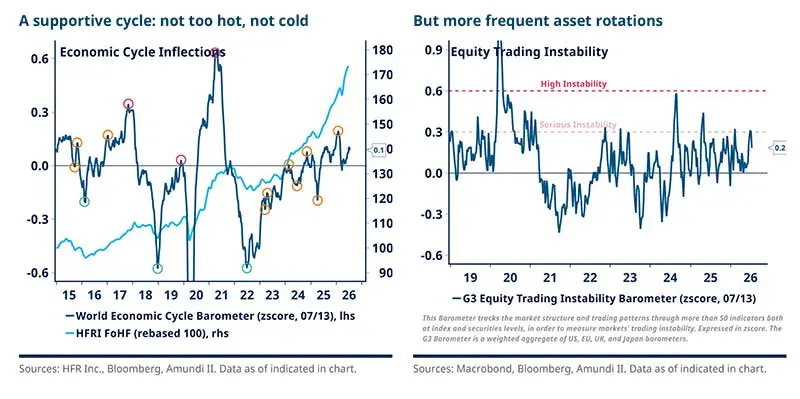
The cycle remains strong enough to preserve risk appetite, but not strong enough to lift everything indiscriminately. It is also not weak enough to trigger a full defensive regime. This kind of backdrop typically favours fundamental pricing, sector rotation and alpha, rather than blind beta. It also tends to generate more frequent asset rotations.
For HF, this implies that broad market exposure should do less of the work than in H1, while stock, sector and country selection should do more. That is constructive for L/S equity, Event-Driven strategies and selective EM specialists. The main risk is that macro headlines can still periodically distort the tape and create violent but short-lived anomalies.
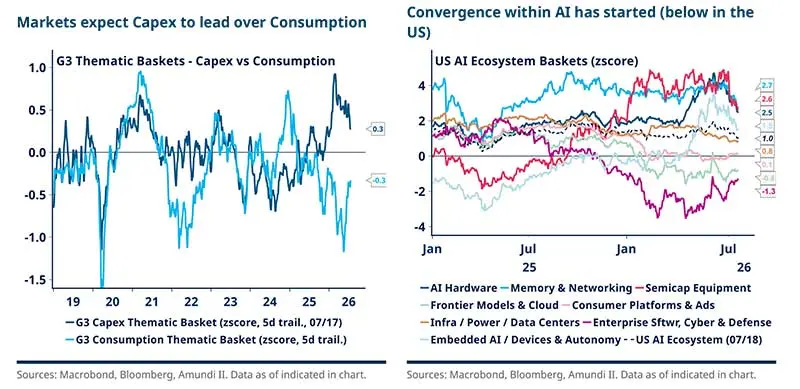
In H2, the marginal dollar of growth should still be directed toward AI, power, grids, energy security, defence, strategic autonomy and supply-chain reshaping. In short, the marginal dollar relates to building, not buying. That matters because capex-led growth tends to be narrower, more policy-shaped, more sector-concentrated and less broadly diffused through the economy than during a consumption-led cycle.
This has two consequences. First, segments outside that epicentre can run on their own tape, which supports dispersion. Second, differentiation should rise within the epicentre itself. AI is the clearest example. After months of focusing on a handful of obvious winners, markets are now debating who will actually capture the value inside the chain (see the convergence across AI segments, shown below for the US).
That is very supportive for directional L/S equity, thematic specialists, Event-Driven strategies and selective L/S credit. The risks are equally clear: crowded longs, violent rotations within the same structural complex, and portfolios that appear diversified while all leaning on the same capex regime.
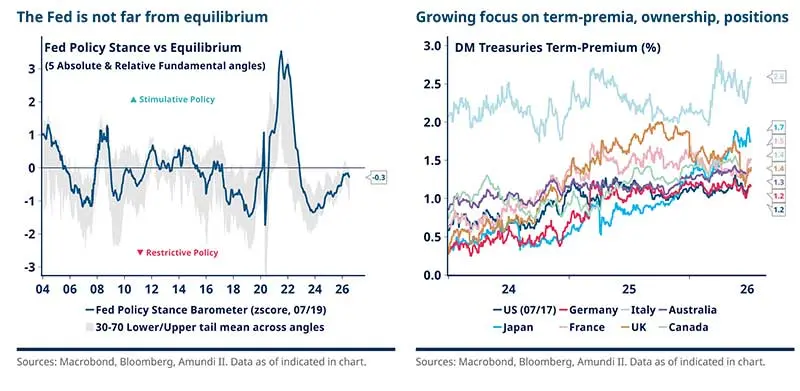
Monetary policies are diverging, but not enough to create dominant macro trades. Most central banks are close to equilibrium, within one cut/hike of cu rent pricing. Where neutrality lies, how much term premium belongs in the curves, who owns duration and how investors are positioned should matter more than the level of rates alone. Dispersion will come from different mixes of inflation stickiness, growth resilience, fiscal and debt pressure, central banks’ forward guidance and tolerance for inflation staying away from target.
So, the debate is moving away from purely cyclical drivers of yields toward more structural ones. Large directional trades may be scarcer, but monetary divergence should still generate many local relative opportunities across rates, inflation curves, cross-market bond instruments and FX.
Liquidity remains available, but it is less generous than headline market conditions suggest. Market liquidity overstates true macro liquidity – which is closer to neutral in our view. Plumbing remains under persistent stress. While a major liquidity accident is not our base case, the backdrop should lead to faster asset rotations. The market beta contribution can remain positive, but more fragile liquidity can generate an adverse asymmetry of risk (a convexity risk).
Credit markets are moving into a more mature mid-cycle phase. Funding remains open, but tolerance for weak balance sheets, poor cash conversion, high refinancing needs and long-duration promises is eroding. That is a healthy shift for hedge funds: it improves alpha conditions by forcing more fundamental discrimination and by creating more tactical trading windows.
This should favour fundamental L/S strategies in both equity and credit, as well as lower-net strategies. More broadly, the combination of positive but fragile beta, faster rotation risk and sharper leverage unwind dynamics creates an asymmetric risk profile which makes HF increasingly attractive relative to fully invested styles.
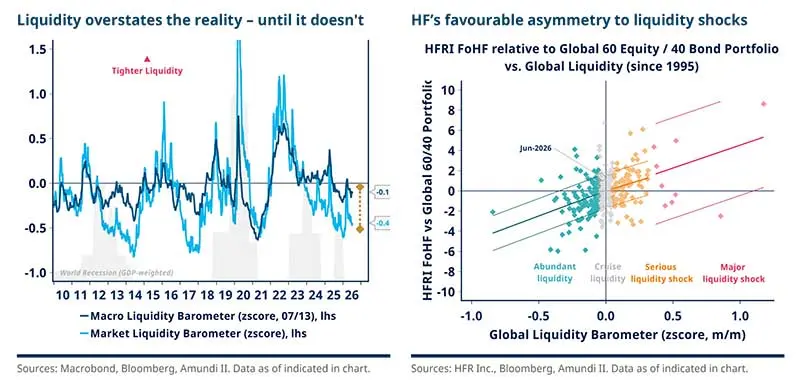
The old divide between rich and poor households, shareholders and workers was largely shaped by globalisation, deindustrialisation and increasingly shareholder-centric capitalism. That logic is now broadening. AI, geopolitical fragmentation, energy and sovereign security, protectionism and reindustrialisation are widening the gap between winners and losers at every level of the economy.
The K-shape is no longer just a household or labour story. It is becoming a system-wide sorting mechanism, creating new winners and losers across countries, sectors, business models and corporate balance sheets. The K-shape is going micro.
This is increasingly visible in the market structure, through low pairwise correlations, elevated dispersion and narrower breadth. That is fertile ground for stock picking and pair trades. The main risks are herding on the long side and falling into value traps, because some securities may remain cheap for good reason while early winners are not always the final winners. Those risks are already visible in themes such as AI and defence.
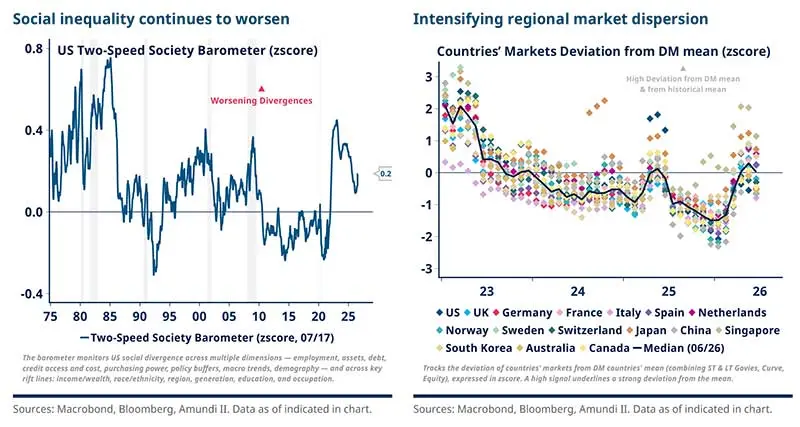
Geopolitics will remain a key variable, but H2 may bring less chaos. Middle East tensions may stay heated, but be less market-dominating. Ukraine remains u resolved, but is less likely to drive the daily tape. US trade policy may stay restrictive, but become less erratic. The European regulatory tone may turn somewhat more supportive of strategic consolidation. Lower policy volatility and fewer abrupt shifts in regulation or tax policy could be enough to support M&A, carve outs, asset sales, activism, liability management, buybacks and strategic reviews.
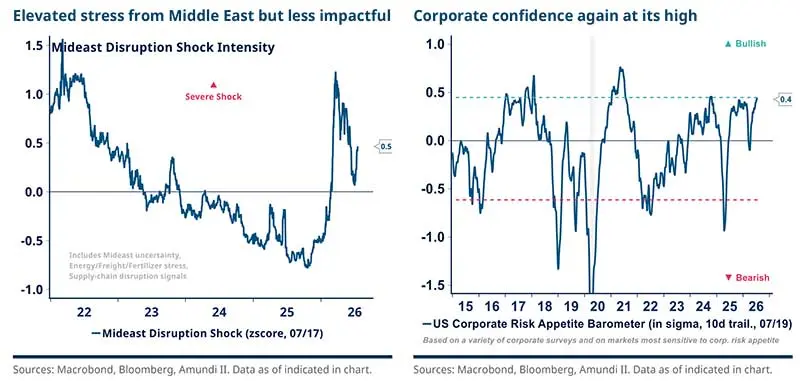
This is an obvious positive for Event-Driven and L/S equity with catalyst. More importantly, the quality of the opportunity set should improve, with a richer pipeline of complex, more attractive situations. The main downside is that more corporate activity also increases the risk of short squeezes for L/S equity.
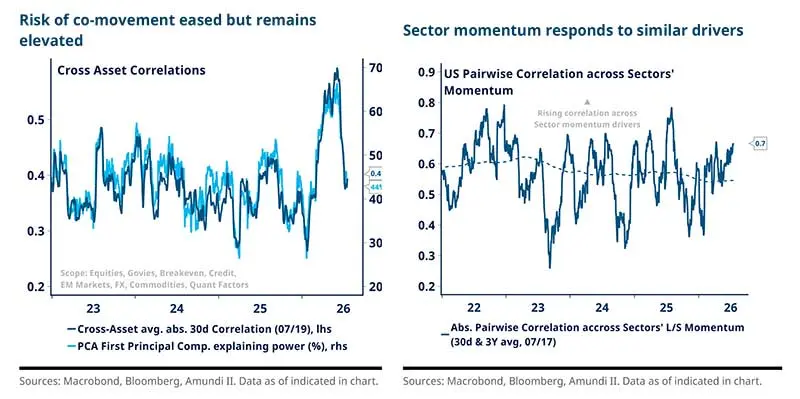
AI, power, energy security, defence and strategic autonomy are different faces of the same structural complex. Many portfolios might therefore be less diversified than they appear. The next unwind might be less about crowding than about hidden sameness in portfolios. Rising correlation across momentum drivers makes this risk even more relevant. Concentration and higher trading leverage also increase the risk of co-movement. In that context, the search for more robust diversification should continue to support HF, thanks to their arbitrage approach, lower net exposure and the complementary contribution from cash.
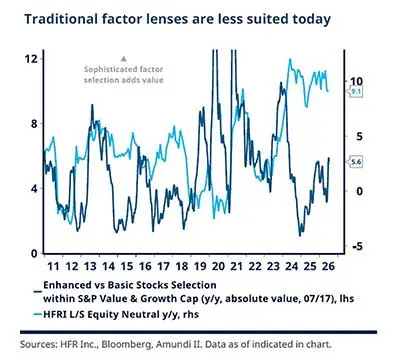
Broad passive and static factor frameworks might increasingly miss where the real action is. Markets are now shaped by secular capex, policy distortions, narrow leadership, unstable correlations and polarised earnings outcomes. Factor investing still matters, but it works in a less linear and less reliable way than before. Broad factors will likely be less efficient at capturing internal fragmentation and shifting thematic leadership. That should favour discretionary stockpickers, adaptive quant, thematic specialists, catalystdriven equity and active relative value over static factorneutral books and passive allocators.
Special focus: HF exposure to and risk from AI
Our analysis shows that HF exposure to AI, a theme likely to remain central in H2, is heterogeneous in size, implementation and risk. This analysis is based on in-house AI thematic baskets and HF sensitivity models.
Directional L/S equity shows the clearest exposure. Since 2025, AI has risen to roughly one-fifth of total beta and has accounted for about one-third of YTD performance. Exposure is concentrated primarily in the US, with selective EU exposure and, more recently, Japan and China AI-related names. It is also dynamic rather than static and, until recently, tilted more toward mid- and downstream segments.
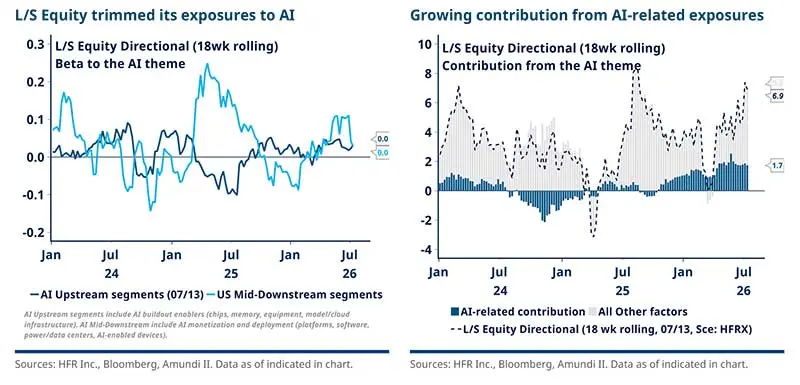
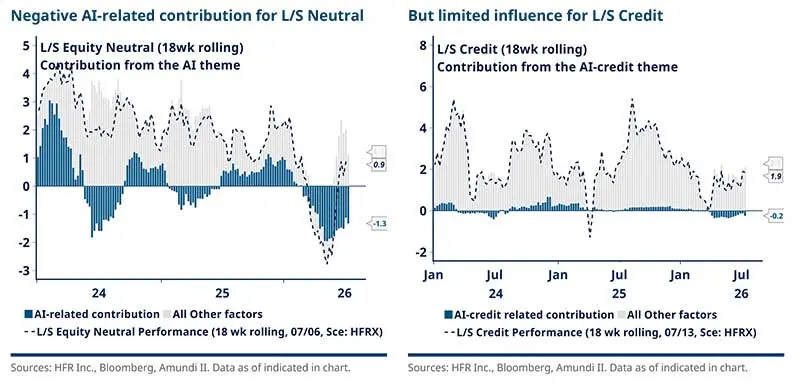
L/S Equity Neutral show limited AI beta as expected, expressing the theme through relative positions. The contribution has been material and likely negative YTD due to frequent AI rotations. L/S credit focuses on funding the build-out through HY and ABS, while shorting business models disrupted by AI. The YTD contribution from the theme has been broadly neutral. Global macro’s AI exposure remains mostly indirect, via rates, FX, energy and Asian supply chains.
Put differently: directional L/S equity owns AI, L/S neutral arbitrages it, L/S credit funds it, and macro feels it through spillovers.
The key AI message for H2 is that the easy money is behind us, but not the story. The ecosystem is moving from buildout euphoria to monetisation scrutiny, and is fra menting into clearer winners and losers. Funding conditions still suggest capital remains available. But bottom-up fundamentals increasingly point to rising capex burdens, lagging monetisation proof and leverage metrics are becoming less comfortable for some of the biggest spenders.
The greatest strain sits with the capex anchors (hyperscalers and other major spenders). Other parts of the chain, such as infrastructure suppliers, data centres and more visible monetisers, still look healthier. Utilities and power remain acceptable, but their outlook depends heavily on timing, funding costs and regulation.
For HF, the AI arbitrage is therefore not simply about rotating into “safe” enablers, because monetisation pressure is likely to travel through the chain. If pressure rises on the major spenders, they may respond by repricing access, tightening terms, slowing spend or squeezing suppliers. The true distinction is not between AI spenders and “risk-free” enablers, but between those with pricing power and bottlenecks, and those forced to absorb the capital burden. For HF, the key question is no longer whether AI can be financed, but where the cost of that financing will ultimately be borne across the ecosystem.
From another perspective, HF are also increasingly users of AI in their own investment processes. The most sophisticated ones are deploying language models and machine learning to improve signal generation, portfolio construction and risk management. Managers with advanced AI tools may gain an edge.
HF strategy review for H2 2026
L/S Equity: themes are consensus; picking winners and losers is not
Directional L/S equity tends to work best when beta contribution is fading, stock dispersion is healthy, correlations are low enough to let selection matter, and fundamentals and catalysts still shape the tape. H2 looks close to that sweet spot. Capexled growth is narrow and differentiated, corporate activity is reviving, the opportunity set remains supportive, and broad beta has already done much of the work YTD. The cleanest hunting grounds are the US, Japan and selective EM. Europe and the UK appear more average, as rates and top-down noise continue to distort the tape more heavily.
The key point is that the main inefficiency is not in spotting the right themes – they are already well known – but in ranking who captures the value within them. That calls for deeper fundamental work, not simply thematic ownership. The main risk is the higher probability of faster and more frequent rotations, driven by leverage, occasional rate shocks or geopolitics interrupting stock-specific narratives.
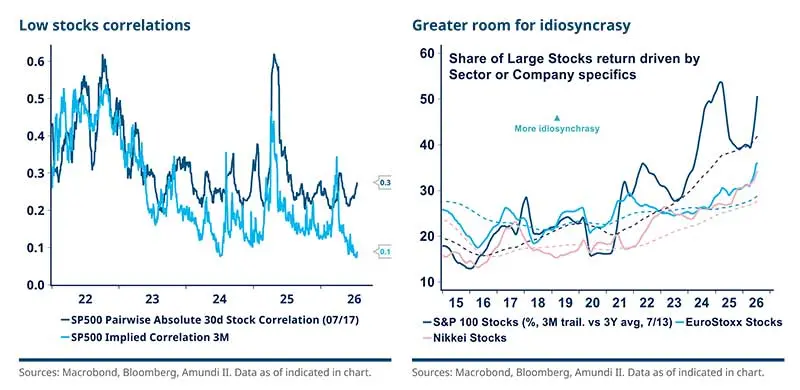
The bar is somewhat higher for L/S equity neutral. That strategy works best when micro dispersion comes with stable relative relationships, a usable factor structure and enough internal logic for mean reversion or sector RV to matter. H2 offers the dispersion, but only part of the stability. The factor map is less reliable because sector and thematic narratives dominate, micro rotations are becoming more frequent, while funds focus on momentum. Neutrality therefore becomes harder to achieve in practice. On the positive side, the K-shape dispersion means the short book is as important as the long book – with structurally impaired business models, AI-disrupted incumbents and capex-heavy balance sheets offering increasingly compelling short candidates. All in all, sector specialists, adaptive quant managers and fundamentally driven neutral styles should still do well, while static factor-neutral books and broad style arbitrage look riskier.
Merger Arbitrage: the pipeline is back – and becoming more interesting
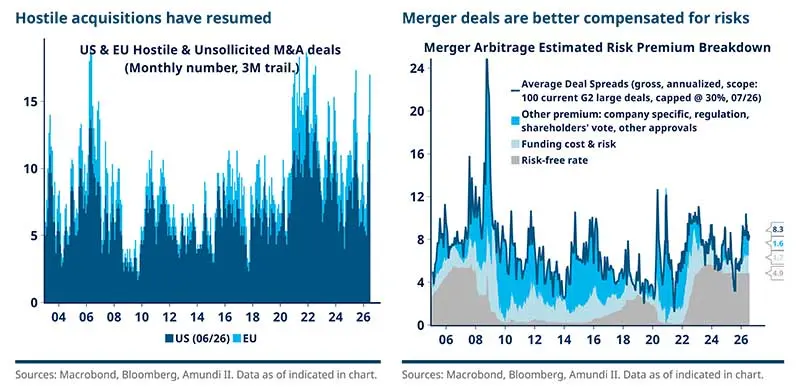
Financing remains available, boards are becoming more willing to act, and the strategic need for industrial reshuffling is rising. The real improvement is not only in deal volume, but in the composition of the pipeline. Plain-vanilla deals still provide carry, but H2 should also bring more complex, more strategic, more hostile and more sponsor-involved situations, with richer event paths around votes, approvals and financing. A higher share of non-pure-cash deals also supports the opportunity set by creating more nuanced spread profiles.
Regulation remains manageable in enough jurisdictions to keep the strategy attractive. In Europe, strategic consolidation and “national champion” logic may create a somewhat friendlier backdrop, although antitrust and crossborder sensitivities have not disappeared. In the US, the environment should remain case-by-case: less uniformly hostile than at the peak of regulatory activism, but it is still strict in strategic sectors and in transactions with national-security implications.
Merger arbitrage does not require a calm market. It requires usable confidence, i.e. enough visibility regarding financing, regulation and strategic rationale over a 6 to-12-month horizon. Deal spreads have become more attractive partly because the market is demanding a healthier complexity risk premium. Added to that, synthetic cash still matters in a world of positive real yields. Overall, the strategy should do well in H2.
L/S Credit: right phase, but dislocations are not there yet
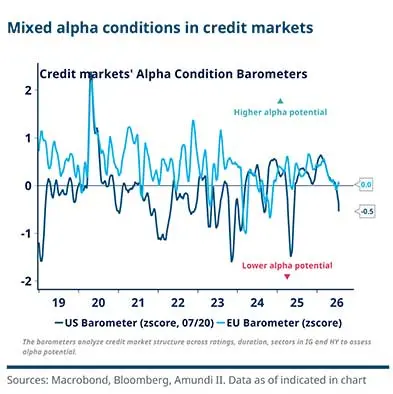
L/S Credit is entering a favourable phase conceptually: a mid-cycle in which financing remains open, with markets becoming more discriminating towards weak balance sheets, poor cash conversion, refinancing pressure, long-duration stories and situations where equity enthusiasm outruns credit quality.
However, ample perceived market liquidity is preventing clear differentiation just yet. Credit dispersion remains insufficient to implement juicy enough long and short positions, while spreads are tight and not dislocated enough. In other words, the backdrop is constructive on paper, but still selective in reality. A shock or valuation reset would be welcome to restore the opportunity set.
EM Fixed-Income/Macro: rich in diversity but still hostage to AI and US rates
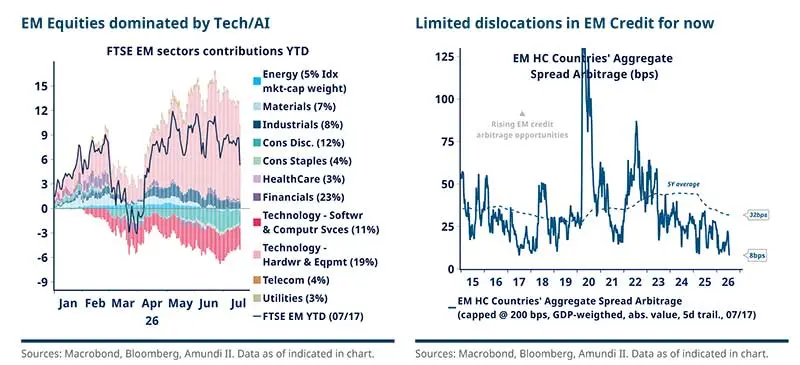
The EM macro backdrop remains supportive enough. Structural vulnerability is manageable in aggregate and has improved, lowering tail risk and allowing investors to access the asset class more comfortably. Liquidity conditions remain uneven, but have loosened overall. Inflation is easing, rates can stabilise or move lower, and risk adjusted carry remains attractive. In that sense, beta exposure still looks appealing.
There are multiple fault lines in EM markets (the “EM” label itself is becoming less and less relevant) running across AI-linked Asia, China-exposure, oil sensitivity, reformers versus fragile financers. Yet, differentiation is still only partly expressed because EM markets are still too dependent on tech/AI and US rates. Correlations across EM credit segments remain elevated and credit dislocations are still limited. That is why we expect more local relative trades across rates, FX and credit than a few blockbuster trades. EM-focused HF should continue to provide access to the space with an enhanced risk/reward profile.
Global Macro: less about the cycle, more about its fractures
On balance, the environment is positive for Global Macro. We don’t see the major economic dislocations that usually create the most attractive opportunities. But the K shape should continue to feed divergences in growth, inflation, monetary policy and fiscal stress. At the same time, markets should become more fundamentally driven, liquidity more discriminating, and the macro scenario somewhat clearer – all of which tend to support risk-taking and more tactical opportunities.
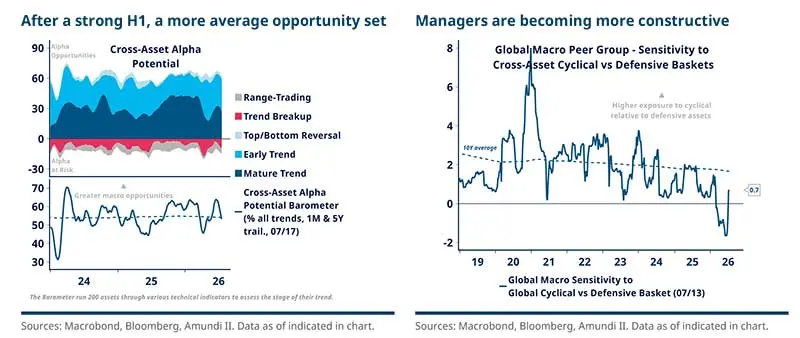
Thus, we expect a diversity of smaller relative trades and market-timing opportunities, rather than a few dominant directional trades. Structural inflation, monetary neutrality, sovereign bond ownership and positioning, fiscal constraints and FX credibility will be central themes. Those themes are likely to be expressed through sophisticated relative trades across rates, inflation curves, bond instruments, selective FX and commodities – where energy, power and grid investments intersect with structural inflation and supply dynamics. In other words, Global Macro in H2 will be less about calling cyclical levels than about arbitraging fragmentation and the forces shaping markets beneath the surface: ownership structure, positioning, flows and premium repricing, which can move markets without a decisive fundamental catalyst.
CTAs: trends are there, favouring nimble over patient
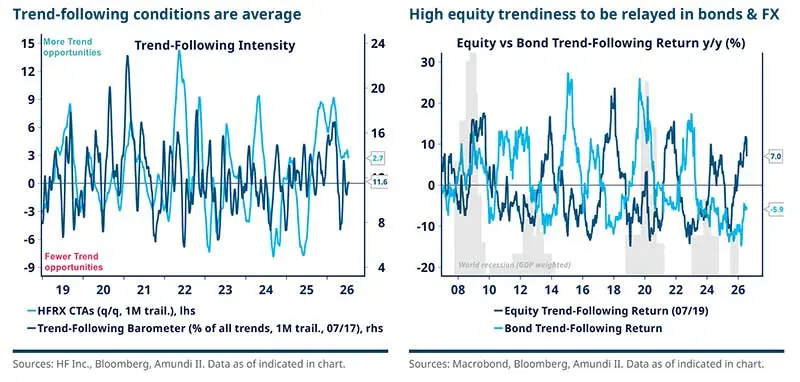
The aggregate directional pulse remains favourable, fewer assets are trapped in range trading, and our model of trendfollowing potential remains decent. Cross-asset correlations have also receded, giving CTAs more room to raise risk budgets. However, as the market moves into a different phase from H1, trends will likely need to refresh. Some existing positions are maturing, while others are constrained by a range-bound dollar and relatively tight rate differentials.
There is a logic to asset trendiness. Strong trendiness in equities usually comes with weaker trendiness in bonds, and vice versa – because equities are most directional when the discount-rate backdrop is stable, whereas bond trends become strongest when inflation and central-bank repricing take over as the main market driver. Trendiness in bonds often leads to trends in FX via changing rate differentials, provided regional divergence is strong enough. Commodity trends can trigger opportunities in bonds, but only when they materially affect inflation. Equity trends dominated H1; H2 may see more opportunities in bonds and commodities, and later in FX.
We expect more short- to medium-term trend opportunities in H2 than a long-lasting trend regime. That argues for a broadly neutral stance. Timing CTAs is always difficult, which also argues for maintaining a core allocation.
Conclusion
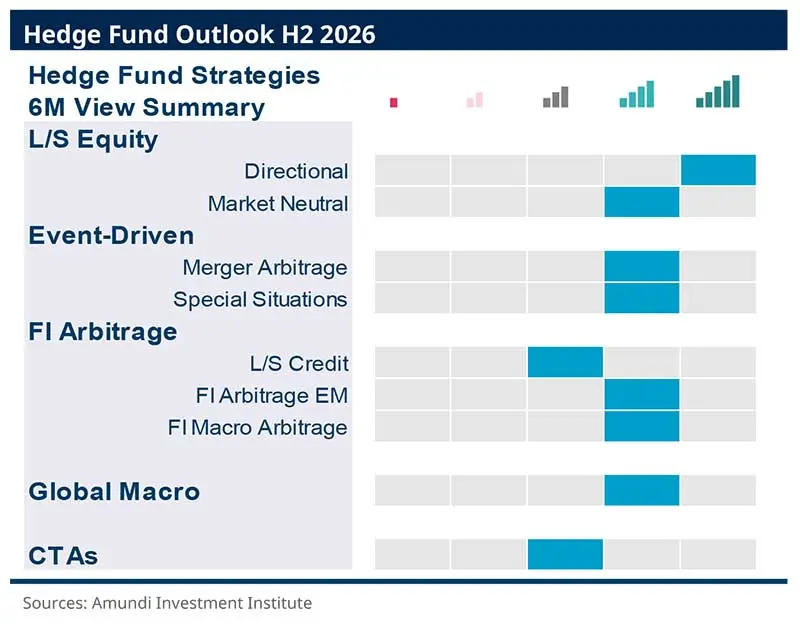
For H2 2026, we expect a narrower beta market and a broader alpha market. The opportunity set should be healthier at the micro level, while top-down strategies should find many local relative trends rather than major directional trades. This is not a market in which hedge funds win because markets are broken, but because markets are becoming more selective and shifting. Our preference remains for directional L/S equity and merger arbitrage, but the backdrop is not polarised enough to justify a narrow strategy call. A combination of bottom-up and top-down strategies looks best suited to H2.
Authors