
Summary
Beyond the surface of overall calm markets, rotations are playing out. Investors should position for a broadening of equity markets by diversifying their exposure and focusing on structural resilience, pricing power and companies’ ability to absorb shocks.
Rotations are playing out
The start of earnings season has been accompanied by greater dispersion in performance across and within sectors.
At the sector level, previously lagging areas are starting to lead. Within the AI trade, investors are rotating from the most expensive segments towards other parts of the value chain.
Amid widening dispersion, investors should focus on quality stocks and sector diversification.
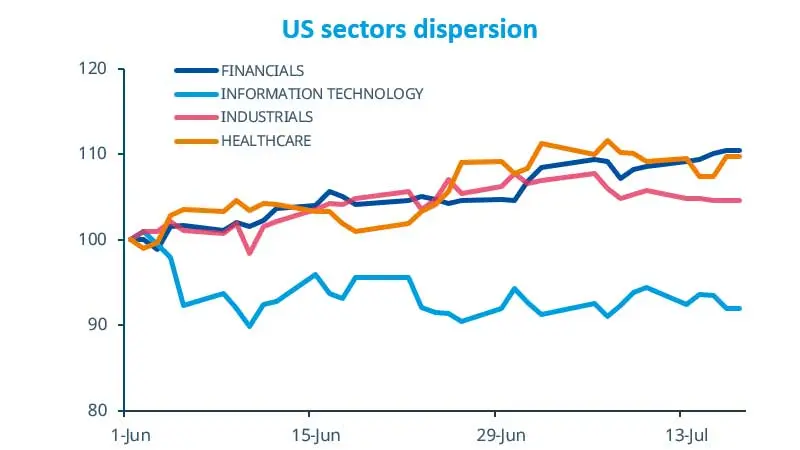
Source: Amundi Investment Institute, Bloomberg, as at 17 July 2026. Indices rebased to 100.
In US equities, recent weeks have shown that despite low market volatility, single stock volatility is rising, as investors increase scrutiny. Market expectations for the upcoming earnings season are high, leaving the market vulnerable to some fragility in case of disappointment. In the technology sector, investors will pay particularly close attention to companies exposed to the shift in customers’ spending towards chips and servers, as well as those that have already deployed significant AI investments. In addition, the recent weakness in semiconductors suggests that markets are also rotating away from chips – the main early beneficiary of AI investments – towards other segments of the AI value chain, including infrastructure, power and applications, in search of new opportunities. This is helping other sectors, such as financials and defensives to lead, while tech stocks ease back from record highs.
This week at a glance
Global equities fell as weakness in semiconductors gathered pace and investors rotated away from crowded areas. In fixed income, Eurozone and US government yields remained towards the upper end of their recent ranges, as central banks stayed cautious while inflation fears and monetary policy expectations tracked the dynamics in oil prices. Gold fell in line with higher yields, while oil rose amid persistent tensions in the Middle East.
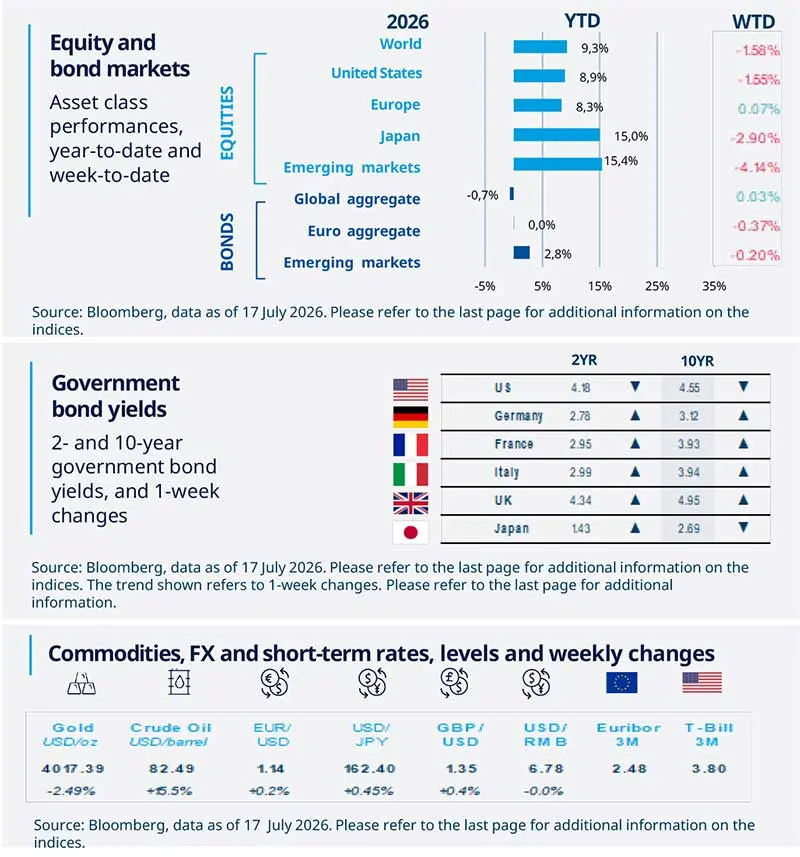
Equity and bond markets (chart)
Source: Bloomberg. Markets are represented by the following indices: World Equities = MSCI AC World Index (USD) United States = S&P 500 (USD), Europe = Europe Stoxx 600 (EUR), Japan = TOPIX (YEN), Emerging Markets = MSCI Emerging (USD), Global Aggregate = Bloomberg Global Aggregate USD Euro Aggregate = Bloomberg Euro Aggregate (EUR), Emerging = JPM EMBI Global Diversified (USD).
All indices are calculated on spot prices and are gross of fees and taxation.
Government bond yields (table), Commodities, FX and short-term rates.
Source: Bloomberg, data as of 17 July 2026. The chart shows the price of gold.
Diversification does not guarantee a profit or protect against a loss.
Amundi Investment Institute Macro Focus
Americas
US inflation declines more than expected
CPI surprised to the downside relative to consensus. Headline CPI slowed to 3.5% and Core CPI to 2.6%. On the headline side, energy prices fell sharply, while food inflation remained relatively modest. The drop in core inflation was driven by softer core services and a second consecutive monthly decline in core goods prices. Lower oil, softer shelter and fading tariff effects should add to disinflation and keep the Fed on hold, absent further Middle East escalation.
Europe
Eurozone industrial production remains weak
Eurozone industrial output edged down by 0.2% MoM in May, leaving production 1.2% lower YoY. The decline was driven by weaker durable consumer goods. At country level, trends were mixed, with gains in Germany and Spain, and declines in Italy and France. Manufacturing showed resilience in recent months, supported by inventory building ahead of possible Middle East-related supply disruptions, but persistent uncertainty in the area continues to weigh on the outlook.
Asia
China growth slows
China GDP slowed more than expected to 4.3% YoY in Q2 from 5.0%, while June data were mixed, with strong industrial production, negative investment growth and only a modest rebound in retail sales. Growth continues to be supported by exports and manufacturing, but domestic demand remains weak, despite easing economy-wide deflation pressures. Policy-wise, we expect stronger easing rhetoric, although demand-side support is likely to remain targeted.
Key Dates
UK CPI and PPI, JP trade balance |
South Korea GDP, ECB policy rate, EZ Consumer Confidence |
Japan CPI, UK retail sales, EZ and UK PMI, ECB Inflation Expectations |



Authors