
Summary
Gradual growth recovery and inflation set to ease in 2027 – France is expected to post GDP growth at 0.6% in 2026 and around 1.0% in 2027. The rebound should be driven by a gradual improvement in domestic demand. The recovery is real, but modest. On inflation, price pressures should remain in 2026, driven by higher oil and gas prices, with spillovers into services, goods and food. Inflation should ease in 2027 as energy prices normalise.
Fiscal position and debt increasingly in focus – Public debt has risen to 118% of GDP, while the deficit remains well above pre-Covid levels at 5.1% of GDP, and will hardly stabilise this year. France can sustain its debt over the medium term, and debt interest payments as a % of GDP remain below those of the US, the UK, and Italy. However a fiscal adjustment will be required in the next three years, as debt would otherwise keep rising and higher bond yields would add pressure to debt dynamics.
The 2027 budget will be important for the market – A draft Finance Bill is expected on 30 September. Markets will focus on whether France begins credible consolidation in the 2027 budget, which must be adopted by the end of 2026. Delaying action may increase the premium investors demand to hold French debt and lead to greater market volatility.
Investment implications – French government bonds are likely to remain volatile amid an uncertain fiscal path. Yields may stay under upward pressure if the 2027 budget fails to deliver credible consolidation, particularly at the long end of the curve. That said, OATs still offer appealing yields and liquidity for investors, which could create opportunities during periods of volatility.
Overall, French debt remains an attractive medium- to long-term investment for bond investors, with yields having returned to high levels for a sovereign with a high-quality rating. However, uncertainty linked to the electoral cycle, the budget approval process and the possibility of foreign investors moving into other markets will likely lead to increased volatility.
France’s economy is on a gradual growth recovery path
We expect France’s GDP to grow by 0.6% in 2026 and around 1.0% in 2027, in line with Eurozone growth. While higher inflation and elevated policy uncertainty, both domestic and external, are likely to weigh on demand in 2026, the economy should retain some underlying resilience, helped by a gradual recovery in private domestic demand, particularly household consumption and business investment moving into 2027.
For 2026, final domestic demand should still make a positive contribution. Household consumption is expected to slow to 0.4% in 2026, from 0.5% in 2025, as higher energy prices weigh on real incomes. Some wage catch-up is expected later in the year, as inflation rises and the usual round of wage negotiations takes place between late 2026 and early 2027, which should help support purchasing power, albeit modestly.
The uncertain domestic and international environment, and the additional burden of higher interest rates, are discouraging businesses from investing aggressively. This is already evident in H1 2026 gross fixed capital formation data. However, we expect business investment to recover modestly from H2 2026.
Despite the sharp decline in exports in Q1, followed by only a partial recovery in Q2, foreign trade is still expected to make a positive contribution to growth in 2026, supported by a rebound in export growth and limited import dynamics over the year.
Consumer price inflation is expected to remain elevated, reflecting high oil and gas prices. Headline inflation is forecast to average 2.1% in 2026, peaking at around 2.6% year-on-year between Q3 and Q4 2026, driven by higher energy prices and their indirect effects on services, goods, and food prices, as well as expected increases in agricultural commodity and fertiliser prices. Inflation should then ease towards 1.7% in Q4 2027, as energy prices decline.
France’s public debt is sustainable, but fiscal policy needs recalibration
France’s debt has risen in recent years, with higher borrowing costs adding to the pressure on public finances.
France’s public debt stands at €3.54 trillion, or 118% of GDP. More than €1.1 trillion has been added since 2019, while the debt-to-GDP ratio has risen by a further 4 percentage points over the past year (from Q1 2025 to Q1 2026), at a faster pace than in the European Union, where the debt ratio rose 1.5 percentage points.
Public debt remains elevated across other EU member states, with debt-to-GDP ratios even higher in Italy, above 100% in Belgium and Spain, and also high in major countries such as the US, where the ratio is now above 120%.
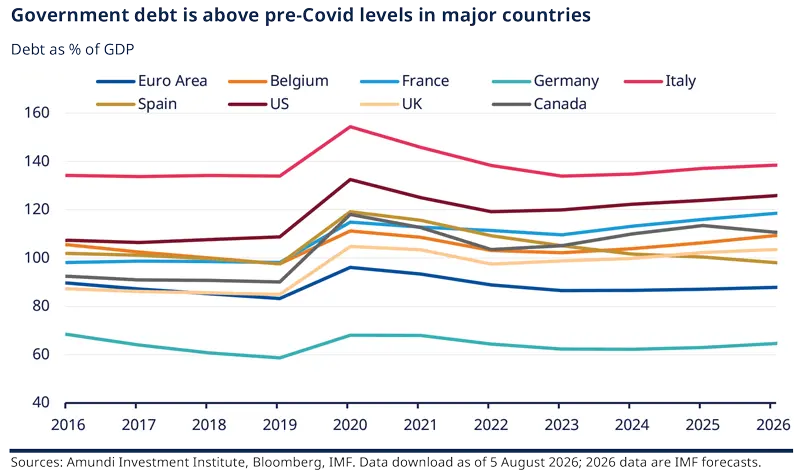
France’s fiscal deficit declined in 2025 to 5.1% of GDP, below the initial target of 5.4%.
However, this figure remains significantly higher than pre-Covid levels, and it is unlikely that the deficit will decrease further in 2026. This reflects a structural primary deficit (in 2025, France and Belgium were amongst the countries with the highest cyclically adjusted primary deficit in the Eurozone, at -2.5% of GDP and -2.6% respectively), together with increasing interest charges resulting from rising government bond yields over the past years.
The debt ratio would increase even faster if fiscal policy remained unchanged.
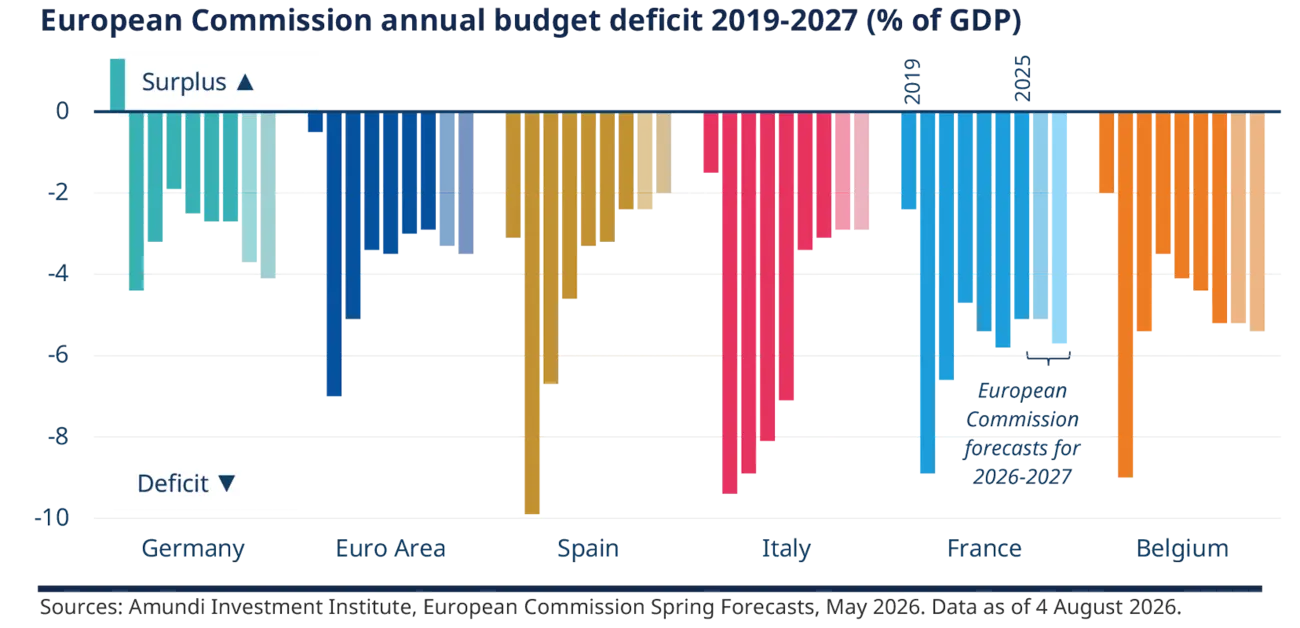
France remains a solid and liquid sovereign issuer, but reducing the primary deficit will be essential to place debt on a sustainable long-term path.
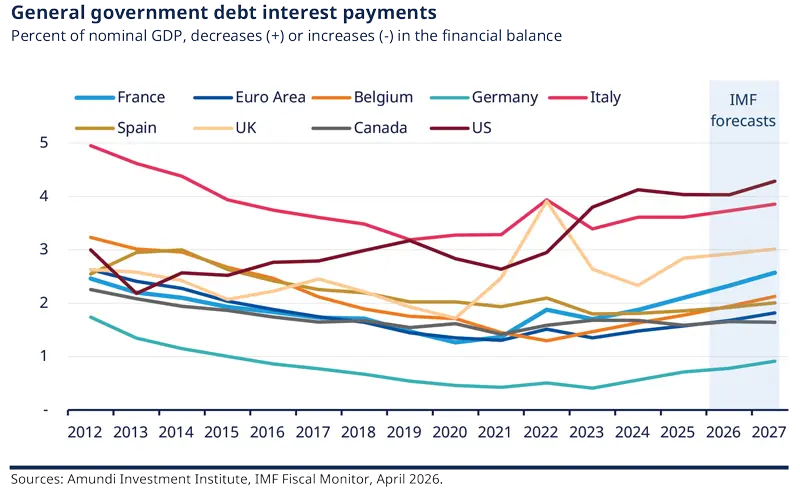
Fiscal adjustment will be essential to place debt on a long-term sustainable path.
The time to act is approaching, with the 2027 budget now in focus
It is increasingly important for France to address its public finance trajectory. Without appropriate deficit-reduction measures, France’s debt could exceed 130% of GDP by 2030, as recently highlighted by the independent Jaravel–Ragot–Tavernier–Valla (JRTV) task force in its report commissioned by the French government. Over time, the interest rate paid on the debt increases, threatening to exceed nominal GDP growth. The fiscal effort required to stabilise the debt-to-GDP ratio is estimated at around €126 billion over the period 2027–31. This is not unachievable, but action cannot be delayed any longer.
Against this backdrop, the 2027 budget, which must be adopted by the end of 2026, will be pivotal. Its preparation is made more complex by the political calendar, with presidential elections scheduled for 18 April and 2 May 2027, followed by legislative elections likely in late May / early June 2027, assuming the National Assembly is not dissolved beforehand.
Even so, there are several measures which could reduce the deficit. At some point, a combination of spending cuts or freezes, tax increases, and structural reforms will likely become inevitable. Media recently reported that the idea of decoupling the pensions of the wealthiest households from inflation has recently resurfaced. While this would be technically simpler to implement in the short term, it remains challenging with the elections just a few months away. A draft budget is expected on 30 September.
Overall, the budget is expected to support deficit reduction. According to media reports, the government intends to introduce measures that would reduce the public deficit to 4.9% of GDP next year. If it instead confirms the current debt trajectory, volatility in French government bond markets could rise further.
French government bonds may see some volatility, but remain appealing
Long-term OAT yields recently reached their highest level since 2008, with 30-year OATs close to 4.9% and 10-year OATs marginally above 4.1% on 28 August. Much of this increase is due to a general trend in fixed income markets, with US, Japanese and German yields all rising this summer.
However, investors are also demanding a higher risk premium to compensate for the uncertain trajectory of French deficits and debt. The 10-year OAT yield spread over Bunds is around 85 bp (as of 28 August 2026), up from roughly 55 bp at the beginning of 2026. Funding conditions remain orderly, but the increase in yields will on the margin add to the French deficit as it becomes more expensive to refinance maturing debt.
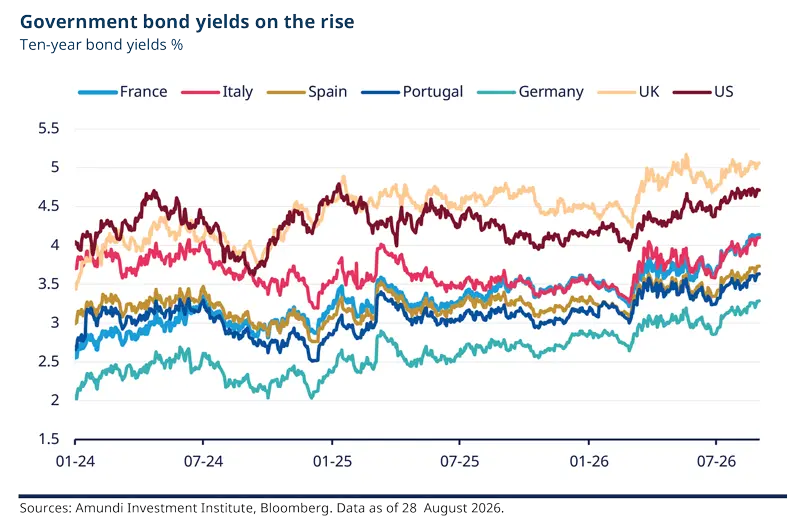
French debt remains an attractive medium to long-term investment for bond investors, with yields that have returned to high levels for a sovereign rating that is still considered safe. However, the debate on the 2027 budget and the fiscal path for the 2027–2030 period will require greater vigilance.
The key issue for investors is how the fiscal trajectory will evolve over the next 5 years.
That said, France enters this phase from a position of relative strength, having benefited from a decade of exceptionally low rates:
France still has a high-quality sovereign credit rating. France remains in the 'investment grade' category, with A+ (stable outlook) ratings from Fitch and Aa3 (negative outlook) ratings from Moody's. The rating agencies have consistently highlighted the size and diversification of the economy, as well as the strength of its institutions.Key strengths include moderate growth, a sound financial system and the capacity to implement reforms that could support a credible consolidation path. However, if no significant fiscal consolidation measures are announced in the 2027 budget, France’s sovereign credit rating is likely to be downgraded.
The OATs market is one of the world’s most liquid sovereign euro-denominated markets. It is a deep market with high liquidity and securities that remain in high demand amongst investors. Given its size, French government bonds represent more than 30% of the euro area’s highest-quality sovereign debt, with ratings in the AAA to A range. OAT auctions continue to be oversubscribed: in spring 2026, for example, the amounts bid were well above those allotted (coverage ratio ~2x). The outstanding volume of medium- and long-term tradable debt exceeds €2.6 trillion, and there is sustained activity on the secondary market. French debt is a major benchmark for the Eurozone and is frequently used as high-quality collateral, which underpins structural demand.
Maturities are long and interest rate risk is actively managed. The average maturity of medium- and long-term debt is around 8.5–9 years, which limits the risk of a 'refinancing wall' and immediate exposure to rising interest rates. The comprehensive OAT yield curve ranges from short-term to very long-term bonds (up to 50 years), enabling the Treasury to smooth the repayment profile and tailor issues to different investors' preferences. Combined with the diversification of instruments (conventional OATs, inflation-linked OATs and green OATs), this active management can help stabilise the debt burden over time and broaden the investor base.
A strong institutional framework encourages the government to make hard choices. The institutional framework (European oversight, the Court of Auditors, the High Council, and increased transparency through the 'no-policy-change' trajectory assessment) provides an environment of governance that reassures investors of France's ability to take corrective action.
High foreign investor ownership is both a sign of confidence and a source of vulnerability. France’s debt ownership structure shows a significant share held by foreign investors, at around 56%, reflecting continued confidence in France’s creditworthiness. This share has risen in recent years as the ECB has begun to shrink its balance sheet, making French debt more vulnerable to foreign investor appetite. While OATs are often used by local investors as a hedge against other assets and liabilities, foreign investor demand depends more directly on the wider opportunity set. With higher bond yields globally, foreign investors may look for better opportunities elsewhere or demand higher yields to stay invested in case of higher political uncertainty.
Overall, French debt remains an attractive medium- to long-term investment for bond investors, with yields having returned to high levels for a sovereign with a high-quality rating. However, uncertainty linked to the electoral cycle, the budget approval process and the possibility of foreign investors moving into other markets will likely lead to increased volatility.



Authors


With the contributions from:
DIDIER BOROWSKI, Head of Macro Policy Research, AII*
GUY STEAR, Head of Developed Markets Strategy, AII*
ANNALISA USARDI, Senior Economist, Head of Advanced Economy Modelling, AII*
ADELE MORSA, Investment Insights and Client Division specialist, AII*
*Amundi Investment Institute