
Summary
Bond volatility has become the main feature of recent market moves. Equities have remained relatively resilient, but bond yields have moved higher in a context in which markets are becoming more sensitive to macro data and policy expectations. As yields move higher and news flows evolve, markets are readjusting across countries and curves. Global bond markets have been the first to readjust, but we have recently seen moves in global credit markets too.
The moves are being driven by several overlapping forces. Tensions in the Middle East have kept oil prices elevated and added to inflation pressure, while stronger US activity data in recent weeks and heavy corporate issuance linked to the AI build-out have pushed long-term yields higher. While benefiting from solid fundamentals, European bonds are under pressure from risks related to energy prices and inflation, reinforced by some fiscal and political concerns, including in France.
For investors, the key implication is the need for a more active approach in fixed income and stronger diversification. Higher yields are improving the appeal of bonds, which now offer yields not seen in decades, but as flows adjust across countries and segments, we see volatility remaining high and dispersion rising in the credit space. In this environment, an active and globally diversified approach to fixed income remains important, with a preference for higher-quality bonds. At the same time, while equities are well supported by strong earnings, prospects for higher inflation and higher yields will increase scrutiny on balance sheets, and on excess capital and debt build-out in the AI ecosystem. This will call for more selection and increase diversification at sector level and across asset classes.
What has been happening recently in global financial markets?
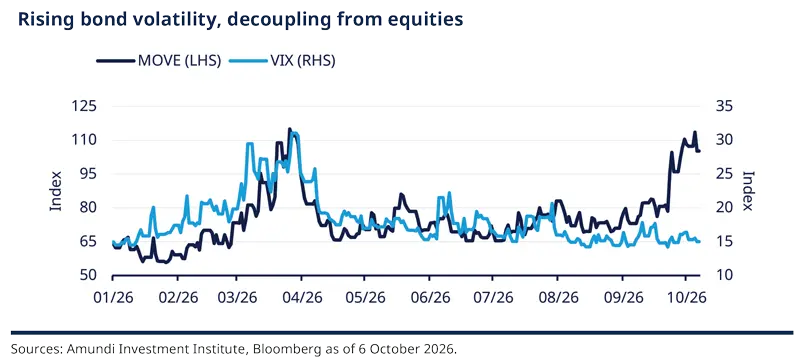
Market volatility has increased in recent weeks, particularly in bond markets. The MOVE index, a measure of expected volatility in US Treasuries, has been rising significantly, decoupling from the VIX equity volatility indicator in an unusual move. This is significantly different from the March volatility spike that affected both markets at the start of the Iran war. While equities have remained resilient and continue to be dominated by the AI capex story, bond yields have been rising sharply over recent weeks. The US 10-year Treasury yield was around 4.7% in late August, moved above 5% for the first time since 2023 on 15 September, and briefly touched 5.34% on 1 October, its highest level since 2002, before easing back into the weekend. Major equity markets also saw more marked swings but closed the past week with overall little change (-0.3% for the S&P 500, -1.1% for the STOXX Europe 600).
What are the reasons behind this volatility?
We are seeing a rotation, particularly within bond markets, as investors exit areas of higher perceived risk to reduce overall portfolio volatility.
Different forces are driving markets, and their interaction is what makes the environment particularly complex.
Middle East tensions and the oil outlook. Escalating tensions in the Middle East over the summer, and the lack of clarity around when the war may end, have kept energy markets highly volatile. In recent days, demand concerns and some easing of the most acute fears have pulled prices back, but Brent remains in the $95 to $110 range, well above the $87 average seen between June and August. This weighs especially on European bonds, as Europe is more exposed to rising oil and gas prices. The G7 leaders’ decision last week to release up to 100 million barrels from emergency oil and diesel reserves to ease pressure on energy prices may help to further stabilise markets.
Growth, inflation and the Federal Reserve. Long-term yields have moved higher on the back of stronger signals on US economic activity, rising inflation risks stemming from the war and heightened competition for capital from heavy corporate issuance to finance the AI build-out. That is happening against a backdrop of positive earnings results and supportive market sentiment, which has helped risk assets remain resilient, but it has also led investors to demand more compensation for bonds.
France and European bond volatility. Rising political uncertainty around the French budget, at a time of increasing debt levels, broader global spillover from higher bond yields and upcoming elections next year, has added another source of volatility in European bonds.
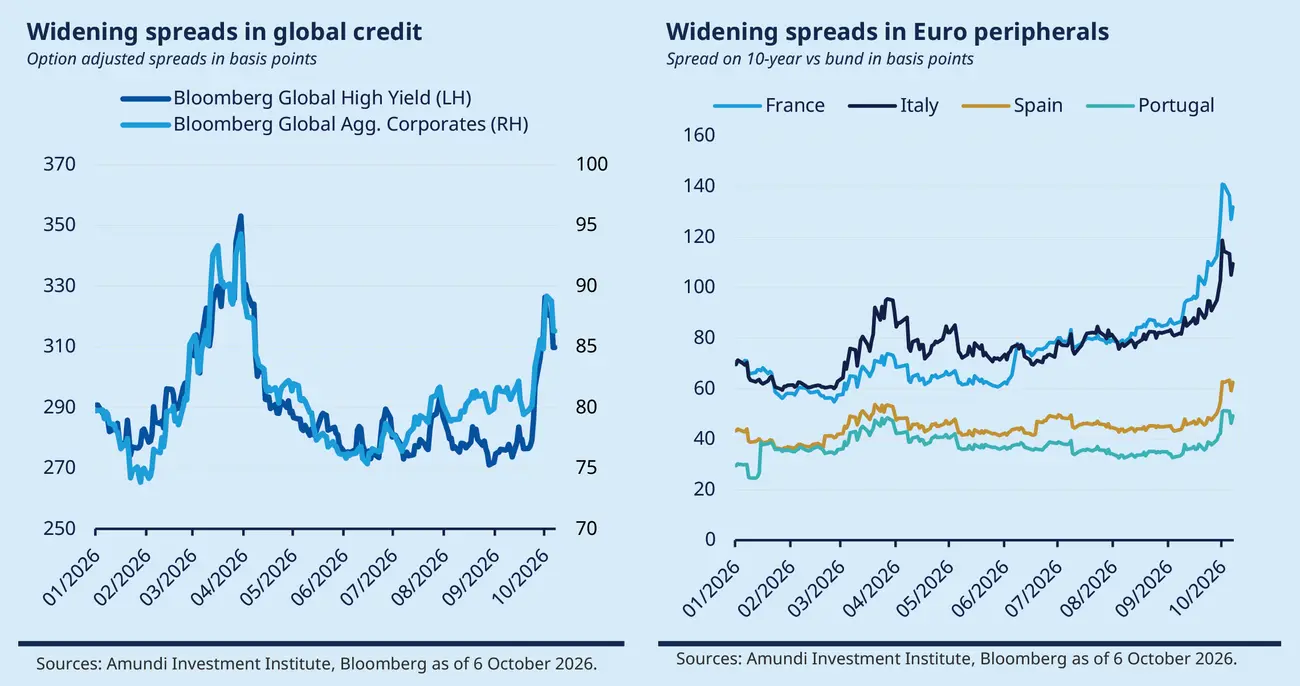
As a result, we are seeing a rotation, particularly within bond markets, as investors try to reduce overall portfolio volatility. This is visible in global credit, where corporate bond spreads have recently started to widen. Here, record AI capex and debt issuance have also been a major driver with rising market scrutiny. In European government bonds, we have seen further spread widening in French bonds with spillovers into Italian and other peripheral bonds, and a “flight to safety” into German Bunds. These are, in our view, orderly rotations that are part of the re-adjustment to a backdrop of higher rates and higher inflation risks.
What is happening in France?
Uncertainty until next year’s elections is likely to drive persistent volatility in French bonds, but the recent spread widening may have gone too far.
This week also saw France present its budget on 1 October. The government proposed a €54 billion fiscal consolidation effort, targeting a public deficit of 5.0% of GDP in 2027. Under the proposed budget, the adjustment starts from a position where the government expects the 2026 deficit to reach 5.4% of GDP, compared with the 5.0% target set only a few months ago. On the same day, France’s independent public finance council — the Haut Conseil des Finances Publiques (HCFP) — issued a formal assessment describing the government’s economic assumptions as optimistic.
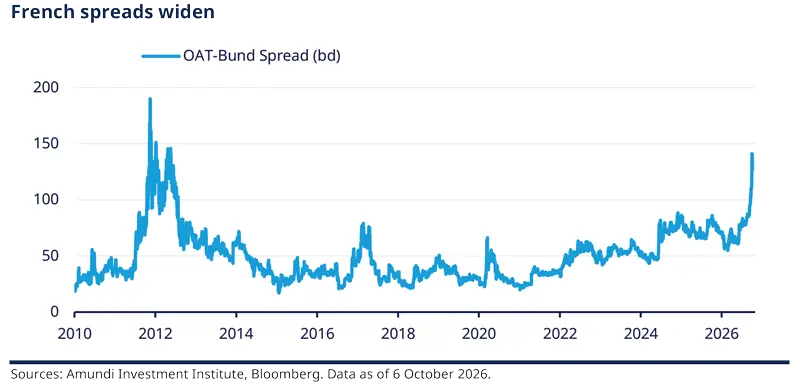
We believe the most likely scenario is one of gradual consolidation, which would not fully resolve the medium-term fiscal challenge. The market has already become more watchful on French government debt in recent weeks, given the approaching budget deadline, higher debt-servicing costs and political uncertainty ahead of next year’s elections. Current market pricing reflects this uncertainty, as shown by the widening spread between France’s ten-year government bond yield and Bunds. However, it remains below previous crisis levels, and we see this move driven more by foreign investor outflows than by genuine concerns
France enters this phase of uncertainty from a position of relative strength, helped by a decade of exceptionally low rates and an overall high-quality sovereign profile. This has helped France keep the average maturity of its debt at around 8–9 years, which limits the risk of a refinancing wall and immediate exposure to rising interest rates. France also benefits from a large and diversified economy, with a strategic position in Europe. It is well placed in many export areas, including luxury goods and defence. Demographic ageing is also less of a challenge than elsewhere in Europe, while higher labour productivity, strong household savings and relatively low electricity prices can help the French economy remain resilient in the current geopolitical context.
This has led over time to an increased share of foreign investor ownership in French debt, at around 56%, reflecting strong demand, but also leaving the market more exposed as higher global yields offer investors better opportunities elsewhere. Until next year’s elections, volatility in French bonds is likely to persist as investors reassess the medium-term fiscal trajectory and adjust to higher yields globally. That said, we may already have seen the worst of the adjustment.
What are the main implications for investors?
Bond yields are increasingly attractive, but volatility is likely to stay high, calling for an active approach to bond investing.
Bond markets are being shaken by unusual volatility. This reflects a regime shift towards a world shaped by geopolitical ruptures, inflationary pressures driven by demand for investment in AI, the climate transition, and increasing debt. At the same time, recent rises in bond yields are making bonds increasingly attractive to investors, with yields now at levels not seen in decades. In this environment, an active and globally diversified approach to bonds is key. In credit we expect dispersion to rise, as the market reassess the impact of higher rates across different sectors and businesses. Here we maintain a preference for high-quality bonds less exposed to the challenge of rising rates.



Authors


With the contributions from:
Claudia Bertino, Head of Investment Insights, Publishing and Client Development, AII*
Laura Fiorot, Head of Investment Insights and Client Divisions, AII*
*Amundi Investment Institute