
Summary
Key Takeaways
|
In a low-trust world that is becoming increasingly predatory, investors should expect supply shocks to become a new norm and the distribution of economic gains to stay uneven. Another result of the global order fragmenting is the rise of fiercer competition between countries. However, this competition is no longer limited to trade, tech, industrial leadership or energy security; it is instead being shaped by a relentless search for capital at the public and private level.
Competition does not necessarily imply weak growth. In some regions, the race for innovation and the pursuit of strategic autonomy are actually supporting, if not boosting, economic activity. What makes the picture more fragile is the concentration of that economic performance: growth is increasingly resting on a narrow base.
Ultimately, countries are all investing in the same sectors, and growth policies are shifting away from consumption and labour towards investment and capital. In this new environment, the economic benefits will be less and less evenly distributed.
At the same time, waiting for innovation to deliver price stability or for demographic trends to suppress demand is not a viable short-term strategy. Inflationary pressure is likely to persist. On the demand side, the investment surge into strategic autonomy, high energy needs and competition for critical resources all collide with scarcity. For critical minerals, supply is constrained by refining and processing, which sits in just a few hands. On the cost side, we are moving into a “toll world”: as chokepoints and waterways become contested, the friction of moving goods rises, and those costs feed straight through to prices. Finally, climate events will materially affect food security and food inflation.
Whether governments are pursuing supremacy, adaptation or survival, this evolving environment requires policy adaptation. For policymakers, the surge in economic and financial warfare means that monetary and fiscal policy increasingly need to be considered together. As a result, fiscal policy is acquiring more importance, while monetary policy might increasingly be left to complement fiscal policy rather than anchor the entire macroeconomic framework on its own, with important repercussions on the market.
The problem is that fiscal policy’s broader ambitions collide with the almost global absence of fiscal room. Overall, subdued growth is generating insufficient revenues to revert high debt ratios. In many countries, binding fiscal rules also remain. High debt, high debt-service costs and high rates form a toxic combination – and we have recently seen an effort by the US Treasury to keep interest rates low.
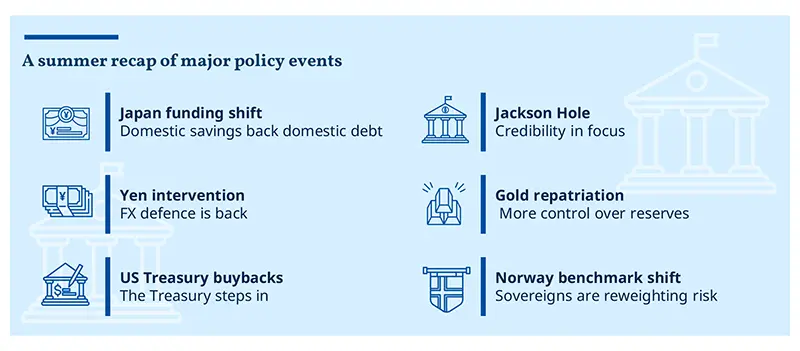
With that in mind, it’s worth revisiting the events of the summer because they may appear unrelated, but they are not.
Domestic investors invited to fund domestic debt. In July, Japan’s Finance Ministry encouraged pension funds and households to invest more heavily in domestic assets; it also floated the idea of putting government bonds inside the tax-free NISA wrapper and began designing new retail JGB products. Japan wants its own savings to finance its own debt, just as the BoJ is stepping back from the market and catching up with more entrenched inflation.
Unconventional policy tools being used at a time when the financial structure of sovereign bond markets appears more fragile precisely because of the fiscal-financial stability nexus.
After the yen weakened sharply, the BoJ carried out its largest monthly intervention on record. Washington joined in, saying it would not hesitate to do so again. The details matter more than the headline: the US Treasury sold euros, not Treasuries, to fund its yen purchases. Tokyo signalled it could use the Fed’s FIMA repo facility in future, allowing it to borrow dollars against Treasuries rather than sell them. In effect, the intervention protected the US Treasury market as much as it supported the yen.
The US Treasury then moved directly to the long end of the curve. It announced that it would triple the size of its long-dated buyback operation from $2bn to $6bn.
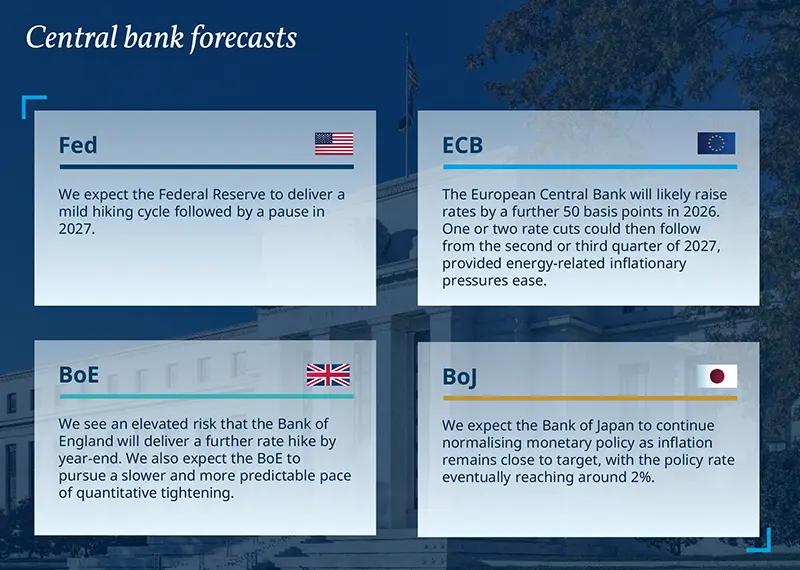
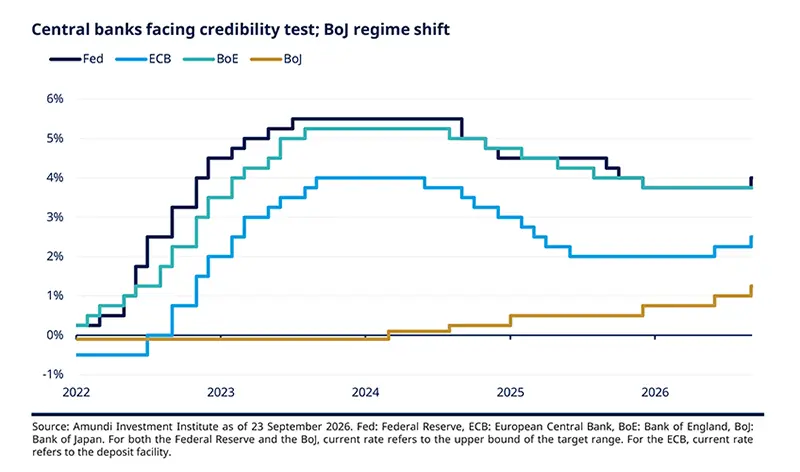
Policy credibility in focus. With fiscal sustainability under review and yields swinging, monetary policy must remain credible and unambiguously committed to price stability. Warsh had little choice but to sound hawkish at Jackson Hole and to deliver a rate hike. In the US, inflation remains elevated and core pressures are unlikely to ease quickly. Risks remain tilted to the upside, from Middle East energy shocks to higher food and commodity prices. The Fed’s credibility matters, and a mild hiking cycle could actually keep yields lower, at least in the short term. A sizable hiking cycle is still not our base case: we remain closer to the dots than to the market.
Crisis preparedness.
The Dutch Central Bank shifted 86 tonnes of gold out of NY and Ottawa between March and August, disclosing it only once the operation was complete. London has now 32.1% of the country’s gold stock, up from 18.1%. Most of the transfer was executed by selling in NY and buying in London rather than shipping bars. The stated reason was tradability and crisis preparedness. The unstated reason was more direct control.
Norway went even further. Norges Bank Investment Management is proposing to the Finance Ministry to cut the government share of its bond benchmark from 70% to 50%. It also wants to switch from GDP weighting to market-value weighting, reflecting the reality that DM debt has outgrown output. Under such a framework, Treasuries would fall and Japanese bonds would rise. A decision is expected in 2027.
These are not independent stories. The old model of recycling global savings into US bonds is fading. Creditors are going home for diversifying. The debtor is buying its own paper. The term premium has turned into a political variable and is structurally higher.



Authors