Summary
Over the weekend, the United States launched airstrikes on three key Iranian nuclear sites, Iran responded on Monday by launching missiles at the US’s Al Udeid Air Base in Qatar. The missiles were shot down and resulted in no casualties – Trump thanked Iran ‘for giving us early notice’. Following these developments, on Monday, a ceasefire between Israel and Iran was announced, but as of now, it remains unclear if it will hold. The weakened Iranian regime faces growing pressure.
Market reactions have been cautious. On Monday, global equities fell and oil prices surged above $80 amid US strikes. Gold, the US dollar, and US bond yields showed little change compared to the previous week. After the ceasefire, markets reversed course: oil dropped to around $68, and global stocks rose. While geopolitical risks and the defence topic remain key, as highlighted also by the recent NATO leaders' decision to raise defence spending to 5% of GDP, moving ahead we expect market focus to shift to the US, as the tariff pause ends on July 9.
The oil market has stabilised following the disruption caused by the Israel-Iran conflict, but many issues remain unresolved. We keep our oil price target at $63-68 for Brent. As mentioned in our previous update on the conflict, risks of higher oil prices are mainly related to possible disruption of the Strait of Hormuz, which seems less likely at this stage.
With heightened geopolitical risks, we favour a well-diversified allocation, including hedges and exposure to commodities. While we continue to follow developments, we do not currently see reasons for a structural change in our economic outlook and reaffirm the views in our Mid-Year Investment Outlook.
The evolving conflict: strikes and a fragile ceasefire
The ceasefire remains fragile, with ongoing tensions and uncertainties threatening its durability.
Over the weekend, the United States entered the Iran/Israel conflict by launching airstrikes on three key nuclear sites in Iran. The strikes were ordered by President Donald Trump, who stated that the targeted facilities were ‘completely and fully obliterated.’ The US justified the strikes as a necessary measure to prevent Iran from advancing its nuclear capabilities, which Washington views as a direct threat to regional and global security. The exact degree of disruption to Iran's nuclear plants following the US strikes remains unclear for now.
On Monday, Iran responded to the weekend airstrikes by launching missiles at the US’s Al Udeid Air Base in Qatar. The missiles were shot down and resulted in no casualties. In line with expectations, Iran retaliated ‘below threshold’ to avoid drawing in the US further. The degree of Iran’s restrained and rapid pursuit of a diplomatic outcome, however, highlights how cornered the regime is now.
Following these exchanges, a ceasefire was announced, brokered through diplomatic channels involving regional and international actors aiming to prevent further escalation. The ceasefire is intended to halt immediate hostilities while negotiations continue, but it remains precarious given the underlying tensions and unresolved issues.
There are still many unknowns surrounding recent developments, including whether the US strikes effectively crippled Iran’s nuclear capabilities, the extent of Iran’s remaining military and missile capabilities, and the current cohesion within the Iranian regime.
The ceasefire is fragile, with ongoing tensions and uncertainties threatening its durability. If the ceasefire holds, Trump will have scored a foreign policy victory: reducing Iran’s nuclear threat, weakening the geopolitical threat emerging from deepening Iran, Russia, China, and North Korea ties, and increasing US deterrence power. However, even though both Iran and the US have an interest in the ceasefire holding, Israel’s intentions and goals are less clear-cut.
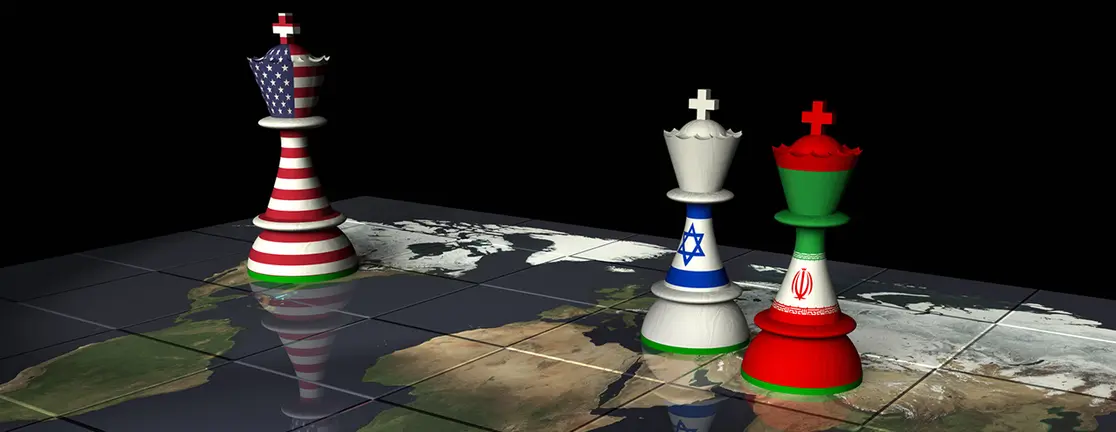
The recent escalation reflects a complex interplay between the US, Israel, and Iran, each driven by distinct strategic calculations:
The US is likely to stay a reluctant participant, seeking to avoid deeper involvement due to domestic political pressures. However, the strike on Iran has bolstered US deterrence, making it difficult for Trump to back down if Iran proceeds aggressively. This delicate balance suggests that the US will avoid prolonged engagement while maintaining a strong posture.
Israel’s actions aimed at reducing Iran’s nuclear ambitions. However, since it remains uncertain whether Iran’s nuclear capabilities have sufficiently been damaged, Israel is likely to continue its efforts to destabilise the regime in Tehran in the hope of achieving a less hostile leadership.
Iran’s priority is now to avoid further escalation while rebuilding its strength. This suggests Tehran may prefer a cautious approach, balancing resistance with diplomatic engagement to preserve regional ties.
What is your perspective on a possible regime change?
The Iranian regime is weakened, and its policy of maximum hostility to Israel and the US has not worked, neither in enhancing its regional power nor in gaining support from the domestic population. As the Ayatollah is 86 years old, this may be a moment when a leadership transition from within, if not full regime change, could begin (likely aided by ongoing Israeli operations).
How is the market reacting? What is your view on oil?
Following the ceasefire, oil experienced its largest two-day drop since 2022, with Brent crude trading near $68 a barrel, returning to pre-conflict levels.
On Monday, most global equities declined following the escalation of the conflict amid US strikes. Oil prices increased amid concerns over supply, with Brent climbing above $80 a barrel. Bond yields in most developed markets fell slightly in this environment, while the US dollar strengthened somewhat against other G10 currencies. Overall, there were no signs of a significant risk-off move in the market.
However, following the ceasefire, market movements showed a clear shift from Monday’s opening. Oil experienced its largest two-day drop since 2022, with Brent crude trading near $68 a barrel, returning to pre-conflict levels. Global stocks climbed, while bonds remained largely unchanged.
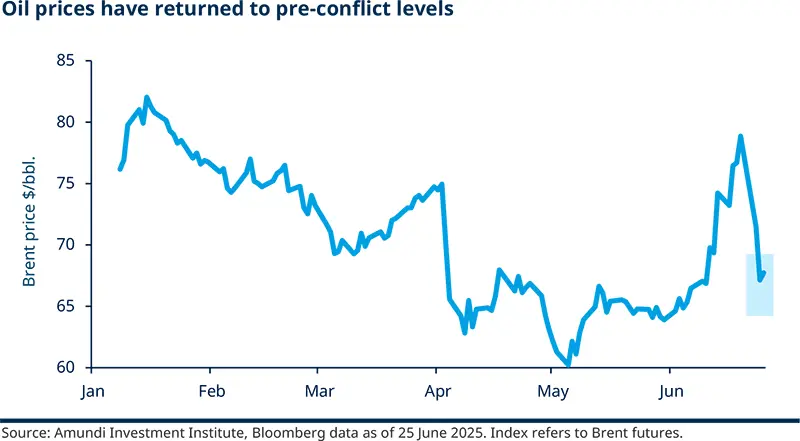
The main risk for oil prices will be whether the Strait of Hormuz could be closed or if regional oil exporting infrastructure is attacked in Iran or in the Gulf countries. Isolated attacks or intimidation in the Strait would negatively affect risk sentiment and push oil prices higher. In the unlikely event of a complete transit halt, Brent crude could surge to between $100 and $120 per barrel. As of now, this is a low probability event. During the near two-week long war between Israel and Iran, oil shipments from the Gulf and transit through the Strait of Hormuz have continued without disruption.
Therefore, we maintain our current price targets for now, pending clearer visibility on any actual supply damage. Brent crude is expected to reach $63-68, and WTI $60-65 in 2026.
What are the investment implications of this situation?
The recent developments reinforce the need to maintain a well-diversified stance with hedges in place and exposure to commodities.
We reaffirm our view that it is key to keep hedges in place over the summer. Despite the recently high geopolitical tensions, the S&P 500 remains roughly 1% below its February record high, following a strong rebound from the April downturn when the global equity index surged over 20%.
We emphasise the importance of maintaining a well-diversified stance, with equity hedges and gold to help mitigate volatility and enhance overall portfolio resilience during these uncertain times.



Authors