
Summary
Key Takeaways
|
US midterms: toward divided government, fiscal deadlock, and sector-specific pressure
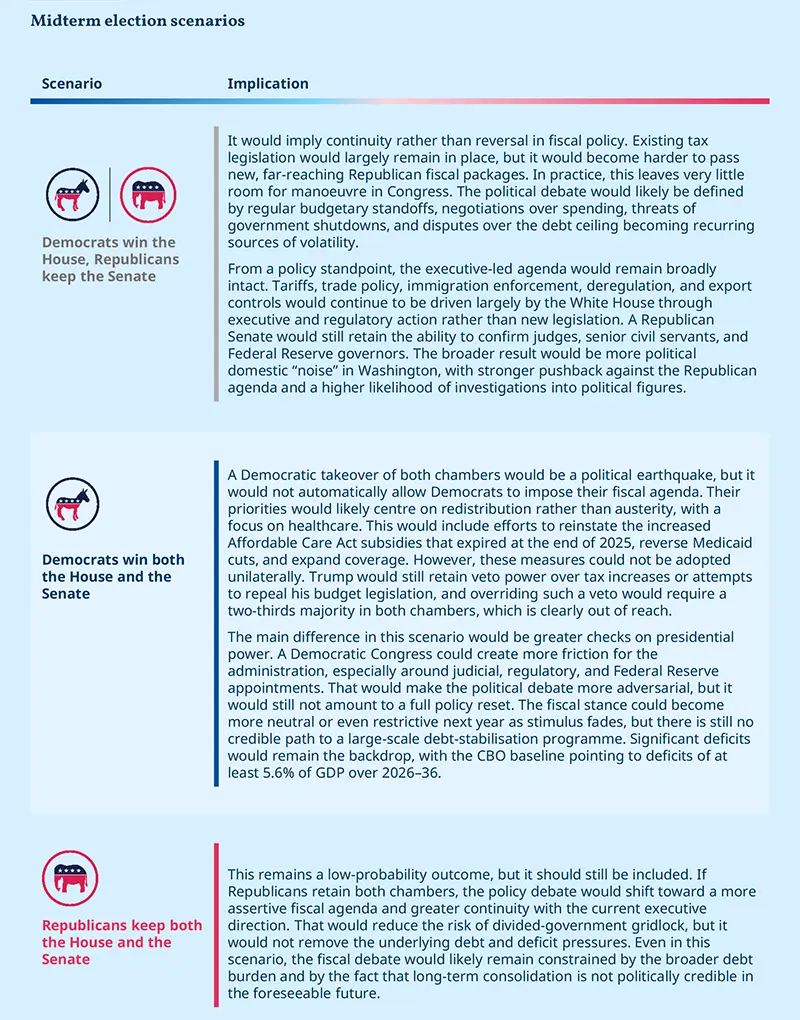
US midterm elections will determine control of the House of Representatives and one-third of the Senate. All 435 House seats are up for election, along with 33 regular Senate seats. At present, Republicans control both chambers: the House stands at 220 Republicans to 215 Democrats, while the Senate stands at 53 Republicans, 45 Democrats, and 2 independents who caucus with Democrats. The chamber most likely to flip is the House, given the narrow margin, while the Senate is harder to change because only one-third of seats are contested at a time.
Against this backdrop, the most likely outcome is divided government, with the House going to the Democrats and the Senate remaining Republican. A divided government would constraint Trump’s policy options at home. Historically, when presidents are faced with this, they tend to focus more on foreign policy. Therefore, the US will likely become more interventionist. Recent polling also suggests that the elections may be shaped by more than normal partisan competition, with concerns about democratic backsliding – such as attempts to sway turnout or intimidate voters – which would further erode trust in US institutions and add to political uncertainty.
Macroeconomic implications
The macroeconomic consequences of the midterms are likely to be limited by the balance of power in Congress, and therefore by the degree of fiscal gridlock. Under the most likely scenario of divided government, the main implication is that it becomes harder to pass large new fiscal packages, including additional tax cuts.
Existing tax legislation would largely remain in place, but the political room for fresh stimulus or broad-based tax reform would be limited. As a result, the fiscal stance is likely to remain broadly neutral to mildly restrictive over time, with elevated deficits and debt still providing the underlying backdrop.
There are likely to be differences across the three scenarios, particularly in how legislation is used to support specific parts of the economy:
Consumers: supportive measures/redistribution. If the most likely outcome, divided government, prevails, there is little scope for additional tax cuts that would materially boost disposable income across household income groups. If Democrats gain more power, there may be more emphasis on redistribution, healthcare support, and benefits for lower-income households, which could support consumption at the margin but would not necessarily boost consumption. By contrast, a Republican sweep would increase the probability of further tax cuts, which could be more supportive of spending and growth, but also more deficit-expanding. In all cases, the effect on consumption is likely to be indirect and modest relative to the broader macro cycle which is currently driven by the tech/AI-related capex story.
Capex cycle: the midterms could clearly affect investment conditions. We believe the expensing and bonus depreciation provisions introduced by the current administration and already in the tax code are likely to remain in place under a divided Congress, providing a meaningful support for capex. This should continue to favour eligible equipment, machinery and software, and help broaden the investment theme beyond Tech and AI to a wider range of business investments. On that basis, we expect the capex story to remain broadly intact. A split government would make fiscal deadlock the base case, increasing uncertainty around the policy environment, debt issuance and the term premium. The risk would be greater if it heightens the chance of shutdowns or debt-ceiling standoffs, and it could limit the scale of the capex cycle or expose weaknesses in the most vulnerable parts of the economy.
In the context of investments, an important channel is the impact on AI-related sectors, particularly through regulation and infrastructure buildout. While the political debate around AI may become more visible at the federal level, the practical effects are likely to be felt increasingly through state and local regulation, especially in areas such as zoning, permitting, electricity access, water use, and environmental rules. That matters because data centres are a key bottleneck in the AI investment cycle. A more restrictive regulatory environment could raise costs, lengthen project timelines, and affect utilities, infrastructure, and AI-linked capital expenditure. The effect would probably be more sector-specific than economy-wide, but it could still matter for investment intentions and market valuations. It is not possible, though, to draw a very clear line between midterm scenarios: the states most exposed to AI-related regulation and infrastructure pressures are increasingly revealing a partisan tension between Democrats, who tend to favour tighter guardrails, and Republicans, who tend to prioritise innovation and faster deployment. But the issue is not purely ideological: local concerns over electricity demand, water use, zoning, and the cost of data-centre buildout can drive regulatory pushback across party lines. Thus, while a Democratic sweep could make tighter regulation more likely, this would probably focus on areas such as consumer protection, labour impacts, environmental costs, energy consumption, and local permitting. Across the broader economy, given the geopolitical priorities of the current administration, we would expect continued emphasis on innovation, competitiveness, and faster infrastructure buildout in the race for AI dominance.
On inflation, the direct macro impact is likely to be very limited, but there could be some effects at the level of the inflation basket. In the event of a Democratic sweep with substantial majorities, an expansion or reintroduction of Obamacare-related subsidies would remain quite unlikely, as noted above. If Democrats nevertheless secured such measures, these could affect the healthcare-related components of CPI and PCE more noticeably, especially since medical care carries a meaningful weight in both baskets. This could introduce temporary shifts in inflation levels, although the effect is unlikely to be large enough to materially change the overall inflation trajectory in the medium term.
Bottom line
The most probable post-midterm outcome is divided government, which would constrain legislative ambition at home while leaving the executive branch largely in control of the core policy agenda. The macro significance of that outcome lies mainly in fiscal deadlock rather than a major change in policy direction, with a higher risk of government shutdowns, more budget brinkmanship, and a higher policy uncertainty premium.
What could be the impact of the midterm elections on US assets and sectors?
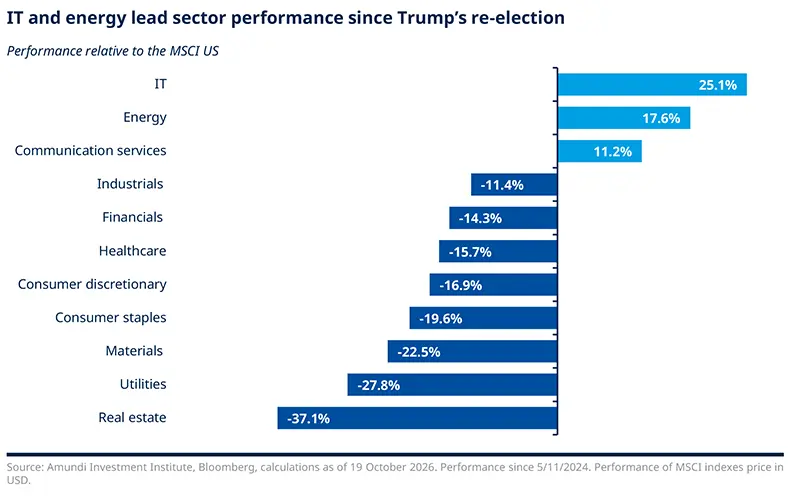
The IT and energy sectors have been the strong outperformers since President Trump’s second election victory. Communication services and utilities have been the underperformers, and though part of this is due to the lower beta of the sectors in a rising market, these two are also the only sectors to have recorder a negative alpha over the period.
Will the winners of the first half of Donald Trump’s second term be the losers after the midterms? That is possible in certain sectors. Artificial Intelligence could face a tougher regulatory regime if Congress swings back to the Democrats, though the President has made clear his opposition to slowing down technology through regulation. We expect investment to continue, however, with technology being more of a driver than politics. This will support IT, and sectors like industrials and materials could benefit from a broadening in the investment trend.
The impact on the energy sector could be mixed. Opposition to renewable energy could wane if Democrats gain ground in Congress, potentially making renewables more competitive with fossil fuels. At the same time, a more interventionist US in case of a divided government could lead to prolonged tensions in the Middle East, keeping energy prices higher for longer.
Any change in direction for the energy sector would also be relevant also to utilities, given the negative correlation between the performance of the two sectors since the start of the second quarter this year.
Healthcare has suffered due to President Trump’s comments on drug prices, even though the President has complained more about foreign consumers paying too little, rather than domestic consumers paying too much. We think the sector could rebound as a result. A Democrat-dominated Congress could launch investigations into the healthcare insurance sector, however, given voters’ ire over this sector.
The performance of financials will depend on regulation, but also on the direction of bond yields and the cost of risk. Regulation is probably more in the hands of the Fed than of Congress, and the trend may not be affected by the midterm elections. Under a divided government, however, progress on reducing the deficit may be extremely halting. As a result, the yield curve could steepen, increasing net banking margins. It could also keep real growth strong and prevent an increase in the cost of risk, helping financials improve their performance relative to the rest of the market. By contrast, further increases in nominal interest rates are likely to continue to put pressure on the real estate sector.
Markets are pricing gridlock without relief
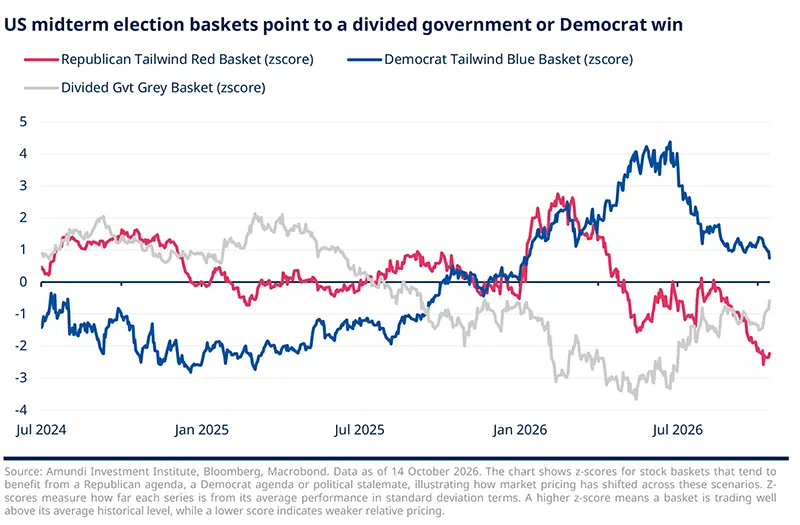
Pricing around the 2026 midterms does not simply reflect rising uncertainty – it reflects a repricing of the baseline. Divided government, the September consensus, has given way to a higher probability of a Democratic sweep. Markets are not just more nervous; they are starting to price a different political world.
That shift has a political logic. The macro backdrop remains supportive: orderly markets, resilient growth, and a growing wealth effect. But the factors that decide midterms – purchasing power, gasoline prices, household sentiment and approval among swing voters – have not improved, and the Iran conflict has compounded these pressures. Trump's political capital looks fine in aggregate, but it is weak precisely where elections are won.
A Democratic House is now close to fully priced. While prediction markets increasingly favour a Democratic sweep, our central scenario remains a divided congress, reflecting our assessment of the electoral map and the remaining uncertainty round the Senate races. A Democratic Senate would control judicial and Fed confirmations, constraining the White House in ways that go well beyond committee subpoenas.
Political and policy baskets complete the picture (see chart below). Republican policy exposure has weakened dramatically, but assets sensitive to a Democratic agenda are not rallying either. Instead, markets are converging on a simpler view: whoever wins, ambitious policy is off the table. Markets already price constrained fiscal ambition, moderate trade tension and continued immigration enforcement through executive authority.
Uncertainty is also visible in the options market. Implied equity volatility for the post-election expiry has risen sharply above that for the pre-election expiry, signalling a prolonged period of policy digestion after the vote.
Rising rates complicate the picture, raising the cost of fiscal confrontation. Shutdowns, debt-ceiling brinkmanship, and budget gridlock under a Democratic Congress are greater risks. In prior cycles, gridlock was a relief trade. At current yield levels, it may not be.
Bottom line: a House flip is largely discounted, and a sweep is increasingly in the price. The remaining market surprise is a Republican rebound – the least priced and most dislocating scenario. The larger post-election question is whether a constrained White House responds with moderation or turns to executive tools – tariffs, China policy, immigration, Fed pressure – more aggressively than markets currently assume. That is the risk not yet in the price.



Authors