
Summary
Introduction
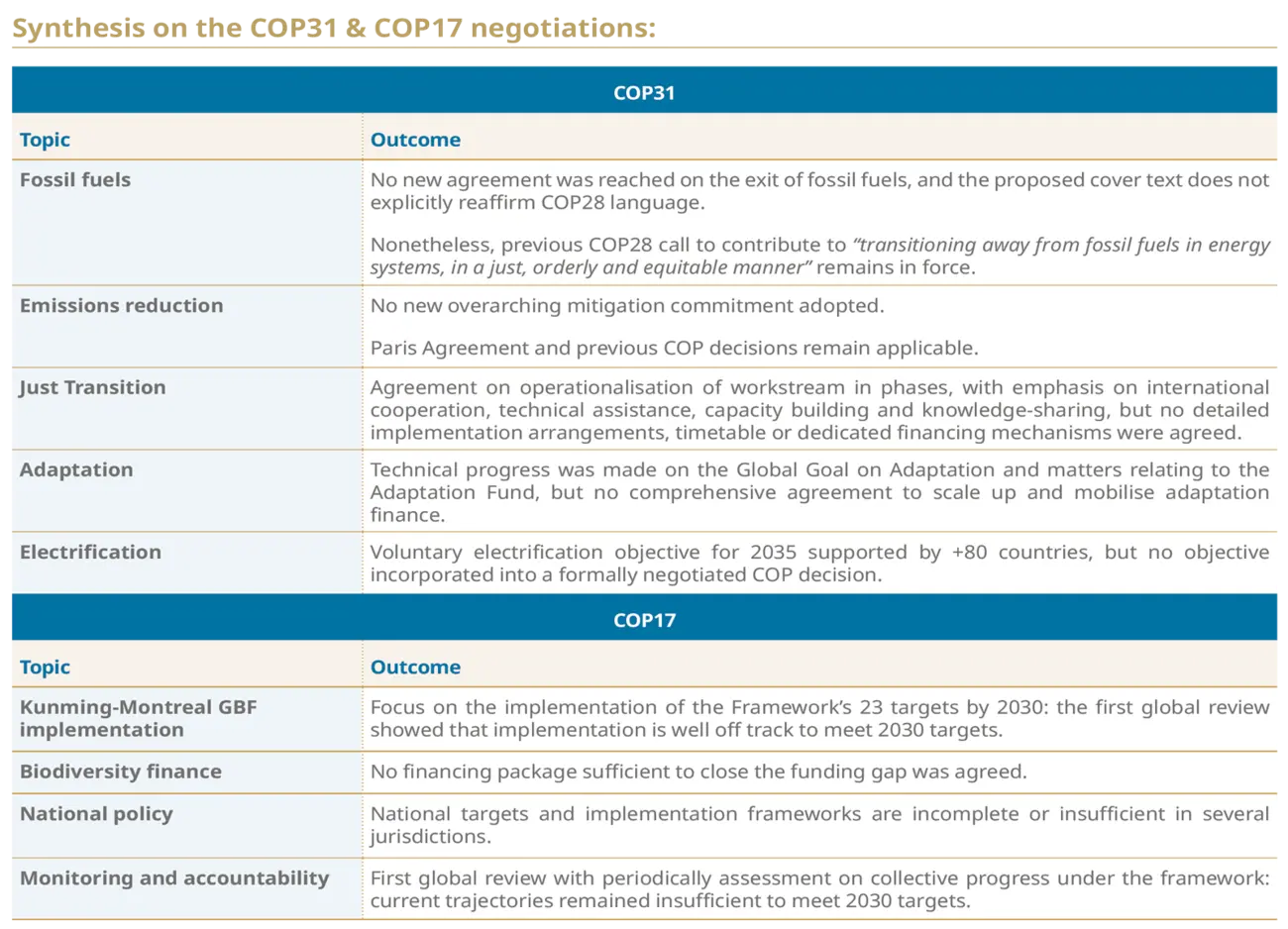
The 31st Conference of the Parties (COP31) to the United Nations Framework Convention on Climate Change (UNFCCC) just concluded in Antalya without agreement on an overarching cover decision, representing a significant political setback for the presidency. The presidency’s final proposal failed to secure consensus. Key Parties, including the European Union and Panama, called for a more explicit reference to the need to transition away from fossil fuels in energy systems, raised concerns about the emphasis placed on abatement and removal technologies and considered that the text did not go far enough in scaling up and mobilizing finance for climate adaptation. The failure to adopt the proposed cover decision does not, however, affect the Paris Agreement or undo commitments agreed at previous COPs. In particular, the COP28 call on Parties to contribute to “transitioning away from fossil fuels in energy systems, in a just, orderly and equitable manner” remains in place.
Despite this diplomatic setback, progress was made through separate negotiation tracks and voluntary initiatives on the just transition, adaptation and electrification. The outcome therefore highlights a growing disconnect between the difficulties of international political cooperation and the continued momentum of the transition in the real economy, increasingly driven by national policies, coalitions of willing countries and non-state actors. For investors, COP31 underscores the importance of looking beyond headline multilateral outcomes to assess national policy frameworks, actual investment flows and physical climate risks, and to identify where implementation needs, financing gaps and emerging mechanisms are creating investment opportunities. A few weeks earlier, the 17th COP to the Convention on Biological Diversity (CBD)1 in Armenia displayed similar dynamics, although negotiations proved less divisive. Released ahead of COP17, the first global review of progress (planned every four years under the Kunming-Montreal Global Biodiversity Framework) showed that implementation remains well off-track to meet the Framework’s 23 targets by 2030, with fewer than half of the national targets assessed currently on course. Here too, the focus was therefore less on setting new headline objectives than on accelerating delivery of existing commitments by strengthening the financing, policy frameworks and investment structures needed to close it.
Taken together, these two COPs point to a common shift: as multilateral consensus becomes harder to achieve, the environmental agenda is moving from setting global targets towards the more complex task of implementing and financing existing commitments.
Executive summary
|
1. Climate and nature finance continues to grow, but so does the investment gap
The Seventh Biennial Assessment and Overview of Climate Finance Flows, released by the UNFCCC Standing Committee on Finance ahead of COP31, estimates global climate finance at around USD 1.9 trillion a year in 2023–2024, up 32% from 2021–20225.
According to the Climate Policy Initiative (CPI), private finance accounts for 62% of the total and most flows already rely on conventional financial instruments: balance-sheet equity and project-level market-rate debt each account for 35%, followed by balance-sheet debt at 16%, while grants and concessional project debt represent only 7% and 3%. Capital is also highly concentrated by sector: clean energy, sustainable transport and buildings account for more than 90% of tracked climate finance.
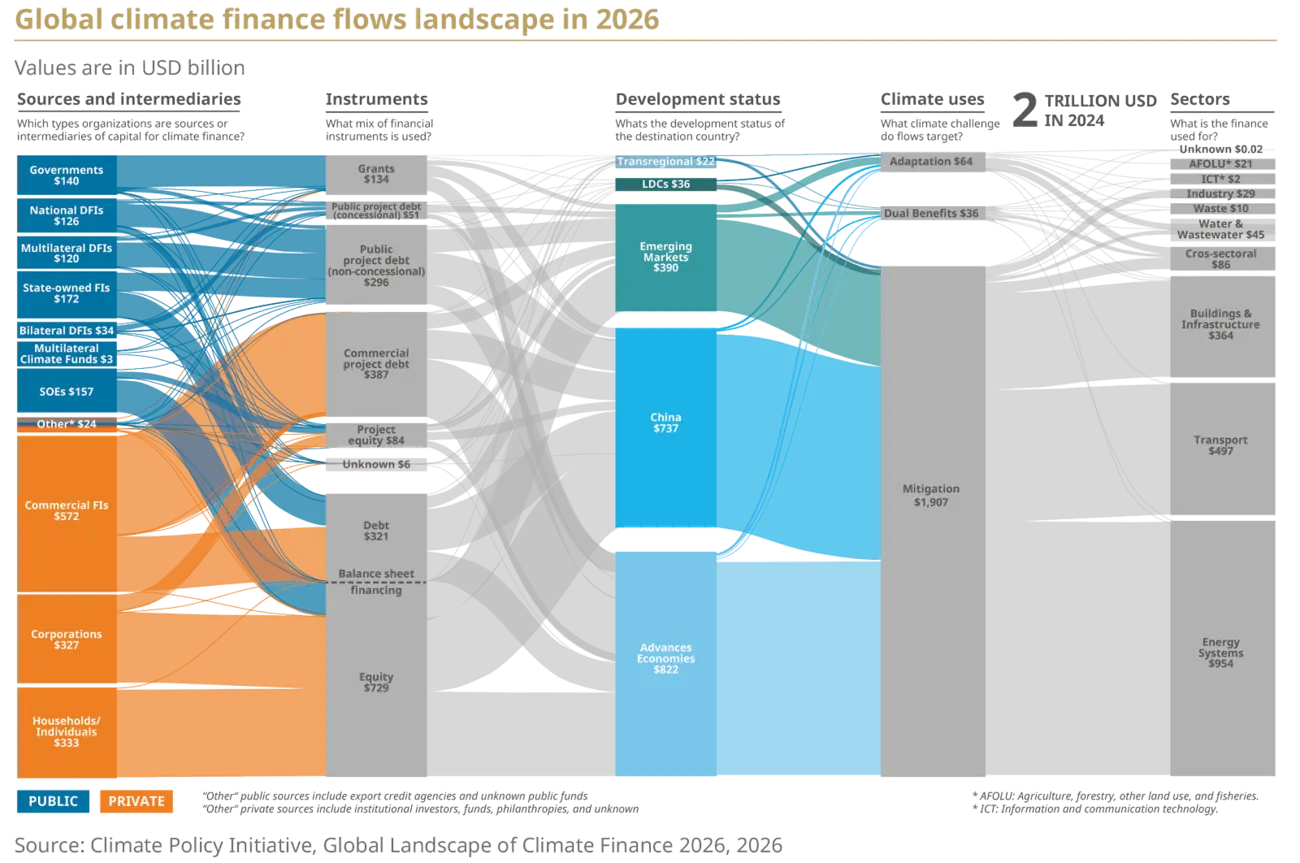
Yet current flows remain far below investment needs. CPI estimates that mitigation investment would need to reach roughly four times current levels annually through 2030 to remain consistent with a 1.5°C pathway. The gap is uneven: energy and transport face the largest absolute shortfalls, at around USD 1.4 trillion and USD 1.5 trillion a year, while investment in industry would need to increase around 31-fold from 2024 levels6.
The financing gap is compounded by more limited visibility over future public climate finance. Many multi-year commitments that expired in 2025 had not yet been renewed ahead of COP31, leaving currently announced forward pledges with an annualized value of around USD 11.7 billion, roughly 70% below the previous pledge cycle7. Even though this does not necessarily imply a comparable decline in future flows, it generates uncertainty, which is heightened by the scaling back of US international climate finance. At COP31, the EU maintained a strict negotiating position, reaffirming its existing commitments while making clear that it would not compensate on its own for lower US contributions. As a result, visibility remains limited on how the additional public and concessional capital needed in the coming years will be mobilised8.
Electrification: 35-by-35 points to large and identifiable capex needs
The sectoral distribution of the financing gap provides an important backdrop to one of the strongest investment signals to emerge from COP31: the push to accelerate electrification, supported by the 35-by-35 Global Electrification Pledge.
This pledge, supported by around 90 parties by the end of COP31 (including the EU, Australia, Japan, South Korea or Canada), aims to increase electricity’s share of global final energy consumption from around 23% today to 35% by 2035, in line with the IEA’s High Electrification Scenario. Its focus on electrification nevertheless left open a key question which fueled the debates at COP31: how quickly this shift will translate into lower fossil-fuel use, and what mix of generation will support rising electricity demand.
This was partly addressed through the fossil-fuel transition roadmaps launched following COP30, building on the COP28 commitment to transition away from fossil fuels. By the end of COP31, close to 30 countries were engaged in national or regional roadmap processes, with seven national roadmaps already published — by France, the Netherlands, Germany, Finland, Denmark, Ireland and Sweden.
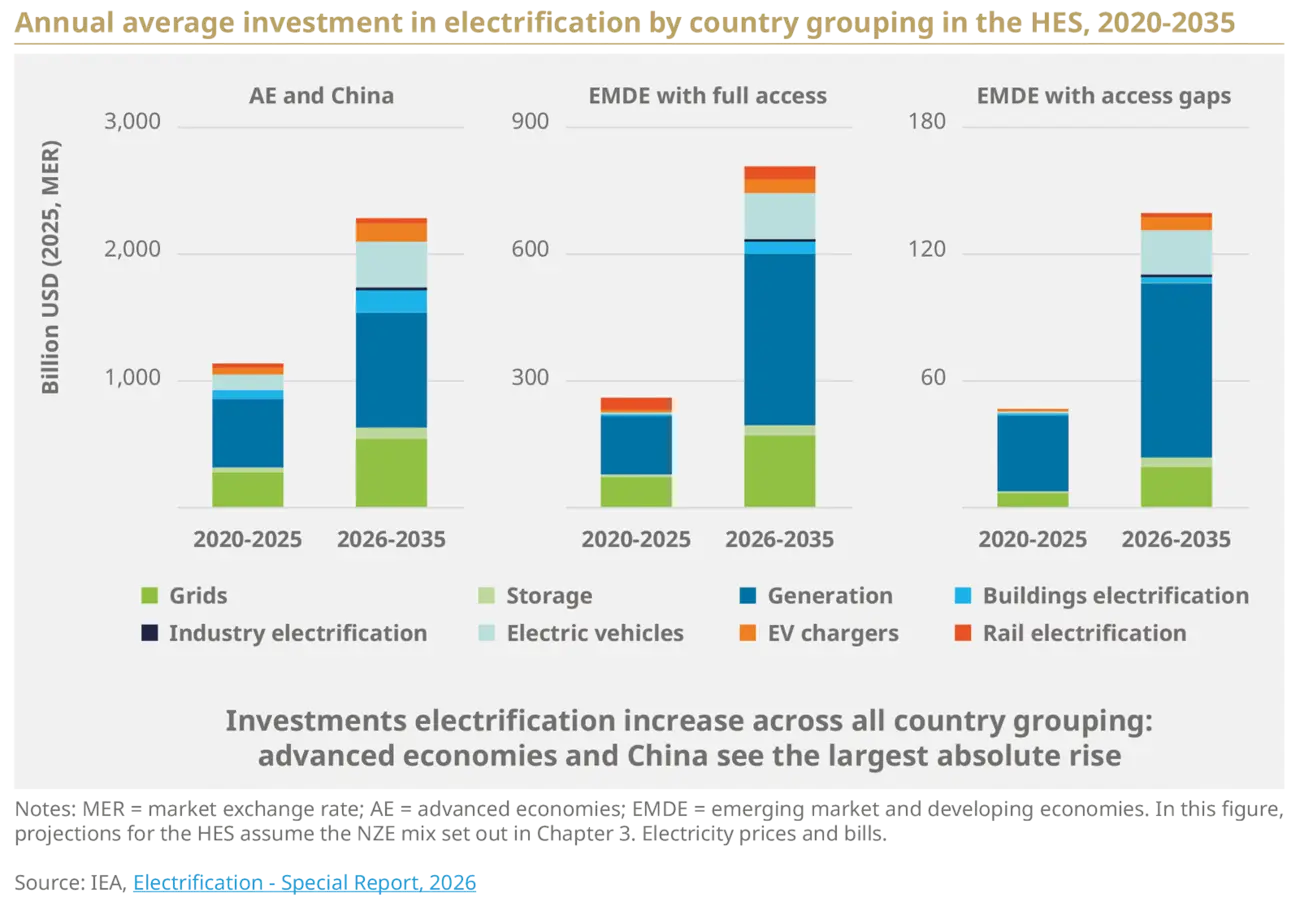
Together, these signals help frame the scale and direction of future investment needs. The IEA estimates that around USD 320 billion is currently invested each year in end-use electrification across transport, buildings and industry. With a 35% electrification target by 2035, this rises to around USD 1 trillion annually. Transport represents the largest pool: annual investment in EVs increases from around USD 125 billion today to USD 530 billion by 2035, alongside approximately USD 175 billion a year in charging infrastructure. Industrial electrification grows nearly sevenfold, while investment in buildings is driven primarily by the electrification of space heating.
Higher electricity demand also requires significant additional investment in generation, grids and storage, which could rise from around USD 1.5 trillion in 2025 to USD 2.5 trillion by 2035. Grid investment alone increases from around USD 450 billion to USD 930 billion, while generation investment rises to around USD 1.5 trillion, predominantly in renewables.
The opportunity is global, but its composition differs across regions. Advanced economies and China account for the largest absolute investment volumes, with annual investment roughly doubling between today and 2035. In other emerging market and developing economies, investment increases around threefold, with particularly strong growth in EVs and charging infrastructure, grids and energy production and storage.
Nature faces an even larger relative financing gap, but a broad investment toolkit
The same financing constraint is visible in nature, but from a smaller base. The OECD’s new 2026 assessment estimates global biodiversity finance at around USD 74.9-92.4 billion per year in 2023–2025. Domestic public expenditure accounts for around two-thirds of the total, international public finance for around 17–21%, and private finance for only 14–17%. On current estimates9, biodiversity finance is therefore below half of the Kunming-Montreal Global Biodiversity Framework’s Target 19, which calls for at least USD 200 billion a year from all sources by 2030.
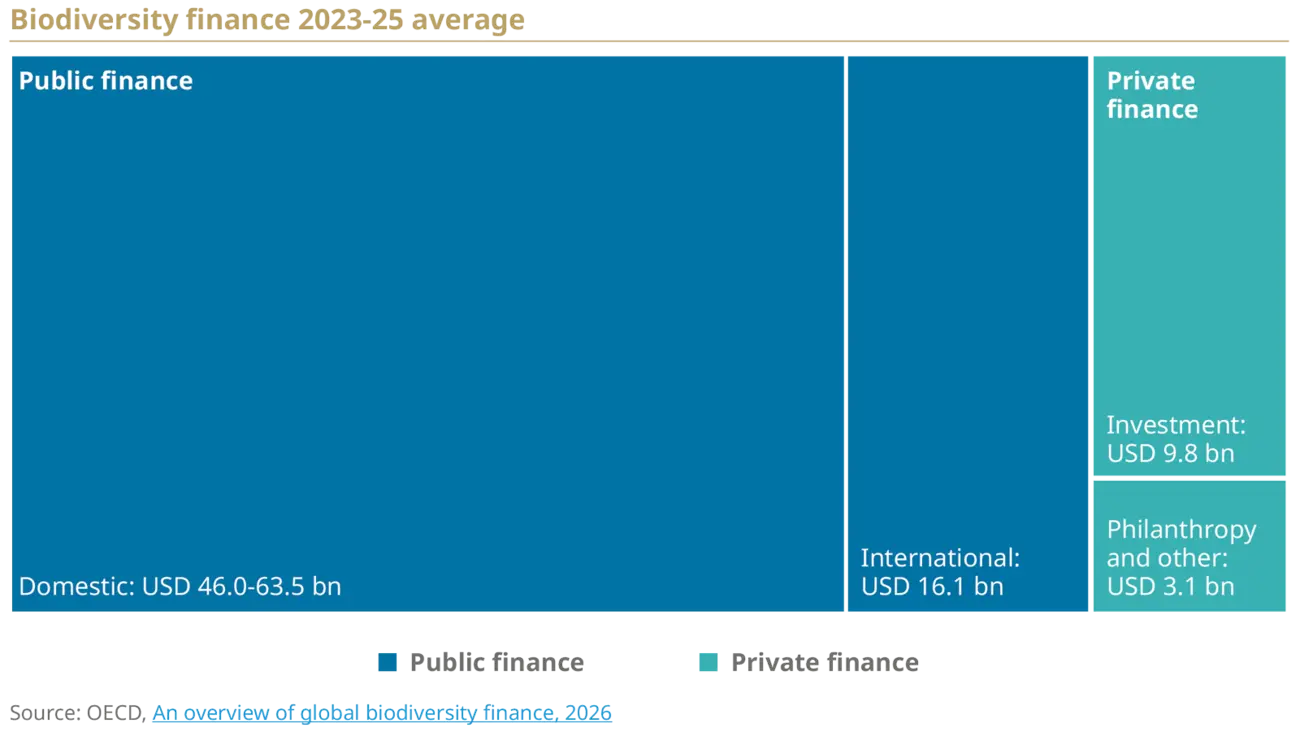
The composition of private finance is nevertheless beginning to change, developing through a growing number of channels. The scale of these markets still varies considerably, with very different levels of maturity. For instance, around USD 317 billion of green and sustainable bonds issued in 2024 listed biodiversity among their eligible uses of proceeds, but the OECD estimates10 the biodiversity-related share at only USD 36 billion. Biodiversity-themed equity funds represented around USD 3.7 billion in assets under management in 2024, while the more narrowly defined universe of “pure-play” biodiversity funds amounted to just USD 1.6 billion. At the other end of the spectrum, the voluntary biodiversity-credit market remains embryonic, with only around USD 6 million of tracked sales by April 2026.
These figures point to a market developing through a range of existing financial formats, but with only limited depth in the most biodiversity-specific instruments. COP17 reflected the next challenge: bringing some of these structures closer to institutional scale. Among the announcements, the Value Nature Fund set a EUR 300 million target for a natural-capital strategy investing in farms and forests, while the Asian Development Bank issued a USD 50 million Biodiversity and Nature Theme Bond and launched a Nature Bond Incubator to help develop and structure investable projects11.
More broadly, COP17 saw nearly USD 2 billion in new biodiversity funding announcements, combining public, philanthropic and private capital12.
2. From investment needs to investable pipelines
Identifying investment needs is only the first step. A recurring theme across COP31 and COP17 was how to turn policy objectives into assets that can attract capital, and how to structure that capital to meet investors’ risk-return requirements. The constraints differ: insufficient project preparation, uncertain revenues, fragmented opportunities or risks that commercial capital cannot absorb alone. Increasingly, this brings together project preparation with concessional capital, guarantees and other blended-finance structures designed to mobilise private investment.
BRIDGE: building bankable pipelines
The COP31 Presidency launched the Climate Implementation Bridge (BRIDGE) to address a recurring gap between national climate plans and the real-life projects that investors can actually finance. It helps governments translate priorities in NDCs, adaptation plans and development strategies into finance-ready project pipelines, strengthening project preparation and regulatory conditions before connecting sufficiently mature projects with public, multilateral and private capital.
The first five pilots are Ethiopia, Fiji, Indonesia, Pakistan and Uzbekistan. BRIDGE also envisages using guarantees, risk-sharing instruments and local-currency solutions where projects require further de-risking to attract commercial capital. If successful, this approach could make future deal flow more visible and easier to originate, particularly where opportunities remain fragmented and transaction costs are high.
Green industrialization: improving project economics
COP31 also sent a clearer investment signal towards industrial decarbonisation, particularly in hard-to-abate sectors such as steel, cement, chemicals, aluminum and fertilizers. The 2026 UNFCCC work highlighted that projects depend not only on technology, but also on shared infrastructure, predictable demand for lower-carbon products and financing structures capable of supporting capital-intensive investments.
Initiatives in Antalya addressed different parts of this equation. The £90 million Green Industrial Demand Accelerator launched by the UK government aims to strengthen demand for lower-carbon industrial products in developing economies. Türkiye’s Industrial Decarbonisation Investment Platform (TIDIP) works further upstream, translating sectoral low-carbon pathways into project pipelines and coordinating policy, technical assistance and financing, with the potential to mobilise EUR 5 billion by 2030. At COP31, additional MDBs and the European Commission joined the platform, while USD 250 million in concessional CIF finance was secured to help catalyse wider public and private investment.
Nature finance: building investable pipelines and structures
COP17 put a similar emphasis on turning biodiversity priorities into bankable projects and financing structures. The ADB’s Nature Solutions Finance Hub, which aims to catalyse at least USD 5 billion of nature-positive investment by 2030, explicitly addresses both the shortage of bankable projects and the limited range of instruments able to attract private capital. At Yerevan, ADB added a Nature Bond Incubator to support project development, bond structuring and investor engagement. Its broader approach combines project aggregation and risk management with instruments including blended finance to make nature-positive programs investable at greater scale.
COP17 also brought forward new capital-market structures. In West Africa, the African Development Bank and conservation partners launched the Park Bonds initiative, which aims to mobilise around EUR 300 million from capital markets and other sources to provide long-term financing for protected areas, linking debt financing to measurable biodiversity outcomes13.
At the same time, not all newer mechanisms are scaling at the same pace. The Cali Fund, operationalised at COP16 and formally launched in February 2025 to channel part of the commercial benefits derived from digital sequence information back into biodiversity. However, benefit-sharing from DSI has long proved difficult to operationalise, and the Cali Fund had attracted only a very small number of early corporate contributors by COP17. Negotiations in Yerevan focused largely on technical implementation and legal certainty rather than on new measures to scale contributions.
These initiatives address the same underlying challenge: using aggregation, public or concessional support and financial structuring to transform fragmented nature-finance needs into assets that institutional capital can access. They also shape a still-maturing nature-finance landscape: some initiatives are beginning to build pipelines and structures that institutional capital can access, while others continue to work through the conditions needed to mobilise funding at scale.
The Tropical Forest Forever Facility (TFFF): taking blended finance to institutional scale
The TFFF pushes this logic further. Although launched at COP30, it sits naturally at the intersection of climate and biodiversity finance: by rewarding countries for maintaining standing tropical forests, it supports both carbon storage and the conservation of some of the world’s richest terrestrial ecosystems. Its investment arm, the Tropical Forest Investment Fund (TFIF), uses a blended-finance structure to generate these payments by combining junior sponsor capital with senior debt raised from institutional investors.
This dual relevance also brought the TFFF into the spotlight at COP17. Ahead of Yerevan, 34 financial institutions and supporting organizations representing more than EUR 10 trillion, including Amundi, Allianz Global Investors, or Deutsche Bank, backed the Rotterdam TFFF Investor Statement, signaling interest in the development of the facility14.
The proposed structure combines at least USD 25 billion of junior capital from governments and philanthropies with up to USD 100 billion of senior debt. The junior layer absorbs part of the risk, allowing the senior instruments to target the credit quality and liquidity required by pension funds, insurers, sovereign wealth funds and fixed-income asset managers.
With the contributions of Canada, the Netherlands and a coalition of philanthropies announced for COP17, sponsor pledges have already reached around USD 8 billion, approaching the initial USD 10 billion 2026 milestone.
TFFF therefore takes blended finance beyond individual projects, using public and philanthropic capital to mobilise institutional investment at much larger scale. Its next test will be whether the senior instruments can achieve the pricing, credit quality and liquidity required for mainstream fixed-income portfolios.
3. Adaptation: a growing priority, but still an underinvested market
Adaptation has moved steadily higher on the international agenda. At the opening of COP31, UNFCCC Executive Secretary described it as moving “from the margins to the mainstream”, with negotiations covering both the Global Goal on Adaptation and follow-up to the COP30 call to triple adaptation finance by 2035. The issue is also increasingly connected to the biodiversity agenda through nature-based solutions and ecosystem-based approaches15.
Yet finance remains far from the scale required. The UNFCCC Standing Committee on Finance tracks only around USD 63 billion a year of adaptation finance in 2023–2024, with 89% coming from public sources. UNEP estimates adaptation needs in developing countries at around USD 305 billion annually by 2035. Against this backdrop, COP30 called for efforts to at least triple adaptation finance by 2035. COP31, however, did not resolve key questions around how this commitment should be delivered and tracked, including the baseline against which progress would be measured. And even a tripling of these flows (estimated at around USD 30 billion in 2024) would cover only around a fourth of estimated needs.
This gap is not only about the availability of capital. Adaptation remains harder to translate into a clearly defined investment universe than mitigation. Assessing physical-risk requires granular, geolocated information across companies’ sites and throughout their upstream and downstream value chains, as exposure to heat, floods, drought or water stress can affect not only production assets, but also suppliers, logistics, distribution networks and customers’ ability to access products and services. Such data are beginning to improve, but remain incomplete. When they exist, the focus is still mainly on processes and governance, rather than on quantitative resilience outcomes.
COP31 made some progress on the Global Goal on Adaptation, notably by launching further technical work to refine the 59 indicators adopted at COP30 and develop guidance for their use. This can strengthen the underlying policy framework, but public-policy indicators do not automatically translate into portfolio metrics. For asset managers, scaling adaptation strategies across sovereigns, infrastructure, real assets and corporates will therefore depend increasingly on more granular and comparable information on both physical exposure and the resilience created by investment.
Corporate disclosure requirements could help improve the availability and comparability of information relevant to adaptation investment. In the EU, ESRS E1 explicitly covers climate-change adaptation, including physical risks and adaptation measures. IFRS S2 also addresses adaptation, though less explicitly, through disclosures on physical risks, climate resilience, capital deployment and adaptation targets. With nearly 50 jurisdictions already using or moving towards ISSB Standards, this could become a wide source for comparable data. In parallel, recent EU prudential frameworks introductions16 require banks and insurers to integrate climate-related physical and transition risks into risk management and, where relevant, capital and solvency assessments; although the resulting information is non-public, this creates additional demand for granular climate data and a significant implementation challenge.
Conclusion
Taken together, COP31 and COP17 reinforce that the next phase of climate and nature finance will be judged less by the adoption of political declarations or new commitments than by the ability to turn increasingly specific policy priorities into investable opportunities. Despite mounting challenges to multilateral consensus, the sectoral signals are becoming clearer, from electrification and industrial decarbonisation to adaptation and biodiversity, and the financial architecture around them is becoming more sophisticated. For investors, the question is now whether these signals translate into greater depth in the investment universe, clearer pipelines and opportunities that can meet institutional risk-return requirements.
By the next COP cycle, several of these signals should become easier to assess in practice. From an investment perspective, the key test will be whether sectoral priorities translate into actual capex plans, bankable projects and investable assets. The first BRIDGE country pipelines and nature-finance incubators will therefore be important indicators of whether the current emphasis on project preparation can generate scalable deal flow. At the same time, the continued availability of public and concessional finance will remain critical, particularly where blended-finance structures are needed to improve project economics, absorb risks that commercial capital cannot take alone and crowd in private investment. The TFFF will be a particularly useful test case: progress towards its initial USD 10 billion target, deployment of that capital and preparation for institutional debt issuance will show whether an ambitious blended-finance structure can move from design to operation at scale.
At the next COPs, in Ethiopia next year for climate and in Ecuador in 2028 for biodiversity, one of the most meaningful measures of progress will therefore be how much of this emerging architecture has translated into investable assets, scalable deal flow and capital actually deployed.
- Convention on Biological Diversity, COP17 official conference page and Yerevan Pathway outcome summary (2026)
- Climate Policy Initiative, Global Landscape of Climate Finance 2026
- OECD, An overview of global biodiversity finance (2026)
- BBC press release, Longest-ever UN climate talks end with no deal as deep divisions exposed
- UNFCCC Standing Committee on Finance, Seventh Biennial Assessment and Overview of Climate Finance Flows (2026)
- Climate Policy Initiative, Global Landscape of Climate Finance 2026, sections on tracked flows and climate-finance needs
- Estimation by Carbon Brief based on NRDC & E3G Climate Finance Commitments Tracker data
- Carbon Brief, Analysis: Climate-finance pledges fall 70% as countries meet at COP31 (based on NRDC and E3G Climate Finance Commitments Tracker data)
- This gap should be interpreted with caution, as the OECD stresses that biodiversity-finance data remain incomplete and that its current estimate is deliberately conservative.
- OECD, An overview of global biodiversity finance (2026)
- Asian Development Bank, ADB Accelerates Nature Finance at COP17 with New Bond, Incubator, and Tracking Report, 27 Oct. 2026
- Convention on Biological Diversity
- African Development Bank, COP17: African countries pave the way for innovative financing for protected areas in West Africa, 21 Oct. 2026
- Tropical Forest Forever Facility, Call for Expression of Interest for the Tropical Forest Investment Fund, 2 July 2026
- UNFCCC, Electrification at COP31 - remarks by Executive Secretary Simon Stiell, 19 Nov. 2026
- This pressure comes principally from CRD VI/CRR III and the EBA ESG-risk guidelines for banks, and from Solvency II, ORSA requirements and related EIOPA guidance for insurers.



Author




With the contributions of: Valentin Le Put, Responsible Investment Advocacy Analyst
With the support of: Marine Braud, Founding partner at Alameda Sustainability Advisory