
Summary
Key Takeaways
|
We entered 2026 expecting expensive valuations and Fed easing, alongside an administration increasingly focused on limiting the cost of financing a deteriorating fiscal position. Together, these conditions were expected to gradually normalise the USD.
The September Fed hike challenges the timing of that view. As the curve flattens and uncertainty around the terminal rate of this cycle rises, the window for broad-based USD weakness appears to be closing. In the near term, carry and relative value matter more than outright USD weakness. A renewed broad decline in the dollar would likely require inflation, and ultimately the Fed, to turn first. As we expect the Fed to deliver less than the market currently prices, we think any renewed dollar strength should be limited, and we would ultimately expect USD weakness to resume further down the road.
The key dividing line is the Fed, and this goes beyond the USD
Market expectations have moved rapidly from cuts towards hikes, while the change in Fed leadership has introduced substantially more uncertainty around its reaction function. Warsh’s communication since Jackson Hole has emphasised the Fed’s commitment to price stability and the need to bring PCE inflation convincingly back towards 2%. History points to an uncomfortable tail risk: when hiking cycles have started with inflation around current levels, around 150–200bp of tightening during the first year has not been unusual. This is the central risk confronting any bearish USD view today. Given Warsh’s communication, further progress on inflation is increasingly necessary to prevent markets from pricing a similar path, which would be particularly supportive for the USD.
So far, the repricing has been surprisingly benign for markets. Rates volatility remains low, helping explain why higher expected policy rates have not generated a meaningful deterioration in risk sentiment or a rise in FX volatility. But renewed uncertainty about where the Fed ultimately intends to take rates (and the price-discovery process around that terminal rate) could change this quickly. The principal risk is therefore no longer simply one or two additional hikes, but evidence that Warsh is prepared to pursue a genuine tightening cycle. If inflation fails to improve, this risk is likely to remain firmly priced in.
A September hike followed by further tightening therefore closes, for now, the window for broad-based USD weakness. The relevant question has shifted from whether the adjustment continues to what would be required for that window to reopen. Given the challenging high energy / high rates mix globally, and the worsening political backdrop in Europe (in 2025 the EUR benefitted from hopes of fiscal expansion, greater European integration and a stronger policy response, but the upcoming electoral cycle raises the risk of a delay of those trends), any material weakness remains a function of the USD leg instead.
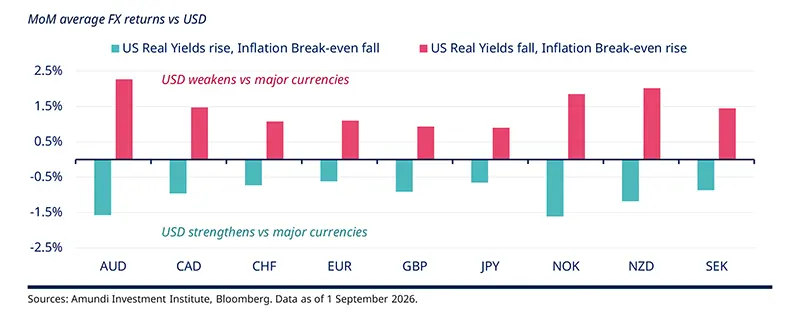
The best cyclical conditions for the USD occur when US real yields rise and compress inflation expectation. The worst occur when the Fed suppresses real yields and lets inflation run.
Our USD view has little to deal with de-dollarisation. The USD’s role remains intact, but the medium-term question around its value has not disappeared
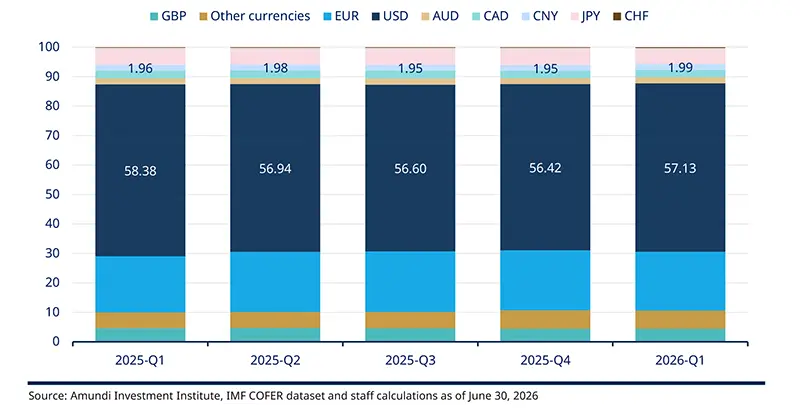
Our structural question marks over the USD should not be confused with a de-dollarisation call. The latest available IMF COFER data provide little evidence of an abrupt shift away from the greenback (see chart below). In Q1 2026, the USD share of allocated global FX reserves increased to 57.13%, from 56.42% in Q4 2025. While more than half of the increase reflects exchange-rate valuation effects rather than active reserve allocation, the underlying message remains one of remarkable stability in the international role of the currency. Central banks are diversifying, but the clearest marginal alternative remains gold rather than another fiat currency. There is little evidence that reserve managers are replacing the dollar with the euro, yen or renminbi at a pace capable of materially challenging the existing reserve architecture. This is consistent also with the latest BIS Triennial Central Bank Survey.
Currency composition of foreign exchange reserves (%)
In our view, the medium-term challenge remains the interaction between US fiscal sustainability, the price of capital and the opportunity set outside US assets. The US faces a rapidly rising interest burden, exceptionally large refinancing needs and a stock of government debt that needs to be continuously absorbed. The relevant risk is whether fiscal arithmetic eventually produces pressure for some form of financial repression (through inflation, regulation, captive balance sheets or other mechanisms) that eventually limits the real financing cost of the government. In such a regime, the currency can become both a shock absorber and an equilibrating mechanism. A weaker USD raises prospective returns on US assets for foreign investors by reducing their entry price in home-currency terms and could eventually become part of the adjustment required to maintain global capital flows towards the US.
This is why the Fed remains the critical variable even after the September hike. If Warsh is orthodox and resilient nominal growth keeps policy restrictive, cyclical tailwinds will likely support the USD, despite the growing medium-term headwinds. But if, on the other hand, policy attempts to reconcile above-target inflation, resilient nominal growth and increasingly difficult public-debt arithmetic by suppressing real financing costs relative to what a conventional Taylor-rule framework would imply, the structural adjustment in the USD can reopen.
Carry remains attractive, but choosing the funding currency matters more than ever
Global growth remains relatively resilient, commodity prices are elevated and cross-asset volatility, particularly rates and FX, has remained contained. These are normally supportive conditions for carry.
Now, if September marks the beginning of a genuine Fed hiking cycle and markets are underestimating its extent, there is ultimately limited diversification that carry can provide against a broad volatility shock. If September does not mark the beginning of a genuine Fed hiking cycle and if the market is not surprised by this extent, we continue to see valid reasons for the carry strategy to perform. AUD and NOK remain our preferred G10 high-beta expressions, alongside selected high-yielding EM currencies where valuations and carry remain attractive. The funding mix is, though, as important as the carry itself. The rising risks suggest to prefer low-yielding European currencies (SEK, EUR, CHF) as funders, rather than the USD or the JPY.
The JPY deserves particular caution
The BoJ has become more credible in signalling further normalisation, and higher JGB yields are improving the relative attractiveness of domestic fixed income. But the tightening cycle is still likely to be shallow compared with other central banks, limiting the case for treating the yen as a conventional high-conviction long. Rather, the JPY increasingly looks like the least unattractive among the traditional funding currencies. Capital repatriation, improving domestic yields and the authorities’ willingness to resist excessive depreciation leave the balance of risks skewed towards gradual appreciation.
A disorderly JPY appreciation, typically associated with a volatility spike and weaker global growth and BoJ tightening substantially beyond what markets price, would be a key risk to carry through. But our base case remains a more gradual adjustment. And if that adjustment broadens into Asian FX, where currencies remain historically cheap despite strong external balances, it could eventually provide another channel through which the structural USD adjustment re-emerges.



Authors