
Summary
The ECB opens a period of central bank meetings. The balance is shifting further towards the risk that inflation proves more persistent than expected, given the recent rise in energy prices amid geopolitical tensions.
The ECB raised rates to 2.50%, remaining determined to deliver on its target of price stability in the medium term.
The ECB raised inflation forecasts for 2027 and 2028, reflecting for 2027 expected high level of energy prices. Growth forecasts were also revised up for 2026 and 2027, reflecting greater resilience.
With yields under pressure, also amid inflation risks, a flexible approach to fixed income is paramount.
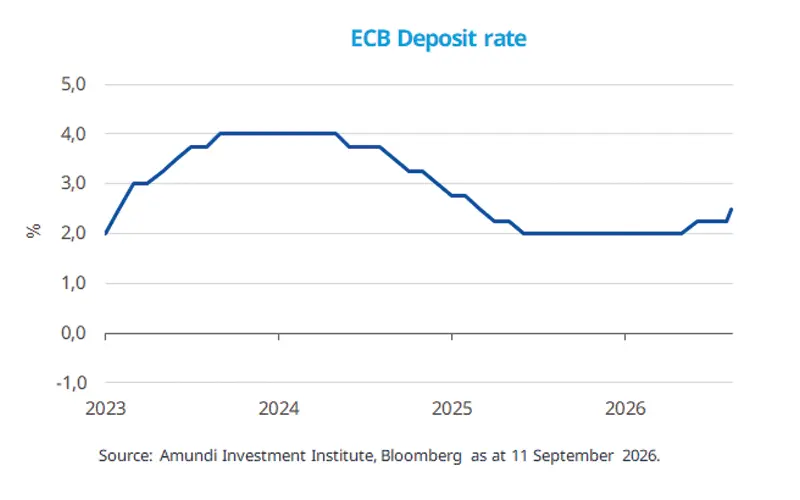
At its September meeting, the ECB raised policy rates by 25 basis points and reaffirmed its data-dependent, meeting-by-meeting approach, with no pre-commitment. The decision was unanimous and was considered robust across the ECB staff’s three alternative scenarios. The ECB said inflation risks are tilted to the upside and growth risks to the downside, particularly amid conflicts in the Middle East and between Russia and Ukraine. Lagarde sounded hawkish, stressing that while inflation has surprised to the downside, especially in food prices, it may prove more persistent than previously expected. Lagarde also noted that indirect effects remain limited and that no second-round effects have emerged so far, although a prolonged energy shock could increase risks, including to food prices. With tensions in the Middle East persisting, risks in the Red Sea rising and oil and gas prices increasing, inflation is likely to remain the dominant consideration for the policy outlook.
This week at a glance
Global equities declined broadly, weighed down by the renewed rise in oil prices linked to escalating tensions in the Middle East. Government bond yields rose across major markets, driven by concerns over oil-price volatility, the impact on inflation and rising expectations of monetary tightening. Brent crude rose above USD 100 per barrel. Yen was supported by expectations of further BoJ tightening.
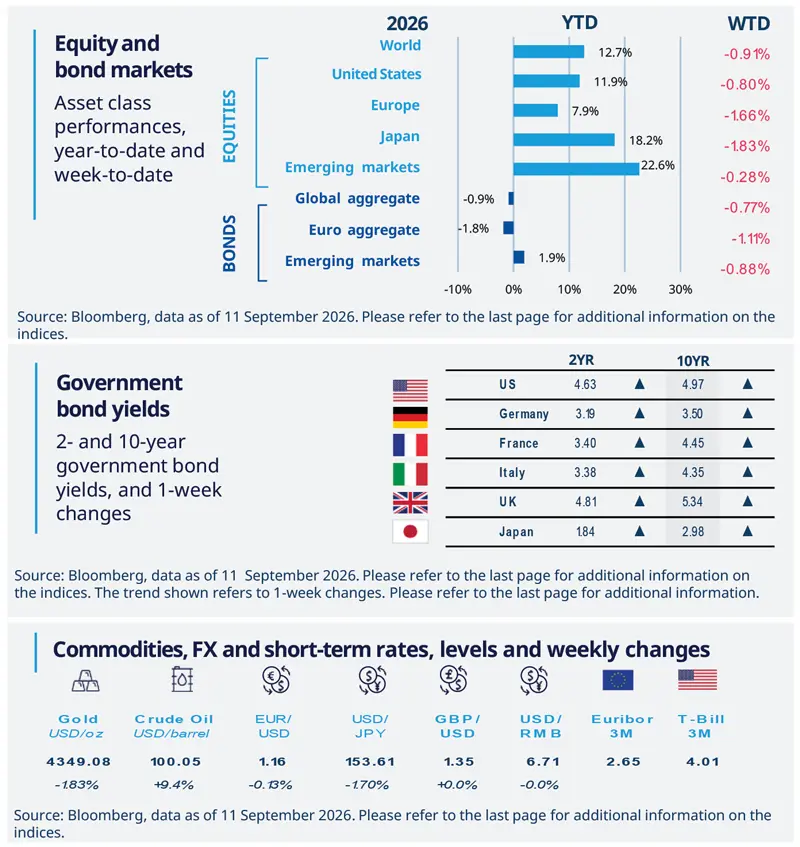
Equity and bond markets (chart)
Source: Bloomberg. Markets are represented by the following indices: World Equities = MSCI AC World Index (USD) United States = S&P 500 (USD), Europe = Europe Stoxx 600 (EUR), Japan = TOPIX (YEN), Emerging Markets = MSCI Emerging (USD), Global Aggregate = Bloomberg Global Aggregate USD Euro Aggregate = Bloomberg Euro Aggregate (EUR), Emerging = JPM EMBI Global Diversified (USD).
All indices are calculated on spot prices and are gross of fees and taxation.
Government bond yields (table), Commodities, FX and short-term rates.
Source: Bloomberg, data as of 11 September 2026. The chart shows the price of gold.
Diversification does not guarantee a profit or protect against a loss.
Amundi Investment Institute Macro Focus
Americas
US labor market not overheating
US payroll growth surprised to the upside in August, with broad-based gains, mainly in the private sector. Local government, construction, manufacturing, leisure and hospitality all contributed. The unemployment rate remained stable as employment and participation rate rose. Wage growth continued to ease gradually towards 3%, with weekly real earnings rose 0.3% YoY. At this stage, the labour market does not appear to be overheating and remains consistent with non-accelerating wage inflation.
Europe
Eurozone recovery remains narrow and exposed
Eurozone growth was revised sharply higher in the second quarter, but the improvement largely reflected an exceptional adjustment in Ireland rather than stronger underlying activity. Excluding this effect, growth remained close to trend and led by exports and household consumption while investment is weak. Early signals for Q3 remain mixed, as softer retail and industrial data contrast with firmer business surveys amid renewed energy-price pressures.
Asia
China inflation rebounded
China headline CPI rebounded in August (0.8% YoY) on renewed pressures from costs through supply chain and Middle East disruption. Core prices have strengthened on gold prices and electronics (1.0% YoY). We expect the rebound as a one-off because of domestic demand sluggishness. Inflation should return to moderate.
Key dates
UK CPI, Eurozone industrial production, Fed policy rate, Brazil policy rate |
Eurozone CPI, BoE policy rate, US initial jobless claims and housing starts |
UK retail sales, US industrial production, BoJ target rate, ECB CPI expectations |



Authors