
Summary
Geopolitical tensions keep refined product markets tight amid refinery capacity constraints, export disruptions and more challenging rerouting
Refined products stay tight
Prices of refined petroleum products, such as gasoline, stay elevated relative to crude oil.
Product markets remain tight, reflecting refining capacity and operational constraints.
The dynamics of refined product prices are important for consumer and producer price pressures, real personal income and consumer confidence.
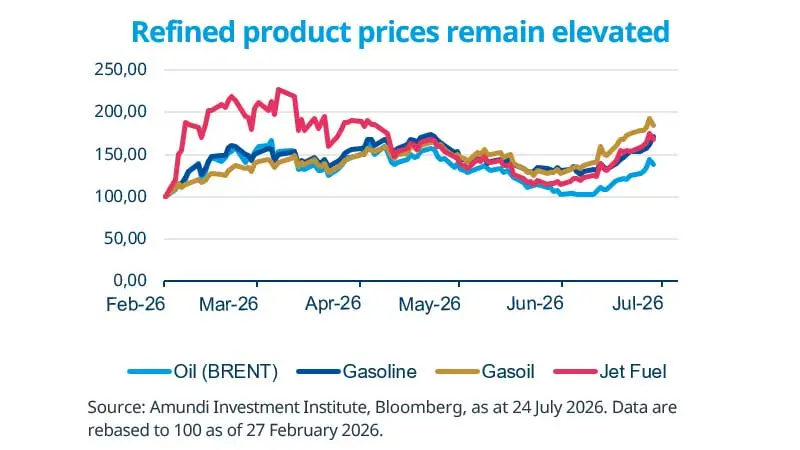
In volatile energy markets, refined petroleum products are at elevated levels relative to crude oil and to the pre-war situation, suggesting that product markets remain tight. As reported by the International Energy Agency in its July Oil Market Report, exports of refined products from the Middle East were still much lower than before the US-Iran conflict, compared with crude flows, even during the period of de-escalation, suggesting that some major refineries’ operations remain constrained. At the same time, the escalation of the Russia-Ukraine conflict, including attacks on Russian refineries, has reduced Russian supply, with an impact on exports and domestic deliveries. Finally, Asian refineries are still operating below normal levels. The UAE could potentially help ease these supply constraints by bypassing the Strait of Hormuz, but only partially. Moreover, renewed tensions in the Middle East, and the risk of disruption along new routes also for oil, make the situation complex.
This week at a glance
Global equities were mixed amid ongoing geopolitical concerns. US stocks were weaker as investors stayed cautious on the profitability of AI investments, while expectations for Fed rate hikes rose. In fixed income, global yields rose as higher oil prices fuelled expectations of central bank action. Gold also gained amid geopolitical risk, while the US dollar strengthened against the euro.
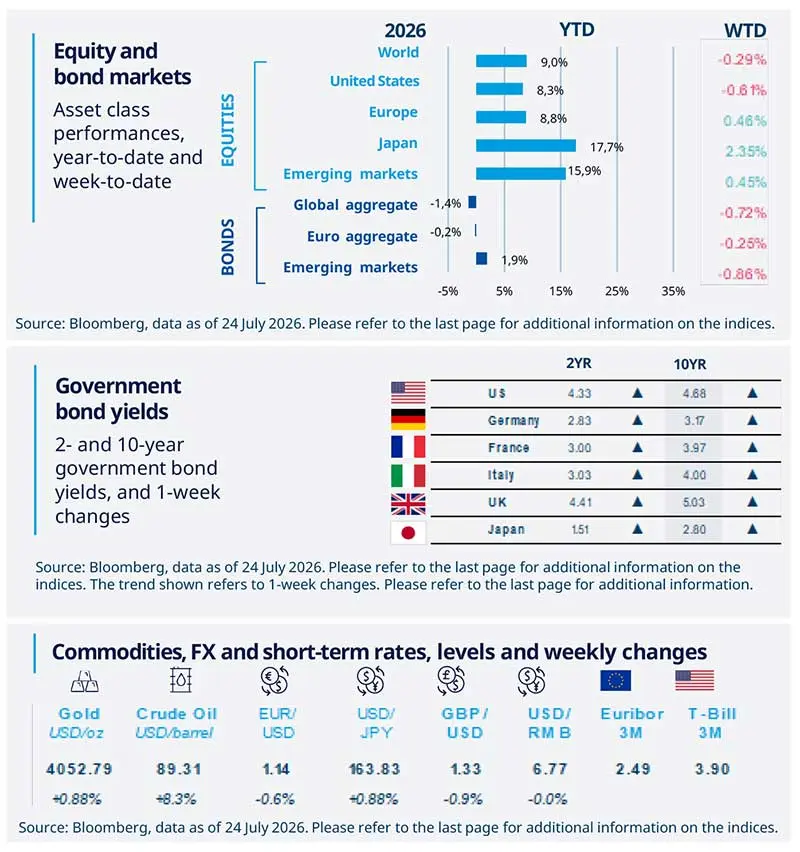
Equity and bond markets (chart)
Source: Bloomberg. Markets are represented by the following indices: World Equities = MSCI AC World Index (USD) United States = S&P 500 (USD), Europe = Europe Stoxx 600 (EUR), Japan = TOPIX (YEN), Emerging Markets = MSCI Emerging (USD), Global Aggregate = Bloomberg Global Aggregate USD Euro Aggregate = Bloomberg Euro Aggregate (EUR), Emerging = JPM EMBI Global Diversified (USD).
All indices are calculated on spot prices and are gross of fees and taxation.
Government bond yields (table), Commodities, FX and short-term rates.
Source: Bloomberg, data as of 24 July 2026. The chart shows the price of gold.
Diversification does not guarantee a profit or protect against a loss.
Amundi Investment Institute Macro Focus
Americas
US tariff pressure broadens
President Trump reimposed tariffs on a broad group of trading partners after earlier global duties expired. Major partners, including the UK, Mexico, the EU, Japan, Taiwan and South Korea, now face rates of 10-12.5%, renewing broader trade uncertainty across key global markets. The measures were justified on forced-labour grounds, after an investigation into unethical working conditions. Separately, the US threatened Canada with 50% tariffs on a wide range of goods, with a negotiation period overlapping the ongoing USMCA discussions.
Europe
ECB Holds Rates Steady
At its July 23rd meeting, the ECB left key policy rates unchanged. The decision was unanimous, but Lagarde noted that some governors questioned whether a rate hike should be considered as oil prices surged following the breakdown of the US-Iran ceasefire. Lagarde also emphasised that there is no pre-commitment to any specific rate path, and the Governing Council will continue to act meeting by meeting on the basis of incoming data.
Asia
Bank Indonesia holds rates steady
Bank Indonesia (BI) kept its policy rate unchanged at 5.75%, against consensus but in line with our expectations. The decision, together with recent measures, has helped stabilise the IDR and tentatively revive financial inflows. Growth prospects and coordination with fiscal authorities remain at the forefront of BI’s monetary policy communication. However, recent developments in the Middle East are increasing the risk that BI will need to adopt a more hawkish policy stance.
Key Dates
US monetary policy rate decision |
EZ GDP Q2 and economic confidence, US personal consumption and income, GDP Q2 |
JP retail sales, industrial production and CPI, EZ CPI, China PMI, US consumer confidence |

Authors