
Summary
Increased constraints on President Trump, but not a policy reversal: Congress will have greater oversight of foreign policy, funding and appointments, while President Trump retains significant executive authority. This points to more political gridlock, which may constrain policy activism but not fully restore discipline.
At the macro level, less fiscal stimulus and greater regulatory scrutiny: increased congressional oversight should limit the scope for further fiscal stimulus. However, this is unlikely to deliver meaningful deficit reduction. Markets would distinguish reduced legislative uncertainty from a genuine improvement in the fiscal trajectory. Greater regulatory scrutiny, particularly of AI and Big Tech, could also slow investment in selected areas, even though more careful consideration of capex and regulatory oversight on AI security may now be welcome.
Iran and AI are the two key policy fault lines. Congress may push to reduce funding for the Iran war and challenge tariffs, potentially easing pressure on oil prices and inflation. At the same time, greater scrutiny of AI, Big Tech and data-centre development could weigh on technology investment and valuations.
The market reaction points to relief and rotation. The market reaction reflects lower political uncertainty, with bonds benefitting, the dollar weakening and equity leadership broadening beyond US technology. AI, data centres and defence face greater policy risk, but the underlying investment themes remain intact.
Investment implications: not a game changer, seek broader diversification in equities. The result is mildly positive for global fixed income, as it could lead to lower inflationary pressure. In US bonds, we continue to favour intermediate maturities. In equities, the election result favours diversification into non-US equities and non-tech sectors.
How is the market reacting to the election result?
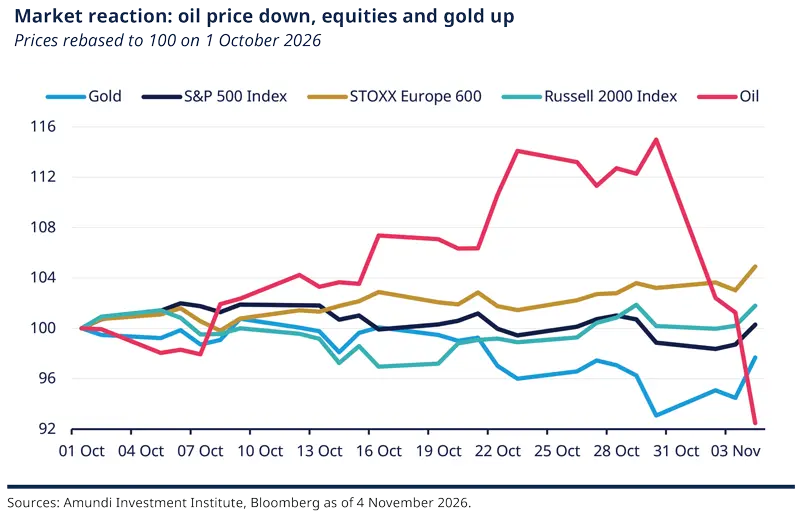
The initial market reaction suggests that the blue wave was broader than expected, but not fundamentally surprising. The early sell-off quickly reversed as investors looked beyond the scale of the shift and focused on the removal of a major source of uncertainty. The immediate message is relief – not enthusiasm for the outcome itself.
This is not a classic risk-on move. Government bonds are rallying, the dollar is weakening and precious metals are rising. With expectations for the next Fed meeting broadly unchanged, lower yields appear to reflect less risk of an additional fiscal impulse, incremental Treasury supply and term-premium pressure – rather than hopes of easier monetary policy. Gold and silver are benefiting from lower yields and a softer dollar, while retaining value as hedges against future political and institutional confrontation. Acceptance of the result and a less confrontational foreign-policy tone have also reduced immediate tail risks, helping oil retreat.
Equity dispersion shows where policy concerns remain. In the US, materials, financials, health care and consumer staples are leading, while technology is participating less fully and energy and industrials are lagging. AI and data-centre names are pricing concerns over tighter permitting constraints, while defence is exposed to greater budget uncertainty. Neither theme is collapsing, however, suggesting that the market is repricing targeted policy rather than a rupture in the earnings regime. The broader rotation is equally revealing. Small caps are outperforming large-cap technology, while European equities and cyclical sectors are benefiting from lower yields and a narrowing US policy premium.
This looks like a broadening away from concentrated US growth and pre-election policy winners toward assets benefiting from lower yields, reduced policy exceptionalism and a broader global opportunity set – not a rejection of US risk assets.
Options markets went into the vote priced for movement but positioned for relief. Elevated volatility, along with call demand and risk reversals, pointed to a constructive post-election bias. The softer volatility curve and equity rebound suggest uncertainty is clearing to the upside.
Markets price less uncertainty, tighter fiscal constraints, and stronger oversight – not a policy revolution.
The implied message is clear: markets price less uncertainty, tighter fiscal constraints, and stronger oversight – not a policy revolution. Markets today are pricing greater political clarity, but policy risks persist. Reduced legislative optionality does not eliminate execution discretion. The remaining risk is that legislative constraint becomes confrontation through budgets, the debt ceiling, investigations or restrictions on AI investment. For now, clarity and upside optionality are outweighing policy anxiety.
What is the likely election impact on domestic policy?
The Democrats’ message during the election was aimed at Big Tech, AI, and alleged corruption in the administration. Therefore, pushback against the AI data centre buildout should be expected, as well as greater scrutiny of Big Tech. In addition, there are likely to be investigations into President Trump and his administration around his business interests and conflicts of interest; therefore, expect a lot more domestic political noise. Furthermore, as the Senate also confirms Supreme Court justices, Democrats can now block judicial nominations.
Importantly, in the Republican and Democratic parties the succession battle now begins. Both parties have big questions to answer over their political positions. The Democrats will see an internal battle playing out between the progressive and more centrist wings, while in the Republican Party MAGA and what it stands for will be questioned.
How do you see foreign policy changing following the election result?
The election results increase pressure on President Trump to de-escalate tensions with Iran, but also the risk of unpredictability.
Since the Democrats won the Senate by a larger margin than expected, they will be able to exercise greater oversight of President Trump’s foreign policy agenda. There will be more scrutiny and therefore more uncertainty. However, a weaker president does not necessarily mean a less assertive foreign policy. President Trump retains executive authority and can still push through his goals on foreign policy and tariffs. Further, since he is now significantly constrained at home, he will likely become more interventionist.
In particular, the most immediate impact will likely be on Iran given that the cost of the war for US consumers has been a key issue in this election. While another round of escalation and US/Israeli attacks on Iran are widely expected in the short term, the election results increase the pressure on President Trump to de-escalate over the medium term also because Congress has greater oversight of funding. President Trump’s interests are now also likely to clash with those of Republicans seeking to succeed him. Nevertheless, the election outcome does not change the political realities in the region, and the likelihood of a return to the pre-war status quo remains low. The US has heavily built out its military presence in the Middle East and US and Iranian demands for a compromise remain far apart.
Ukraine will likely benefit from more support and pushback against President Trump’s overtures to President Putin, as the Democrats will likely push for increased assistance and better security guarantees. Similarly, for Europe, the election results likely mean more sympathetic voices in Congress and more support for legislation to ensure that US troops remain in Europe. The election result also improves the outlook for US commitment to NATO. The next key piece of legislation to watch is the National Defense Authorization Act, due towards the end of the year, as it outlines US foreign policy priorities and authorises related funding. Nevertheless, there remains fatigue on all sides regarding US involvement in ‘foreign’ conflicts and the desire to reduce defence commitments. Finally, no major change should be expected in US policy towards China, although the results will likely increase support for US allies in South and East Asia.
What are the implications for the US economy?
The Democratic emphasis on redistribution, healthcare support, and benefits for lower-income households could support consumption at the margin.
The Democratic priorities would likely centre on redistribution rather than austerity, with a focus on healthcare. This would include efforts to reinstate the enhanced Affordable Care Act subsidies that expired at the end of 2025, reverse Medicaid cuts, and expand coverage. The emphasis on redistribution, healthcare support, and benefits for lower-income households could support consumption at the margin, but it would not necessarily materially boost it. The impact on inflation should be limited unless the Democrats secure the reintroduction of Obamacare-related subsidies, which we consider unlikely. As far as investments are concerned, a Democratic sweep should make tighter regulation more likely, probably focusing on areas such as consumer protection, labour impacts, environmental costs, energy consumption, and local permitting. Across the broader economy, given the geopolitical priorities of the current administration, we would expect continued emphasis on innovation, competitiveness, and faster infrastructure buildout in the race for AI dominance.
In general, several measures cannot be adopted unilaterally. President Trump has already declared that he will exercise his veto power whenever he deems it necessary, and overriding such a veto would require a two-thirds majority in both chambers, which is clearly out of reach. That said, the new political landscape will create greater checks on presidential power. A Democratic Congress will create more friction for the administration, especially around judicial, regulatory, and Federal Reserve appointments. While the fiscal stance may become more neutral or possibly restrictive next year as stimulus fades, we do not envisage a credible path to a large-scale debt-stabilisation programme. Significant deficits would remain the backdrop, with the Congressional Budget Office baseline pointing to deficits of at least 5.6% of GDP over 2026–36.
What can we expect for markets?
At the margins, the result is mildly positive for global fixed income and mildly negative for AI stocks. Non-tech and international markets may benefit.
Looking ahead there are two major questions that may push markets in opposite directions.
Will Congress look to reduce financing for the Iran war and roll back tariffs? If so, this could reduce inflation pressure by pushing oil prices lower and reducing taxes on imported goods.
Will Congress want to regulate AI and slow the building of data centres? This could be a direct threat to the revenue growth of tech companies and drive stock prices lower across the sector.
On fixed income, the election result is not a game changer, but at the margin can be seen as slightly positive. In the US, we keep a close to neutral stance on duration. We favour intermediate maturities, while we remain more cautious on the long end of the curve, where fiscal credibility and term premium remain key considerations.
In equity sectors, AI/Tech names are under scrutiny, but a lot will depend on how much the Democratic Party can change the status quo. More broadly, the AI race is increasingly about execution, not just innovation. Eneregy availablity, infrastructure bottonecks and social accepance – all of which can be shaped by state and federal regulation – may determine the pace and geography of future AI investments. This calls for greater diverisication across the AI value chain, including power infrastructure, grid investment, compute and enabling technologies tied to AI applications. Investors may also seek rotation outside the tech sector and, geographically, beyond the US towards the rest of the world. Some data centre projects may be delayed, but it remains hard to imagine a regime change given the structural investment and the competition with China.
With regard to the dollar, looking at past mid-term elections (12 episodes since 1978), the dollar has tended to weaken, with the effect building over the first 6 months, with the weakness looking more persistent in the sweep case and then fading back to flat over a 12-month horizon. Within G10 foreign exchange, the Swiss franc, New Zealand dollar and euro have been the main beneficiaries of dollar weakness at the six-month horizon. Meanwhile, the Japanese yen, Norwegian krone and Swedish krona show little directional bias, and their historical upside in our sample is small.

Authors