
Summary
Prepare for rotations in concentrated and flow-driven markets
July saw tensions flare once again in the Middle East. Markets questioned the feasibility of returning to a ceasefire, pushing Brent oil prices back towards $100. Previously, prices had fallen to pre-war levels due to effective rerouting efforts and a reassessment of supply risks.
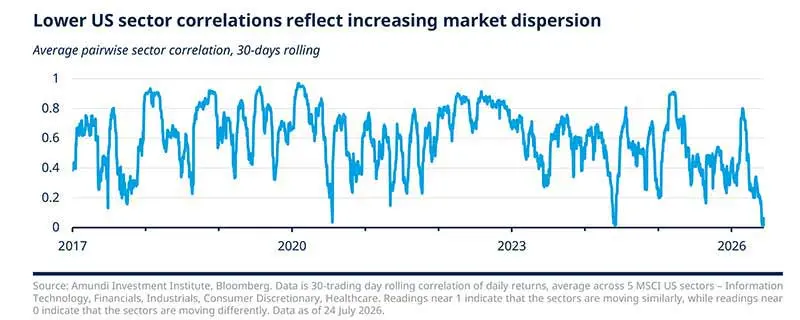
At the same time, an undercurrent of market rotations has been reshaping global equity markets. The move out of crowded trades has picked up as the market rebalances towards defensives, financials and industrials. As sector-specific drivers become more influential, performance has become more dispersed, reflected in low cross-sector correlation. In bond markets, yields rose to high levels, with initial scrutiny on fiscal space putting pressure on the long-end.
While investor sentiment remains supported by expectations for another strong earnings season, there is little room for disappointment, which could trigger faster rotations if results or guidance fall short. Liquidity remains supportive but may wane during the summer period; leverage in some tech names and crowded trades could also amplify market movements.
Looking ahead, our key convictions on oil prices, inflation, central bank action and markets are outlined below:
Rerouting is key to oil prices’ response to recent tensions; recent movements have reflected an increasingly uncertainty, with volatility remaining elevated as investors assess the risk of further disruptions. In addition, LNG flows remain the main bottleneck, as rerouting is more difficult, Qatar’s output cannot easily be replaced, and Asian and European demand keeps the gas market undersupplied.
Recent US and euro area inflation data have shown a more benign picture. However, given recent tensions in the Middle East and oil price dynamics, the disinflation path could be less straightforward, with some volatility in the data. Central banks are likely to remain cautious; any inflation-driven tightening should prove temporary and be reversed next year following an easing of tensions in the Middle East. On a medium-term horizon, the inflation debate remains structural rather than cyclical. The key question is where the inflation floor ultimately settles amid a capex cycle that exposes scarcity, the need to reinforce strategic autonomy, the race for AI supremacy, high debt and the impact from climate change.
Growth is expected to marginally improve, but unevenly across countries and across segments of the economy, with investments leading. In Europe, Germany’s reform package is a structural pillar that should mildly impact GDP growth in the short term by improving confidence; a larger growth contribution should materialise over a longer horizon.
In equities, the rotation theme is confirmed. The recent weakness in semiconductors underscores a broader rotation: out of chips – the main early beneficiary of AI investments – towards other segments within the AI value chain, including infrastructure, power and applications, in search of new opportunities. After a massive year-to-date run, this looks like a profit-taking and a call for greater selectivity, as the AI trade fragments into winners and losers.
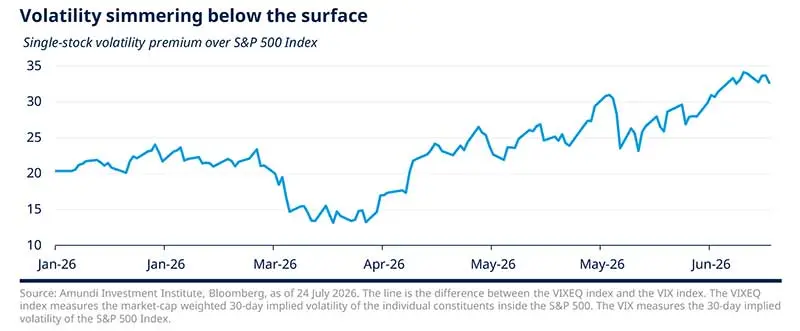
In this environment, we maintain a mild risk-on stance overall. We believe it is not time to add risk as rates are approaching high levels, earnings leave limited room for disappointment, and thinner summer liquidity could amplify market swings.
Overall, we maintain a modest risk-on stance, but do not view this as the time to add risk. Rates are approaching elevated levels, earnings expectations leave little room for disappointment, and liquidity may wane over the summer, potentially amplifying market moves
| Amundi Investment Institute: Central banks’ framework post-Sintra Forum |
Forward Guidance: The Fed has progressively moved away from forward guidance since 2018 towards a more data-dependent framework. However, reduced policy guidance by principal central banks may increase uncertainty over the short-rate path, creating additional volatility at the front end of the curve. Yield curve movements. Looking ahead, we believe yield curve movements will be driven less by growth and more by monetary policy expectations, term-premium and fiscal vulnerabilities. High debt and deficits, as governments seek to finance strategic policy objectives, will require greater issuance, which markets will need to absorb. A shift in investor focus towards domestic bonds could therefore reshape bond market flows and determine the winners and losers in this race for high-quality yields. |

Monica DEFEND
Monetary policy uncertainty remains a material factor changer for equities more broadly, as well as for the US dollar. While a Fed hike is not our base case, such an outcome would likely trigger a significant repricing across both asset classes.
In this environment, we confirm that diversification across regions and sectors is paramount to building a resilient portfolio, focusing on fundamentals and selectivity. Our convictions across asset classes are outlined below:
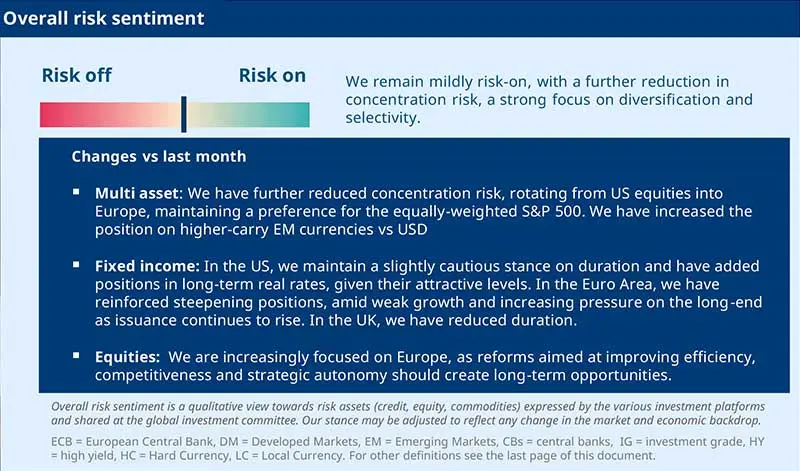
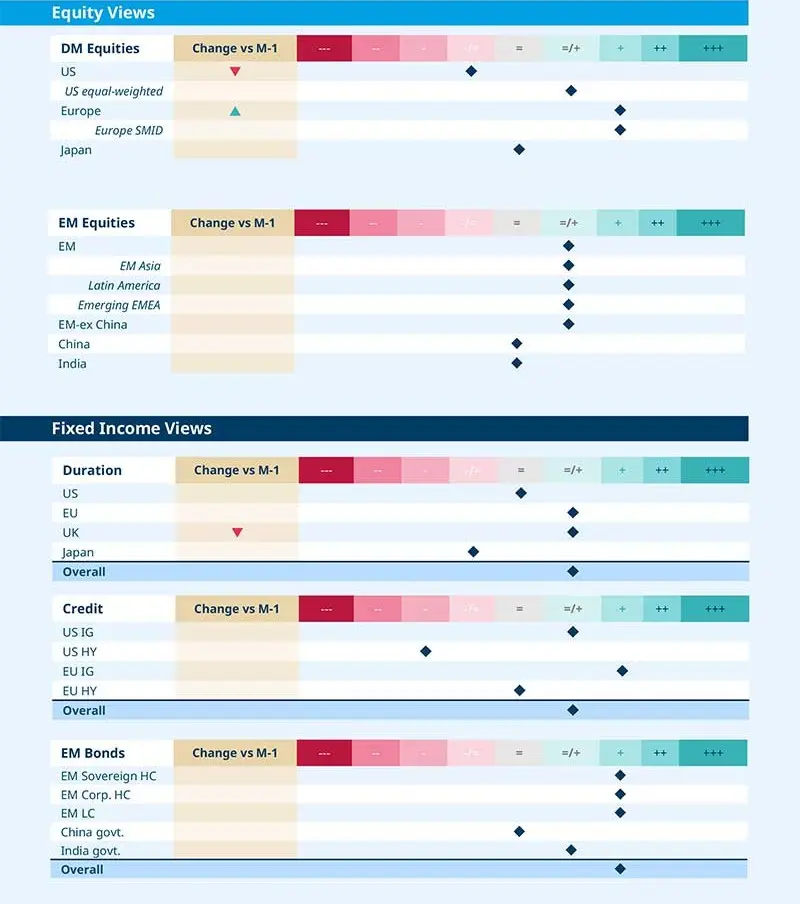
In fixed income, we maintain a slightly cautious-to-neutral stance on US duration, favouring the middle part of the curve. We continue to believe in curve steepening and have added positions in long-end real rates, given their attractive levels. In Europe, we have increased steepener positions and still favour peripheral debt over core. In the UK, we have taken profit on our position, maintaining a steepener conviction. High-quality credit still offers attractive yields while we remain constructive on EM debt.
In equities, we focus on resilient business models that are less exposed to disruption, alongside balance sheet strength. Strategically, we are positioned away from the US given elevated valuations and concentration risk. We are constructive on Europe and Japan, while Emerging Markets also look attractive, given their technological strengths and more compelling valuations relative to Developed Markets.
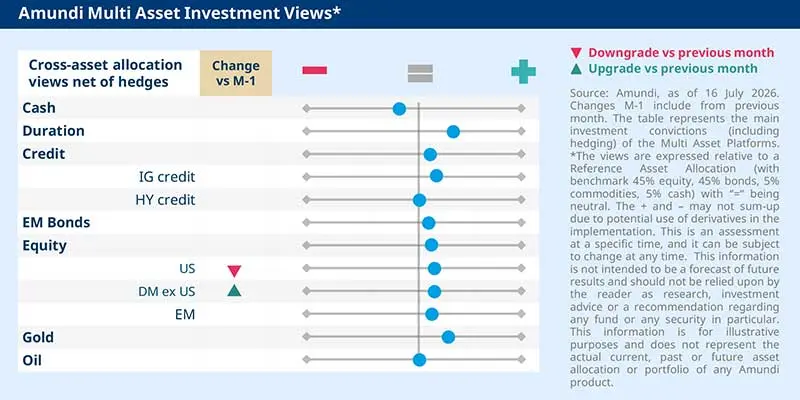
In multi-asset, we maintain a pro-risk stance, but our preference is for carry, selectivity and regional diversification rather than strong directional positions. As a result, we have tactically reduced our positive stance on the S&P 500 while retaining a constructive view on the SPX 500 Equally Weighted. This rotation favours Europe, where the German reform package and infrastructure package should provide support. In FX, we continue to favour rotation into higher-carry EM currencies.
Beneath the surface of calm markets, rotations are underway.
Investors should position for a broadening equity market, focusing on structural resilience, pricing power and companies’ ability to absorb shocks
FIXED INCOME
Long-end rates reaching attractive value
Amaury D’ORSAY |
The macro backdrop remains mixed, with central banks remaining cautious, while inflation fears and monetary policy expectations are still being shaped by oil price dynamics. In the US, robust data and a relatively hawkish Fed are putting upward pressure on rates, supporting our cautious stance on duration, while also creating attractive opportunities in certain segments, such as the middle part of the curve and real rates.
In the Eurozone, the ECB appears to be fine-tuning its terminal rate, with any further moves likely to reflect calibration rather than a renewed tightening impulse. Pressure at the long end is likely to remain as issuance, net of ECB purchases, continues to rise. This supports our conviction in curve steepening, further reinforced after a period of flattening. In the UK, we slightly reduced the position, confirming the steepening amid weak growth and fiscal uncertainty.
In the US, slightly cautious stance on duration, with preference for the 5-year tenor and steepening. We added positions in long-term real rates, given the attractive levels. In the Euro Area, we reinforced the steepener positions, continuing to favour peripheral over core.
In the UK, we slightly reduced the position, following recent strong performance, maintaining the steepener.
We remain cautious on Japanese bonds, as the BoJ remains behind the curve. We continue to believe in curve flattening.
We remain constructive on credit overall, with supply well absorbed and the hunt for quality yield keeping spreads supported. Fundamentals remain robust; as sector dispersion is increasing, sector/issuer selection will be important.
The US IG market is resilient, but we favour the EU over the US. At a sector level, we prefer financials (strong profitability and high capital levels) over non-financials.
We maintain our preference for subordinated over HY, favouring short-dated bonds.
We maintain a constructive view on EM debt overall, with a focus on selection. The asset class is supported by attractive carry, resilient domestic fundamentals and stable spreads. Regionally, we like Latin America, with a tilt towards commodity exporters like Brazil.
We are positive on EM hard currency debt, sovereign and corporate, where we favour strategic themes (e.g. green transition, technology).
In local currency bonds, we continue to favour a country-wise selective approach.
EQUITIES
Focus on resilience and selectivity
Barry GLAVIN |
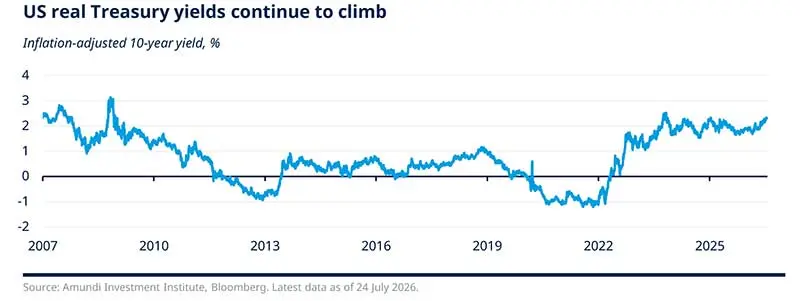
Recent weeks have shown that despite low market volatility, single-stock volatility is rising as investors increase scrutiny. Concerns over AI-related investments, profitability, valuations and supply chain risks remain in focus, reinforcing the importance of selectivity and structural resilience. Against this backdrop, we are strategically positioned away from the US, as concentration and valuation risks persist.
We confirm our long-term view on Europe, as reforms aimed at enhancing efficiency, competitiveness and strategic autonomy should support long-term opportunities. We are constructive on Japan, underpinned by solid fundamentals, pro-growth policies and valuations. Emerging Markets also look attractive, supported by technological strengths and valuations.
With headline valuations appearing full, we favour low-beta, AI-resistant companies whose business models are less likely to be disrupted. We prefer the healthcare and consumer staples sectors, while rising electricity demand driven by AI, data centres and the energy transition is creating opportunities in utilities, construction and industrials. We also maintain a constructive view on financials although recent market dynamics make stock selection paramount.
We remain constructive on European technology stocks, although we have recently taken profits in semiconductors.
In Japan, we favour industrials and selected small- and mid-cap companies exposed to supply-chain resilience, AI and infrastructure. Overall, valuations are attractive.
EM remain supported by diversification benefits amid geopolitical and economic risks, alongside supportive valuations and strength in technology.
We maintain a slightly positive stance on Asia, while remaining selective on the tech/semiconductors sector. AI-driven demand for memory and chips should continue to support earnings, although upside may moderate as supply growth accelerates and pricing momentum eases.
We keep a neutral stance on China amid an uncertain earnings outlook; we favour selective industrial names with technological and global competitive advantages.
We remain constructive on Latin America, with Brazil’s elections in October a key event to monitor.
MULTI-ASSET
Mildly pro-risk, with caution
Francesco SANDRINI CIO Italy & Global Head of Multi-Asset | John O’TOOLE Global Head - CIO Solutions |
The overall macro backdrop remains supportive, yet inflation is sticky, central banks are still cautious, and growth continues to diverge across regions. In this context, we remain mildly pro-risk, focusing on carry, selectivity and diversification rather than strong directional conviction.
On equities, we remain constructive. However, in the US, the high concentration in a few names may lead to underperformance versus the rest of the world. As a result, we have tactically reduced our positive stance on the S&P 500 while maintaining a constructive view on the SPX Equally Weighted Index to participate in broad-based earnings growth momentum.
This rotation favours Europe, as the German reform package and infrastructure plans should provide a tailwind for the region. Moreover, the technical picture suggests that European equities are under-owned. We believe a rebound in European growth is possible in the second half of the year, with cyclical sectors, including banks, looking attractive.
In fixed income, we maintain a constructive duration view in the US and Europe, while remaining cautious on Japan, where the long end remains vulnerable to higher inflation, BoJ policy tightening and a rising term premium. We remain positive on 5-year US Treasuries, as softer labour data and subdued core CPI suggest the Fed may stay on hold longer than markets expect. In Europe, we maintain a positive stance on Bunds and Schatz, as markets now price only limited further ECB tightening and growth remains weak. BTPs continue to look attractive on carry. Finally, we remain constructive on EU IG credit, given attractive valuations, demand from yield buyers and positive seasonality, and on EM.
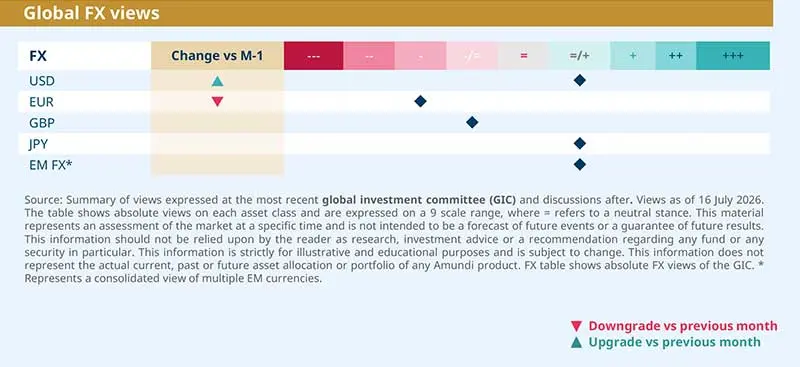
In FX, we continue to favour a rotation into higher-carry EM currencies vs USD, reducing the position on EUR vs USD. We favour the Brazilian real and Turkish lira because both are supported by improving fundamentals and attractive carry, with central banks expected to ease only cautiously.
VIEWS
Amundi views by asset classes
Definitions & Abbreviations
Currency abbreviations: USD – US dollar, BRL – Brazilian real, JPY – Japanese yen, GBP – British pound sterling, EUR – Euro, CAD – Canadian dollar, SEK – Swedish krona, NOK – Norwegian krone, CHF – Swiss Franc, NZD – New Zealand dollar, AUD – Australian dollar, CNY – Chinese Renminbi, CLP – Chilean Peso, MXN – Mexican Peso, IDR – Indonesian Rupiah, RUB – Russian Ruble, ZAR – South African Rand, TRY – Turkish lira, KRW – South Korean Won, THB – Thai Baht, HUF – Hungarian Forint.


Authors