
Summary
In a market shaped by AI, energy price uncertainty and re-routing, Latin American equities can offer diversification supported by attractive valuations and improving policy dynamics
Despite rising yields. global equities remained resilient in Q3 supported by strong earnings and favourable economic conditions.
Within emerging markets, Latin America stood out in Q3, confirming its role as diversifier beyond the AI-trade and amid global geopolitical frictions.
EM offers opportunities to diversify across different themes, including energy, technology and structural demand drivers.
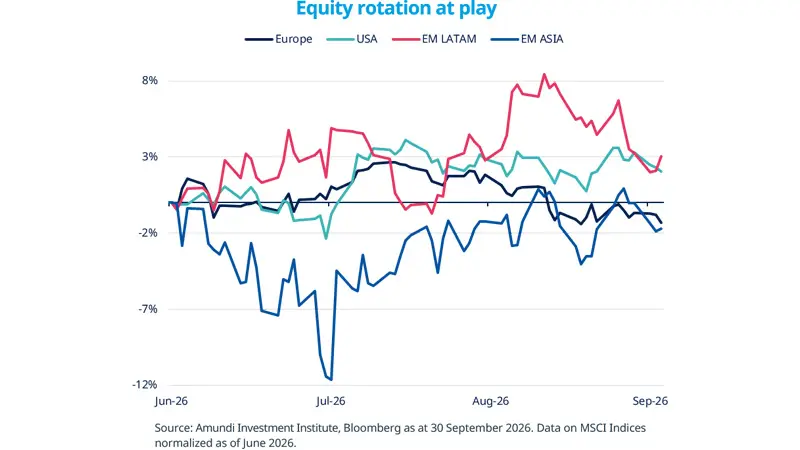
Equity markets remained resilient in Q3 despite the headwind from higher interest rates, which led global government bonds to post their worst quarterly loss since the end of 2024. Global equity indices were supported by a strong earnings cycle and favourable economic conditions. Across sectors, technology and energy led, while utilities, industrials, real estate and consumer stocks were in the red.
In emerging markets, Latin America stood out with a positive quarter. The region is supported by attractive valuations and the prospect of an improving policy mix, boosting macro stability and the reform outlook. This could further reinforce the region, which is positively geared to global geopolitical frictions and has a competitive advantage in agricultural and critical commodities.
This week at a glance
Global equities fell over the week. In the US, the Nasdaq 100 outperformed the S&P 500 Equal Weight Index, reflecting the positive dynamics of AI-related themes relative to other segments. Bond yields were mixed, but remain at elevated levels. This weighed on gold. Oil fell sharply over the week. The euro weakened notably against the dollar, touching its lowest level since May 2025.
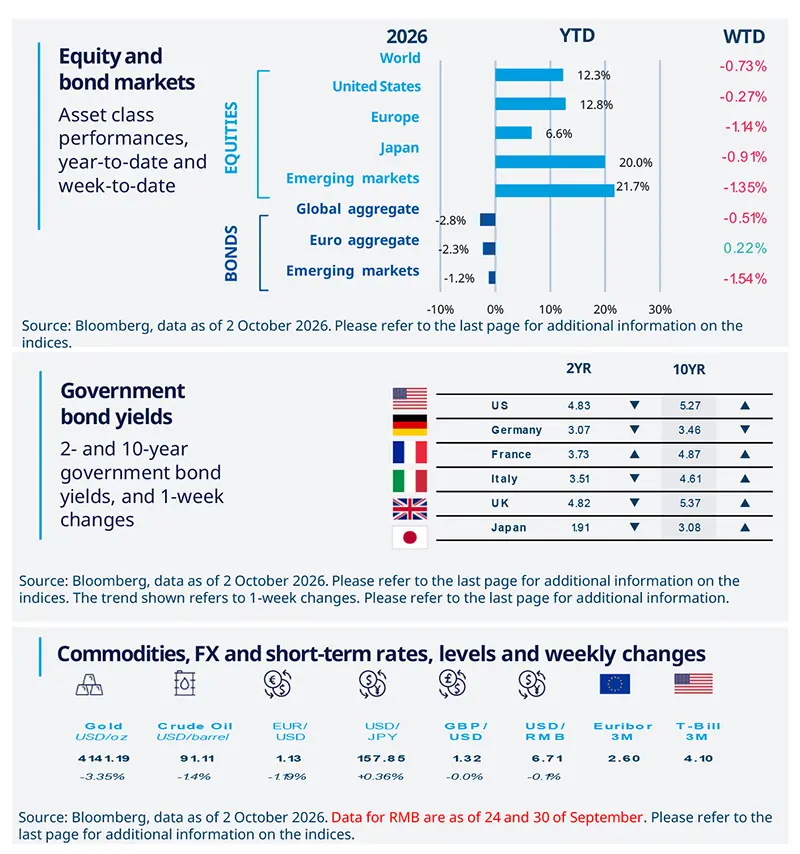
Equity and bond markets (chart)
Source: Bloomberg. Markets are represented by the following indices: World Equities = MSCI AC World Index (USD) United States = S&P 500 (USD), Europe = Europe Stoxx 600 (EUR), Japan = TOPIX (YEN), Emerging Markets = MSCI Emerging (USD), Global Aggregate = Bloomberg Global Aggregate USD Euro Aggregate = Bloomberg Euro Aggregate (EUR), Emerging = JPM EMBI Global Diversified (USD).
All indices are calculated on spot prices and are gross of fees and taxation.
Government bond yields (table), Commodities, FX and short-term rates.
Source: Bloomberg, data as of 2 October 2026. The chart shows the price of gold.
Diversification does not guarantee a profit or protect against a loss.
Amundi Investment Institute Macro Focus
Americas
US growth holds while consumer confidence weakens
The final revision to Q2 economic growth showed a higher annualised expansion of 2.2%, driven by stronger consumer spending and fixed investment and a smaller drag from inventories. Separately, the Federal Reserve’s preferred inflation measure came in slightly below expectations, with the annual rate reaching 3.0%. However, household sentiment weakened markedly to a multi-year low, reflecting deteriorating assessments of both current conditions and the outlook.
Europe
Europe faces renewed inflation pressures
German consumer prices rose 3.3% YoY in September, the highest reading in almost three years and above expectations, with energy as the main driver. The data followed similarly strong preliminary inflation readings from France, Italy and Spain earlier in the week, pointing to a broad re-acceleration across the eurozone. Against this backdrop, the ECB’s internal assessment appears to be shifting closer to a more adverse inflation scenario, amid heightened forecast uncertainty, rising energy prices and higher long-term interest rates.
Asia
Japan business sentiment improves
Japan’s third-quarter Tankan survey showed improving confidence among large manufacturers, beating expectations and signalling continued optimism in the industrial sector. Separately, Tokyo consumer prices—a closely watched indicator of national inflation—rose 2.7% YoY in September, partly driven by energy costs.
Key dates
5 Oct Japan Services & Composite PMI Final, US ISM Services Index, Eurozone Services PMI |
7 Oct Reserve Bank of India policy rate, China Foreign Reserves, Japan Labor Cash Earnings |
9 Oct China Money Supply M2, US University of Michigan Consumer Sentiment |

Authors