Summary
KEY TAKEAWAYS
On 2 July, the coalition (CDU/CSU + SPD) reached a comprehensive agreement on 34 structural reforms designed to revive the economy, to boost competitiveness, safeguard the welfare state and combat the growing influence of the AfD.
|
A U-turn in economic policy
Although the German economy is still characterised by a weak recovery, sluggish productivity and persistent supply constraints, the combination of an extensive infrastructure and defence spending programme and a package of 34 structural reforms is improving the medium-term outlook. While the direct impact on growth in 2027 is likely to be limited, more significant gains are expected over time, provided the reforms are implemented effectively.
The major change in 2026 is the combination of fiscal support and supply-side reforms. The coalition led by Friedrich Merz has launched an exceptional fiscal stimulus comprising a €500 billion infrastructure and climate transition investment programme over 12 years, as well as exempting defence spending exceeding 1% of GDP from the debt brake. In early July, the coalition adopted a programme of 34 measures covering taxation, pensions, the labour market, cutting red tape, housing, energy, and technology sectors. The aim is twofold: to restore competitiveness and to adapt the economy to demographic and technological changes. This is undoubtedly the most ambitious plan since Schröder's Agenda 2010 was presented in 2003.
The combination of fiscal support and supply-side reforms is essential. Germany is suffering more from structural constraints than from a mere cyclical problem: labour shortages, administrative sluggishness, low levels of productive investment, high energy costs, and the decline of the traditional export-led model. In this context, while public spending can support demand and expand capacity, reforms are also necessary to ensure that the stimulus is not lost to bottlenecks.
Reforms are the only way to remove barriers to growth
| The transmission channels to the economy are well identified: |
|
The effect on growth in 2027 will be modest
The impact on growth will be limited next year due to the time lag inherent in structural reforms. Supply-side reforms generally do not have an immediate effect on GDP, as they require gradual adjustments by businesses, households and the public sector, as well as time for legislative and regulatory implementation. Improving competition, simplifying procedures or addressing skills shortages first strengthens production conditions before translating into productivity gains.
This is all the more true given that the German Parliament still needs to adopt the individual measures by the end of the year, implying a gradual ramp-up rather than an immediate macroeconomic boost from the start of 2027. Even the most growth-conducive measures (reducing red tape, making certain contracts more flexible, pension reform and targeted tax cuts) rely on mechanisms whose effects are channelled through expectations, labour supply, investment and productivity and therefore take time to materialise.
Germany’s past experience also suggests that caution is warranted. Although Agenda 2010 was introduced by Schröder in 2003, it did not immediately transform German growth. Its macroeconomic impact only became apparent much later, from 2006 onwards, as changes to the labour market and incentives spread throughout the economy. While the context is different, this reinforces the idea of a 'J-shaped trajectory', whereby there is little immediate impact, followed by visible gains after a few years. Looking ahead to 2027–28, the most reasonable assumption is that improvement will be gradual rather than spectacular.
Towards a positive confidence boost?
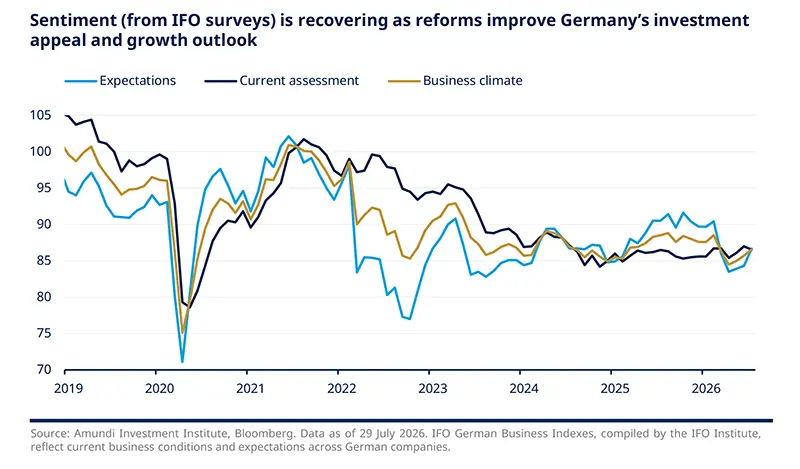
Although the reforms themselves are unlikely to have a significant impact on GDP in the short term, their adoption could rapidly improve the business climate, investment expectations, and how companies and markets perceive Germany’s economic trajectory. Initial surveys show that businesses welcome the announced measures as a signal that Germany will become more attractive for investment and job creation.
From this perspective, additional growth of around 0.2 pp by 2027 is a realistic prospect. This would not be due solely to the structural reforms themselves, but rather to their interaction with fiscal stimulus, greater clarity on economic policy, and the expectation of gradual improvement in profit margins and market opportunities in certain sectors. German think tanks had already estimated that making greater use of the new debt margins could provide a boost of around 0.5 pp of GDP over a one-year period from 2026 onwards. This leaves scope for a more modest additional effect linked to confidence and the credibility of the reforms.
That said, there could be sector-specific effects that materialise more quickly. The first visible effects are expected to appear at the microeconomic and sectoral levels. Sectors such as defence, infrastructure, energy, housing, electrical equipment, semiconductors, batteries and public investment-related services are most likely to see improvements in order books, expected margins or valuations first.
Execution and consistency will be just as important as the initial announcement. If infrastructure is effectively modernised, administrative bottlenecks are reduced, labour supply contraction eases, and capital continues to be reallocated towards innovative sectors by the early 2030s, Germany can improve its growth potential and restore some of its industrial competitiveness. Some economists predict that trend growth could almost double by 2030, rising from 0.4% to 0.7% per year. While this would still be modest in absolute terms, it would represent a significant shift away from recent stagnation.
While no economic miracle is on the horizon, a credible recovery is possible for an economy that still boasts a powerful industrial base and strong technological capacity, with the added bonus of the state now acting as an investor once again.
The reforms in Germany coincide with the ongoing reforms across EuropeThe reforms in Germany coincide with the ongoing reforms across Europe
The Draghi and Letta reports have evolved into a plan but implementation remains uneven. Progress is most advanced in critical raw materials and transport, while industrial coordination and innovation funding are lagging. The Letta report's 'One Europe, One Market' initiative sets deadlines of 2027-28 for the capital, energy, and digital areas. Four legislative streams were launched in the first half of 2026: the 28th regime ('EU Inc.'), the Savings and Investments Union (SIU) package, securitisation reform, and the Industrial Accelerator Act.
These initiatives now underpin a pro-European narrative. European sovereignty is now a capital expenditure programme, not just a political slogan. The SIU and securitisation open up financing channels, the Industrial Accelerator Act reshapes demand-side incentives, and the Security Action for Europe, European Defence Industry Programme and European Investment Bank anchor defence procurement. Meanwhile, the rising cost of carbon energy makes electrification a profitable trade.
The outlook for investors is clear: defence contractors, grid operators, storage providers, and critical materials processors and consolidators in fragmented industrial value chains are set to benefit from a multi-year wave of subsidised, procurement-backed investment.



Authors