
Summary
Credibility under scrutiny
A summer cocktail of earnings data, geopolitical headlines, and “policy events” has prompted investors to increasingly scrutinise equity and bond markets.
On the one hand, equities have held up, even advanced, on the back of a strong earnings season, which has so far supported the credibility of the AI trade. On the other hand, bond yields have risen globally to levels not seen in decades, largely due to uncertainty surrounding major central banks’ policy paths amid fears of sticky inflation, as well as rising concerns regarding funding needs and fiscal discipline.
In the US, 30-year Treasury yields reached their highest level in almost two decades, resulting in the Treasury’s announcement of a double buyback programme. This action, together with the joint US Treasury–BoJ intervention in the yen, has reinvigorated the debasement trade, pushing the US dollar lower against other major currencies and highlighting the role of gold as a store of value.
With growing investor scrutiny of policymakers’ credibility and corporate leverage, we focus on the following main themes:
Ahead of the US midterm elections, the interaction between the Treasury’s efforts with the buyback programme and the Fed's inflation mandate will be a key market theme. The scale of the Treasury’s intervention would need to be substantial to ease pressure on long-end real rates, although the Treasury’s position may help keep rate volatility subdued. The Federal Reserve, meanwhile, is navigating a narrow path: inflation remains above target, but the labour market does not show signs of overheating.
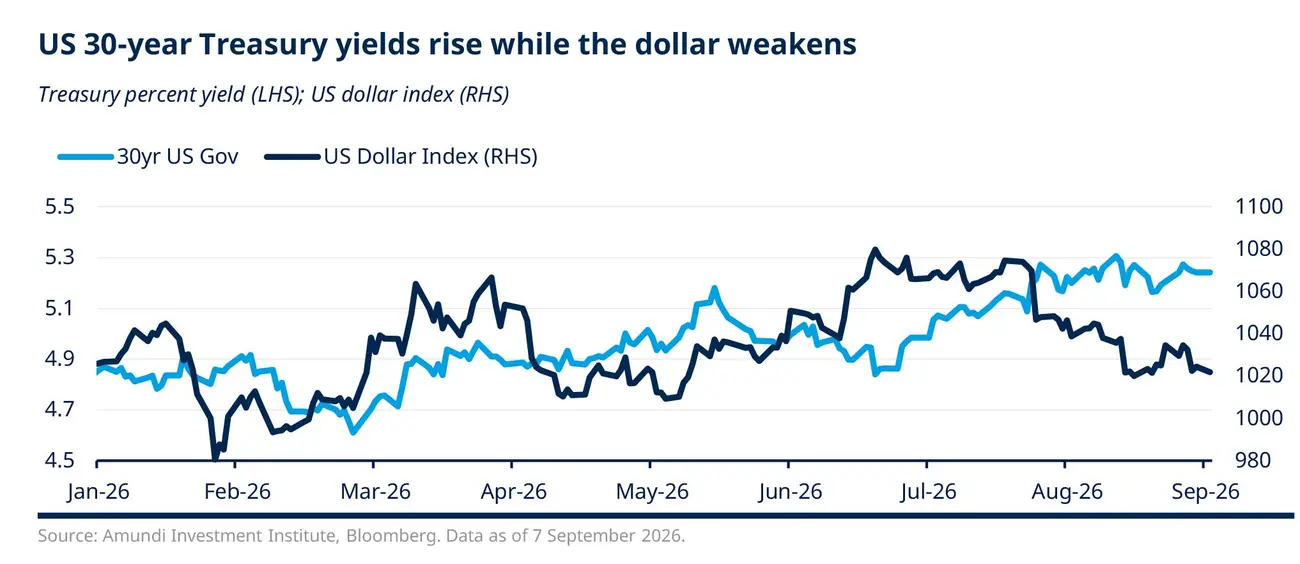
Diversification and selectivity are key in an environment of higher scrutiny of policymakers’ credibility and of the AI ecosystem, including its links to credit markets and off-balance-sheet positions.
The recent currency intervention by the US Treasury and the BoJ has reinforced the case for a regime change at the BoJ, raising expectations for the terminal rate in this hiking cycle. PM Takaichi can no longer pursue an all-in reflationary policy mix: loose fiscal policy, loose monetary policy, a weak yen and capital repatriation. As loose fiscal policy is likely to remain in place, adjustment is expected to come first through the yen and monetary policy. These adjustments must be implemented in a way to avoid tensions in global fixed income markets.
The economy is showing resilience amid mounting risks. Tensions in the Middle East persist, with disruptions in the Strait of Hormuz still unresolved and Red Sea risks increasing. Maintaining alternative routes for oil supplies and bypassing the Strait of Hormuz are crucial for the economy’s resilience and for mitigating inflationary pressures. It is also important to monitor the risks of rising food prices linked to climate change and the trend in gas prices, as reserves remain low in Europe and in Germany in particular.
The AI theme is becoming more selective. Q2 earnings season has highlighted that the infrastructure build-out is accelerating, but increasingly through debt financing and off-balance sheet positions. This is adding to long-end supply pressure and creating a feedback loop between tech valuations and debt markets that did not exist two years ago. Going ahead, the scrutiny of company leverage will be paramount.
Emerging markets remain resilient and could continue to benefit from demand for diversification in bonds and equities, but selectivity remains key.
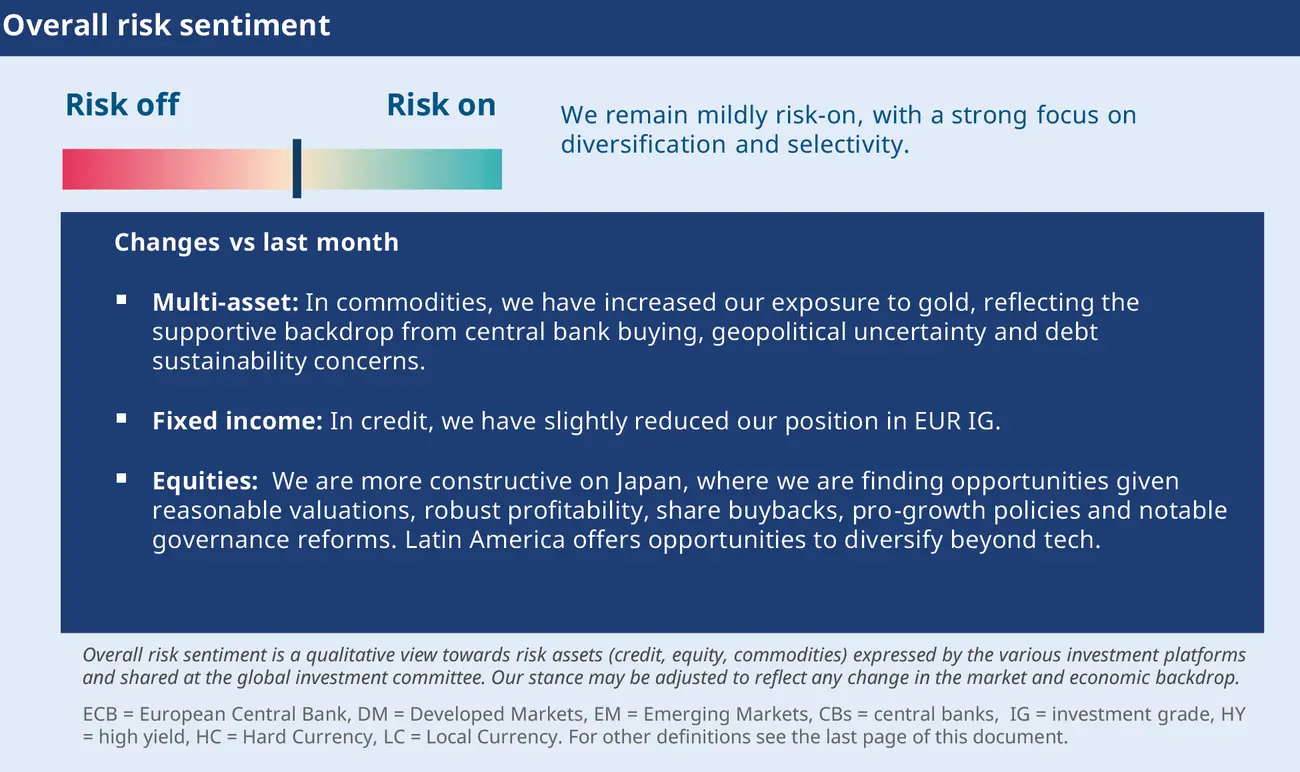
In this environment, we maintain a mildly risk-on stance overall, as the broader economic environment remains moderately constructive as long as credit and liquidity conditions remain benign. However, as risks build beneath the surface, we believe diversification is now more important than ever.
| Amundi Investment Institute: Central bank actions |
Fed: At Jackson Hole, Warsh struck an overall hawkish tone and a commitment to price stability without signalling an imminent hike or providing a policy threshold. The important message is a higher hurdle for cuts, and a higher-for-longer bias, with tightening still possible should inflation reaccelerate. The speech confirmed little appetite for alternative views on what matters most for the Fed and limited space for forward guidance. Short-term interest rates are set to remain the dominant tool, with unconventional tools to play only a limited role. BoJ: Acknowledging upside inflation risks, the BoJ is likely to squeeze in four hikes before mid-2027, raising the policy rate to a neutral 2%. This is a regime change compared to its previous gradual normalisation, accelerated by the increased pressure on a weak yen. |

Monica DEFEND
The faster normalisation of monetary policy in Japan must be implemented smoothly to avoid spiking volatility in global bond yields.
Below we have outlined our views on asset classes in our current base-case scenario:
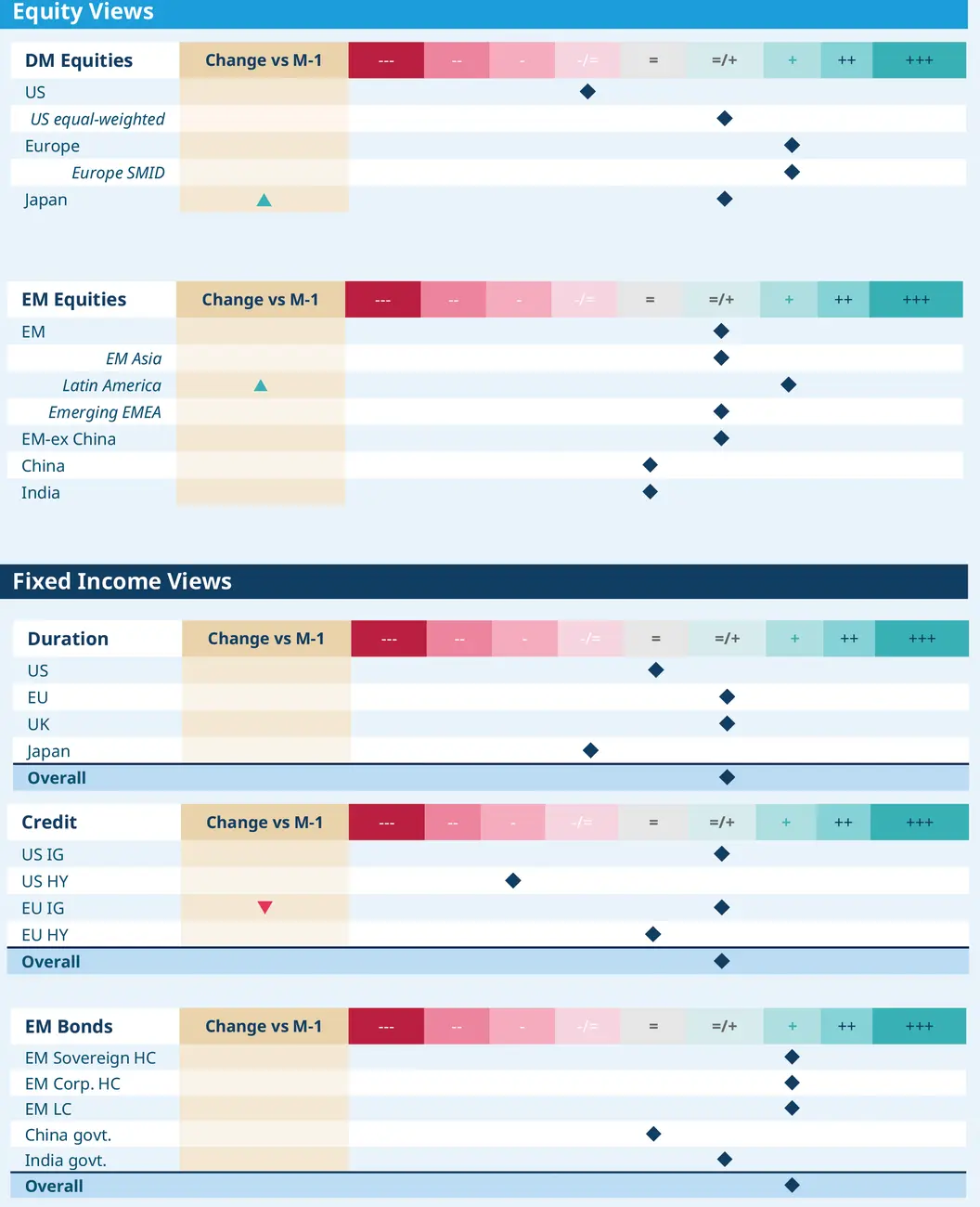
In fixed income, we keep a close to neutral stance on US duration, with a steepening bias. In the EMU, we favour peripherals over core and also confirm steepening. In the UK, we confirm a less positive stance on UK duration, while in Japan we remain cautious, given the normalisation of monetary policy. In credit, we remain constructive on an all-in yield basis, favouring Global IG, while slightly reducing our position in EUR IG.
In equities, we continue to focus on resilient, non-disrupted business models and balance sheet growth. Strategically, we confirm a cautious stance on the US given high valuations and concentration risks. We maintain our long-term positive view on Europe, which looks attractive on earnings and the drive toward strategic autonomy. We are more constructive on Japan, given reasonable valuations, robust profitability, buybacks, pro-growth policies and notable governance reforms. In EM, LatAm offers opportunities to diversify beyond tech.
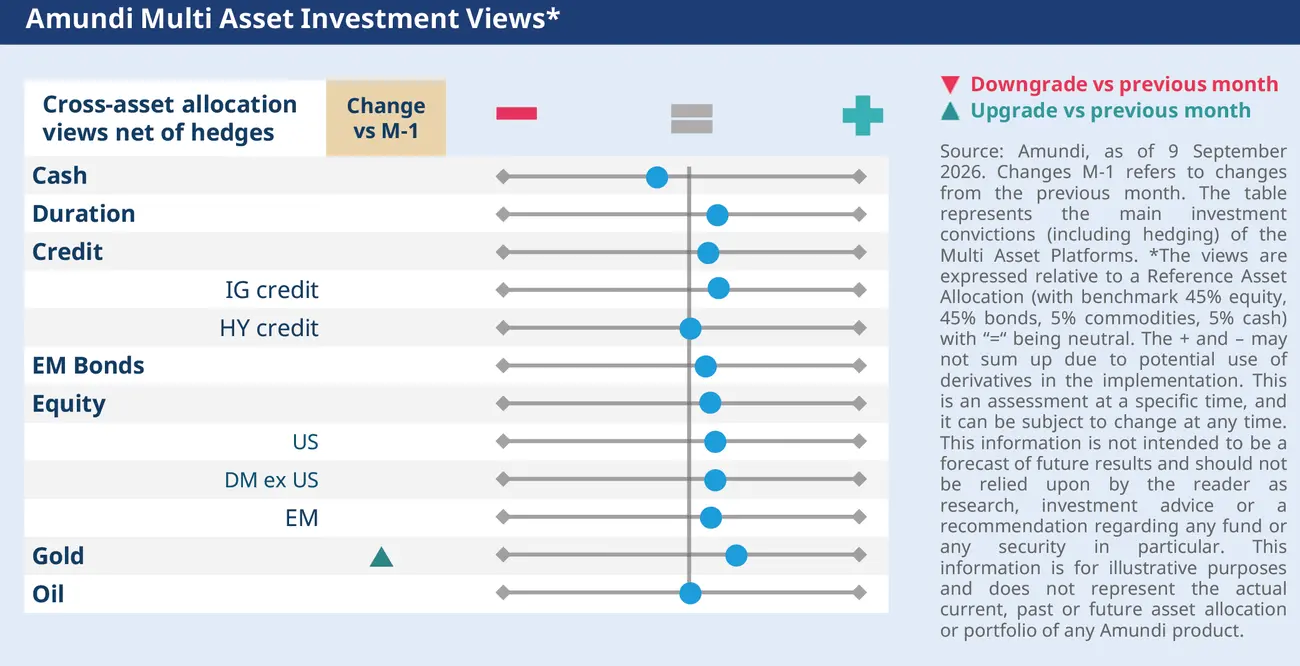
In multi asset, we maintain a pro-risk stance, but our preference is for carry, selectivity and regional diversification rather than strong directional positions. On equities, in the US we maintain a balanced stance through the S&P 500 Equal Weight alongside an even allocation to the S&P 500. We confirm a positive view on Europe. In FX, we continue to favour higher-carry EM currencies. In commodities, we have increased our exposure to gold, reflecting the supportive backdrop from central bank buying, geopolitical uncertainty and debt sustainability concerns.
A prolonged period of higher rates could tighten financial conditions and put pressure on some equity sectors and corporate bond markets. We favour areas where return on assets should remain strong enough to absorb higher funding costs.
FIXED INCOME
Bond yields on the rise
Amaury D’ORSAY |
Global growth remains resilient but uneven, with policy divergence and geopolitical tensions creating an increasingly fragmented macro environment. Oil price volatility over the summer, driven largely by geopolitical developments, has renewed uncertainty around the inflation trajectory and, by extension, the path of monetary policy. These factors, together with funding needs and a lack of fiscal discipline, have created tensions in longer dated bond markets globally.
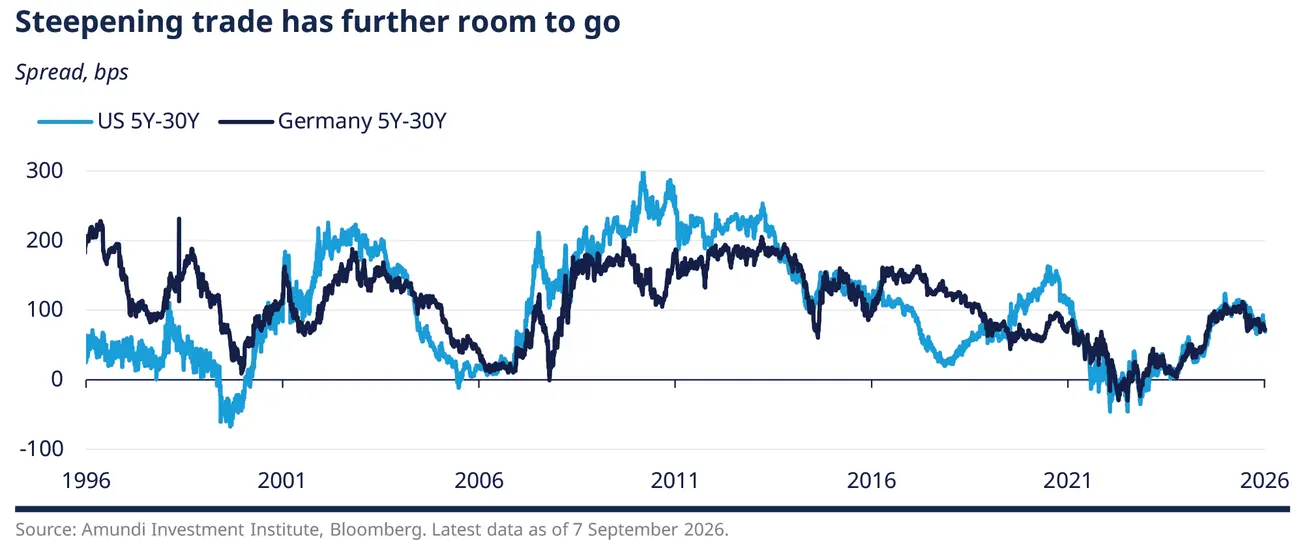
Even so, this does not materially change our view. We confirm our more dovish outlook for the Fed, expecting it to remain on hold through year-end, and for the ECB, where we continue to expect only one further hike. As pressure at the long end is likely to remain, this supports our conviction in curve steepening across the curves, except for Japan.
In the US, we keep a close to neutral stance on duration, with a preference for the 5-year segment and steepening, as we believe that pressure on longer-maturity bond yields could persist.
In the EU, we continue to favour peripherals over core and confirm the steepener view.
In the UK, we confirm a cautious stance, maintaining the steepener.
We remain cautious on Japanese bonds, confirming the flattening.
We remain mildly constructive on this asset class, in particular high-quality credit. As sector dispersion continues to increase, sector/issuer selection will be important.
We are positive on Global IG, although we have slightly reduced the preference for EUR IG.
We continue to favour subordinated over HY, with a preference for short-dated bonds.
At sector level, we prefer financials and, among non-financials, telecom, tech and pharmaceuticals.
We are constructive on EM debt, supported by a weaker US dollar, attractive real yields and improving fundamentals.
We have a positive stance on Corporate Hard Currency and Sovereign Hard Currency, where we favour Latin America and Sub-Saharan Africa. We favour a country-wise selective approach in Local Currency bonds (Brazil, Hungary and South Africa).
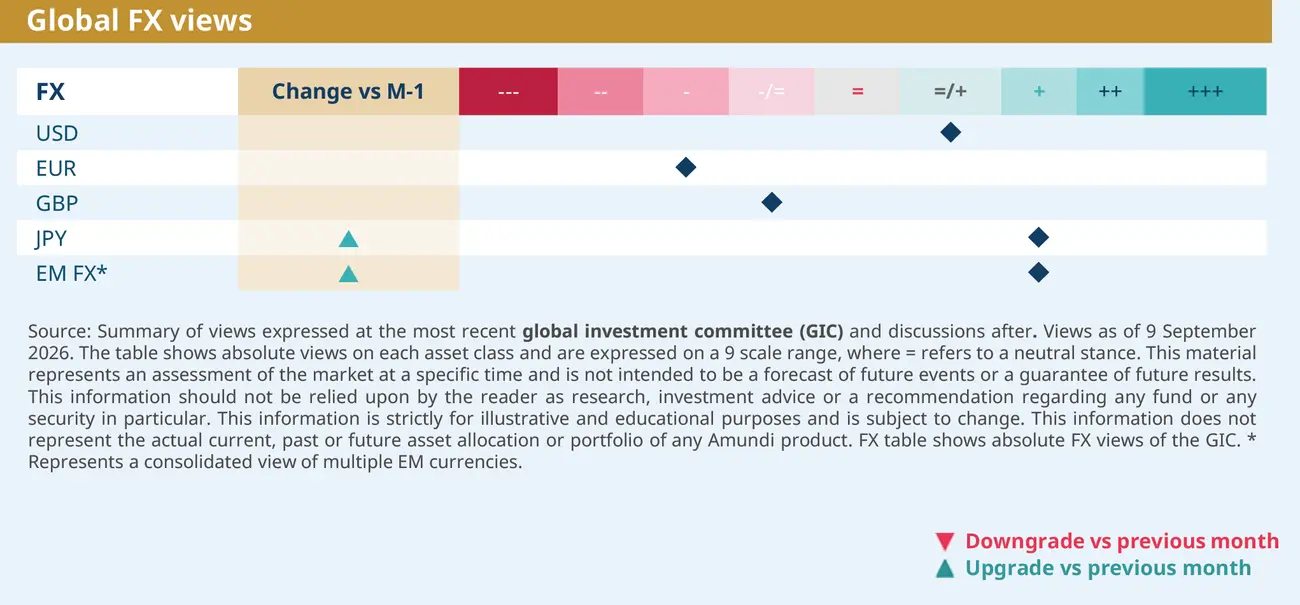
We are cautious on EM currencies, favouring LatAm and Central-Eastern Europe over Asian currencies.
EQUITIES
Positioning for growth amid dispersion
Barry GLAVIN |
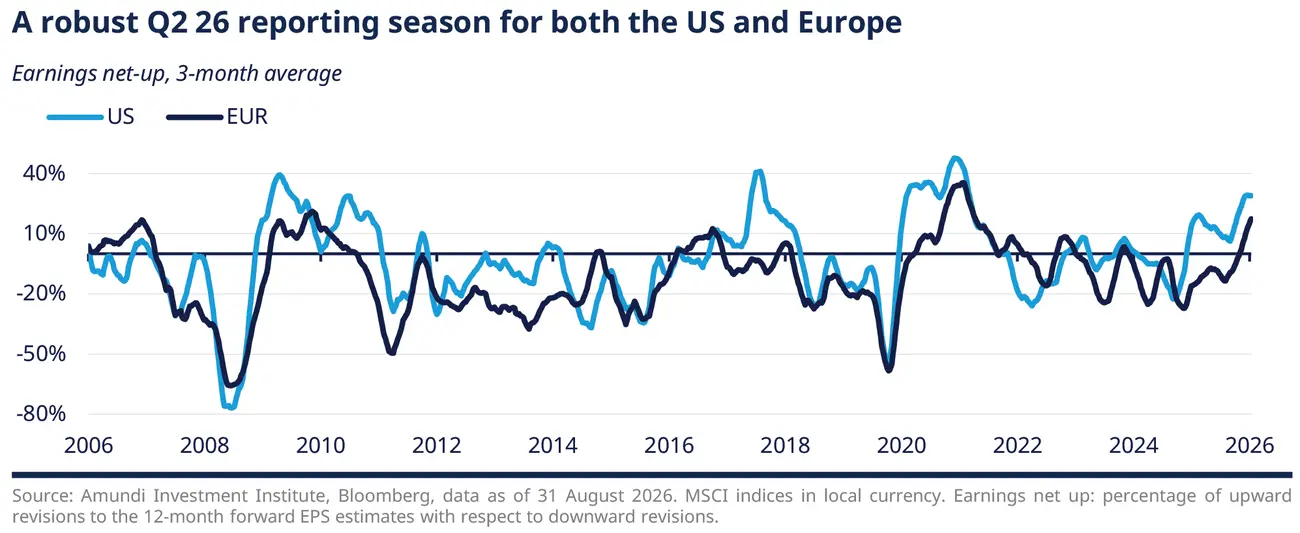
Equity markets edged higher, led by Europe and emerging markets. Earnings growth remains solid on both sides of the Atlantic. The earnings season highlighted wide single-stock dispersion, with investors rewarding growth and punishing misses. It has also delivered strong upgrades. As a result, earnings revisions have risen to levels usually seen during recovery phases. Also in EM, earnings remain robust.
We continue to diversify away from the U.S. to reduce concentration and valuation risks. Europe looks attractive on earnings growth and the drive toward strategic autonomy. In Japan, we are finding opportunities given robust profitability, share buybacks, pro-growth policies and notable governance reforms. We remain constructive on EM, while noting the importance of AI capex momentum for equity indices.
We focus on AI-resistant stocks in the consumer staples, healthcare, industrials and materials sectors.
In Europe, we retain a positive stance on technology stocks, with any valuation weakness potentially offering opportunities. Given concerns around profitability, valuations and supply chains, we remain selectively exposed to AI enablers, while avoiding stocks with capital misallocation risk. Capital goods stocks should benefit from data-centre demand and construction businesses from infrastructure spending. In global financials, we believe stock picking is now vital.
In Japan, we like small- and mid-cap stocks exposed to onshoring, supply-chain resilience, defence, AI and infrastructure. In particular, we focus on industrials with a domestic bias.
Earnings are robust, driven by digitalisation. Taiwanese and Korean suppliers benefit from the AI-boom, but profits are unlikely to last. U.S. technology spending underpins demand, despite concerns over returns, leverage and Chinese competition.
We keep a neutral stance on China. While government investment may accelerate, much is likely to go into infrastructure, with computing capacity a key focus. Domestic consumption support should stay gradual. The earnings outlook is uncertain amid overcapacity while the anti-involution drive will take time to help.
In Brazil, the downside seems limited if Lula wins the October election, but the upside is notable if he loses. Brazil also faces fiscal, monetary policy and El Niño-related inflation worries.
MULTI-ASSET
Mildly pro-risk, with selectivity
Francesco SANDRINI CIO Italy & Global Head of Multi-Asset | John O’TOOLE Global Head - CIO Solutions |
The broader economic environment remains moderately constructive, as growth has so far proven resilient, particularly in Europe, and inflation has given some signs of easing. As markets continue to be sensitive to any signs of renewed geopolitical or inflationary pressure, we confirm a pro-risk positioning, but with a clear preference for carry, selectivity and regional diversification.
On equities, we confirm a diversified approach as we continue to prefer areas with more supportive valuations and less risk concentration. In the US, we maintain a balanced stance through the S&P 500 Equal Weight alongside an even allocation to the S&P 500. In Europe, we confirm a positive stance. Valuations remain attractive, positioning is still light and the policy backdrop is supportive. We continue to see scope for a cyclical recovery, with banks and other cyclical sectors looking well placed. In emerging markets, Latin America also remains attractive with interesting valuations relative to other emerging markets.
In fixed income, we retain a constructive duration bias in the US and Europe. However, pressure at the long end has led us to adopt a more defensive view on the US curve, with a new steepening bias. We remain cautious on Japan. In credit, we maintain a constructive stance on Euro IG credit, given the still-attractive relative valuations and the potential for spreads to remain stable or compress further, whilst monitoring liquidity conditions closely. We also confirm a positive view on EM spreads, which continue to offer attractive carry and benefit from supportive market sentiment.
In commodities, we have increased our positive stance on gold: Central bank buying is still strong, while geopolitical uncertainty, debt sustainability concerns and a softer dollar continue to underpin structural demand.
In FX, we favour higher-carry EM currencies, with BRL and TRY still offering attractive carry.
VIEWS
Amundi views by asset classes
Definitions & Abbreviations
Currency abbreviations: USD – US dollar, BRL – Brazilian real, JPY – Japanese yen, GBP – British pound sterling, EUR – Euro, CAD – Canadian dollar, SEK – Swedish krona, NOK – Norwegian krone, CHF – Swiss Franc, NZD – New Zealand dollar, AUD – Australian dollar, CNY – Chinese Renminbi, CLP – Chilean Peso, MXN – Mexican Peso, IDR – Indonesian Rupiah, RUB – Russian Ruble, ZAR – South African Rand, TRY – Turkish lira, KRW – South Korean Won, THB – Thai Baht, HUF – Hungarian Forint.


Authors