
Summary
The Fed’s September hike was primarily an insurance and credibility measure. Significant geopolitical uncertainty and scrutiny from bond markets could influence its actions going forward.
The Fed raised rates for the first time since 2023, bringing them into the 3.75% - 4% range. The decision was unanimous.
In the statement, the economy was described as solid, with domestic demand resilient despite elevated uncertainty related to geopolitics, while inflation remains elevated.
US bonds saw a divergence, with shorter-dated yields rising while longer-dated yields fell, supported by a retreat in oil.
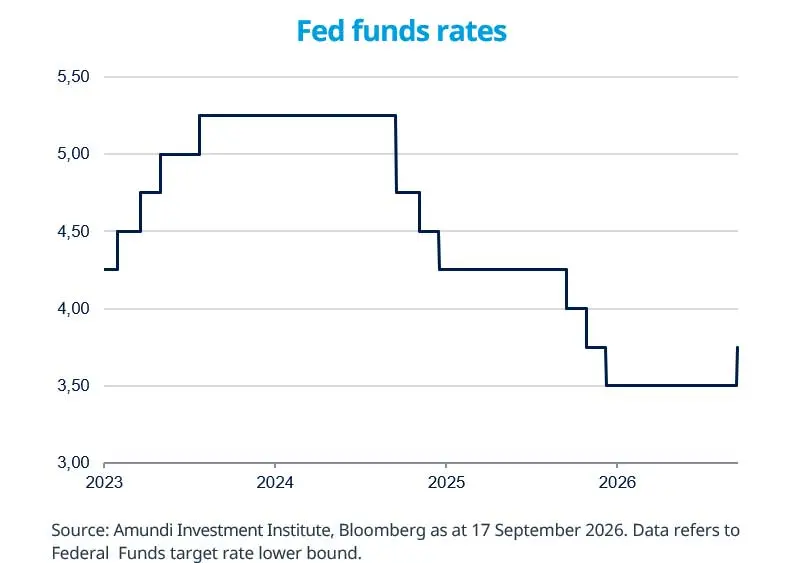
The FOMC raised rates by 0.25%, describing the move as supportive of a timelier return of inflation to target. The Fed’s rate projections were revised higher, signalling one further hike by the end of 2026, followed by a hold in 2027. In a brief press conference, Warsh reiterated that price stability remains the Fed’s priority. He also noted that, given the macro backdrop, it is difficult for the Fed to see financial conditions as restrictive, adding that some accommodation has been removed. Markets reacted by lifting rate expectations and pricing in four additional hikes over the next year. The gap between the Fed’s and the market’s expectations reflects concern that inflationary pressure may persist, given continued tensions in energy prices and robust domestic demand. In our view, inflation is unlikely to ease enough in the near term, which supports the case for the Fed to hike again in the coming months, although the pace and scale of tightening will depend on inflation trends.
This week at a glance
Global equity markets started the week weaker, weighed down by calls from major technology companies for slower model development, before easing after the Fed’s meeting and lower oil prices. In the government bond markets, with shorter-dated yields rose more, in response to the central. The dollar strengthened broadly, putting pressure on the euro and the yen. Oil prices declined, extending recent weakness.
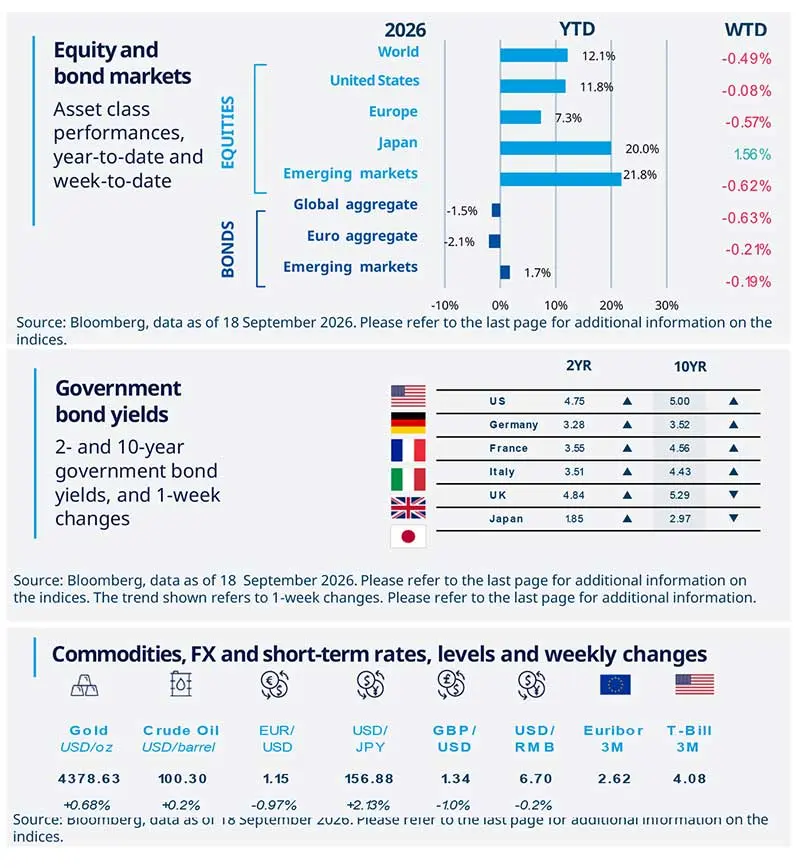
Equity and bond markets (chart)
Source: Bloomberg. Markets are represented by the following indices: World Equities = MSCI AC World Index (USD) United States = S&P 500 (USD), Europe = Europe Stoxx 600 (EUR), Japan = TOPIX (YEN), Emerging Markets = MSCI Emerging (USD), Global Aggregate = Bloomberg Global Aggregate USD Euro Aggregate = Bloomberg Euro Aggregate (EUR), Emerging = JPM EMBI Global Diversified (USD).
All indices are calculated on spot prices and are gross of fees and taxation.
Government bond yields (table), Commodities, FX and short-term rates.
Source: Bloomberg, data as of 18 September 2026. The chart shows the price of gold.
Diversification does not guarantee a profit or protect against a loss.
Amundi Investment Institute Macro Focus
Americas
The US Consumer Keeps Spending
US retail spending rebounded sharply in August, well above expectations. The rise was broad-based, from electronics to restaurants, and showed consumers remain resilient despite higher borrowing costs and elevated fuel prices. Meanwhile, weekly jobless claims fell to one of their lowest levels since the late 1960s, confirming that the labour market remains firm. The data point to a still-solid economy.
Europe
Bank of England holds rates but warns inflation could stay stubborn
The Bank of England kept rates unchanged at 3.75%, as expected, but three policymakers wanted an immediate increase. They warned that high energy prices could start feeding into wages and everyday costs if they stay elevated for long enough. The bank also scrapped plans to sell its longest-dated government bonds, which helped ease pressure on the UK bond market.
Asia
Japan raises rates again in a split vote
The BoJ raised its policy rate by 25bp to 1.25%, as expected, although two dissenting members signaled caution over further tightening. The decision reinforces our view that Japan’s monetary regime shifted in late July, from gradual to a more proactive cycle aimed at preventing entrenched inflation. We expect quarterly hikes to lift the policy rate to 2% by mid-2027. An October hike remains unlikely; our base case is December, as Governor Ueda continues to signal that inflation will take time to settle sustainably at 2%.
Key dates
Eurozone consumer confidence, US ADP Weekly Employment, SK consumer confidence |
India PMI, Eurozone PMI, United Kingdom PMI, US PMI |
US durable goods orders, University of Michigan consumer confidence |


Authors