
Summary
Shifts to quality and scarcity
Recent weeks have seen a reassessment of risks across energy markets, fiscal space, artificial intelligence-related (AI) stocks and emerging markets. Investors are increasingly favouring businesses with strong balance sheets, pricing power and exposure to structural supply constraints. In energy markets, the geopolitical premium appears more apparent, reflecting tighter and more expensive supply routes, rather than a temporary disruption. Although energy prices have retraced, this premium is likely to stay for some time.
In equities, we are witnessing a rotation out of AI-related stocks. Markets are scrutinising the earnings potential and cash flows from the massive capital expenditure on AI. In addition, the Democratic sweep in the mid-term elections has raised concerns about closer examination of AI, Big Tech and data-centre development.
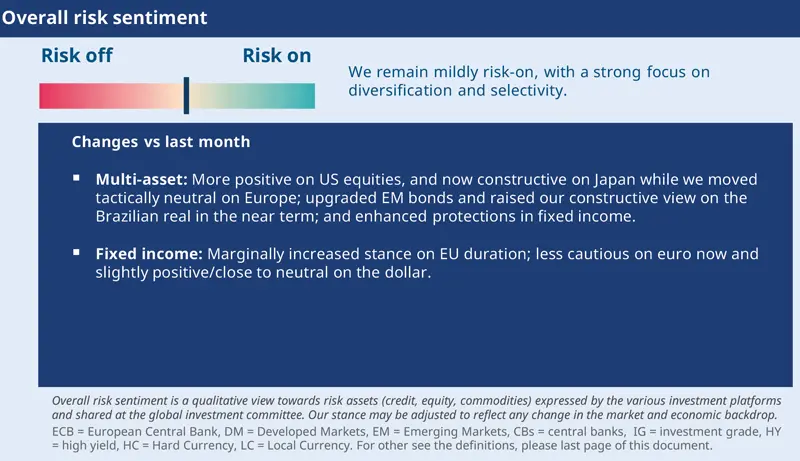
Government bond yields initially rose to levels not seen in years, but Treasuries eventually regained their safe-haven appeal. Core European bonds also benefited from a flight to quality.
This could, however, change, particularly amid a growing market focus on energy prices, monetary and fiscal policy, and the evolution of the AI narrative. We discuss these points below:
The second round of energy shock and inflation risk. Oil markets have shifted materially, with rerouting implying that effective supply is currently around 80% of pre-Iran-war levels. We expect prices to remain elevated through year-end before gradually easing over H1 2027, as transport conditions normalise. Gas markets face tighter constraints, as rerouting options are more limited. The inflation pass-through is becoming increasingly evident, and this second wave of energy price increases could prove more persistent. The key risk to monitor is second-round effects via wages and services inflation.
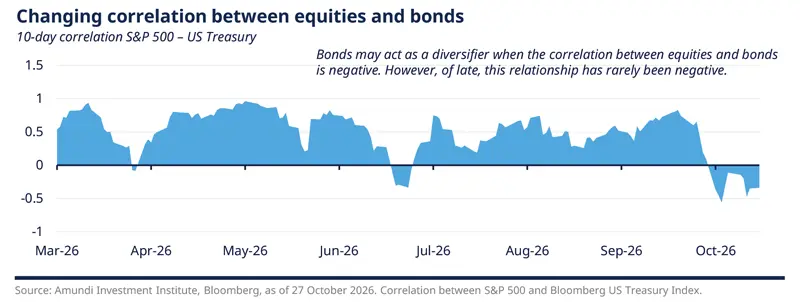
While AI remains a compelling long-term productivity theme, markets are now seeking clearer evidence of cash generation and are differentiating more carefully between likely winners and losers.
Higher-for-longer rates. This remains the dominant narrative across yield curves. The short end continues to reflect central bank policy tightening, or signals of further action. As inflation is expected to remain above target across most developed countries, the Fed will likely hike once in December and possibly again in early 2027, before staying on hold for the rest of 2027. We also expect the ECB to raise rates once in December and again in early 2027. The long end of the curve in most developed countries is likely to remain under pressure from fiscal deficit concerns. Additionally, competition for capital may weigh on long-dated bonds, primarily via real rates, as investment and issuance may continue to outpace savings.
Fiscal policy in Euro Area. Europe’s fiscal framework is facing its toughest test since the post-pandemic overhaul of the Stability and Growth Pact. Policymakers face an increasingly difficult trade-off between public backlash and the need for fiscal consolidation, creating an incentive to delay the latter. The broader risk is credibility erosion, with widening European sovereign spreads suggesting that investors are scrutinising debt trajectories more closely. Looking ahead, the key question is whether the institutional framework can hold under the combined pressure of monetary tightening and fiscal strain.
AI trade dispersion amid higher rates and power bottlenecks. AI-related investments are becoming increasingly differentiated. Investors are becoming more cautious about higher interest rates, power constraints and the lack of near-term returns from large capital outlays. Weak IPO performance, project delays and rising credit default swap costs for AI-linked companies all point to cooling sentiment.
Emerging market fragmentation. We believe the developing world is becoming increasingly fragmented, with a split between commodity exporters and importers. Some idiosyncratic risks are also emerging and we continue to monitor events in Brazil and Indonesia.
| Amundi Investment Institute: Building portfolios that adapt to a changing world |
Portfolio construction guidelines: In a supply-driven environment, where supply constraints matter more than demand, investors should focus on scarce assets. Many commodities markets are likely to remain structurally undersupplied. In equities, this includes scarce resources such as rare earths, as well as sectors linked to supply constraints, such as AI infrastructure, defence, aerospace and energy. In bonds, preference should be given to countries with low debt-to-GDP ratios, given the risk of oversupply in more indebted economies. |

Monica DEFEND
In a multipolar world, where supply chains are being rewired for security rather than efficiency, careful selection and diversification are increasingly important.
Below we have outlined our views on asset classes:
In fixed income, we have marginally raised our constructive stance on Eurozone duration, favouring peripherals over core and retaining a steepening bias. We are also positive on the UK. However, in the US and Japan, we remain close to neutral. EM bonds remain attractive, and we are increasingly selective, favouring countries with strong external finances. In credit, we prefer global and EU IG as well as higher-quality yield opportunities.
In equities, we maintain a balanced approach, combining defensive sectors with quality cyclical stocks and a focus on balance sheet strength. We remain positive on Europe and Japan over the long term, and constructive on EM, where earnings remain supportive, despite widening divergence.
From a multi-asset perspective, we see rotation opportunities emerging in favour of the US and Japan. At the lower-risk end of the spectrum, we are positive on US and European duration, as well as euro investment-grade credit. Secondly, in EM, we have become more constructive on both local-currency and hard-currency EM debt. In FX, we raised our tactical view on the BRL. Overall, our stance is well diversified through gold while we also see a need for bond hedges.
Overall, we maintain a mildly risk-on stance, with an emphasis on diversification and selectivity amid volatility, while paying close attention to portfolio construction.
Rising geopolitical competition is likely to tighten supply chains, create scarcity and, over time, generate opportunities across economies, reinforcing the case for a global, diversified investment approach.
FIXED INCOME
Constructive and flexible amid high rates
Amaury D’ORSAY |
Resilient economic data on both sides of the Atlantic keep the macro backdrop constructive, but sticky inflation and elevated energy prices make the path of oil and gas the key variable for rates. In the US, the Fed remained on hold in October but still has accommodation to withdraw. The central bank’s patience should not be mistaken for complacency. The ECB also held rates steady amid higher energy prices, and tighter financial conditions, leaving the door open to further action.
Looking ahead, we remain constructive on duration, albeit selectively, and continue to prefer short- to medium-maturity bonds over the long end.
In the US, we remain close to neutral on duration, with a preference for intermediate maturities. Long-end yields look attractive, but we would only reduce our cautious stance gradually, given persistent fiscal risks.
In the Eurozone, we are marginally more positive on duration, while retaining a preference for curve steepening and peripheral debt. We remain positive on UK duration, supported by Budget reassurance and QE adjustments.
In Japan, we are neutral, with a flattening bias.
Although credit spreads have widened recently, they remain range-bound at low levels, with demand for high-quality fixed income continuing to offset heavy supply.
Dispersion is increasing across sectors, making selectivity more important. We remain positive on global and EU investment-grade credit. Within the latter, we favour subordinated bonds, short-dated maturities and corporate hybrid debt.
At sector level, we prefer financials, telecoms, technology and pharmaceuticals.
Tactically, we have marginally upgraded our view on the USD due to Fed policy and higher US real yields. Long term concerns over debt and deficit remain. On the euro, we are less cautious than before owing to improved economic activity.
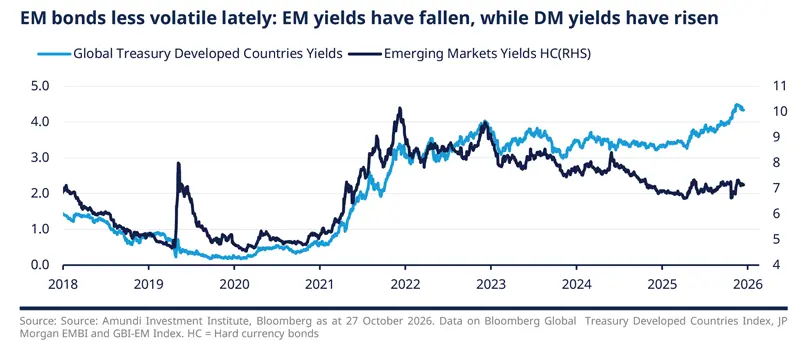
In EM, we stay positive on corporate and sovereign HC debt, with a regional preference for LatAm and commodity exporters. Brazil stands out in HY credit. In LC bonds, we see selective opportunities in Hungary and South Africa, while EM FX is attractive in LatAm and Central and Eastern Europe.
EQUITIES
A balanced approach in volatile times
Barry GLAVIN |
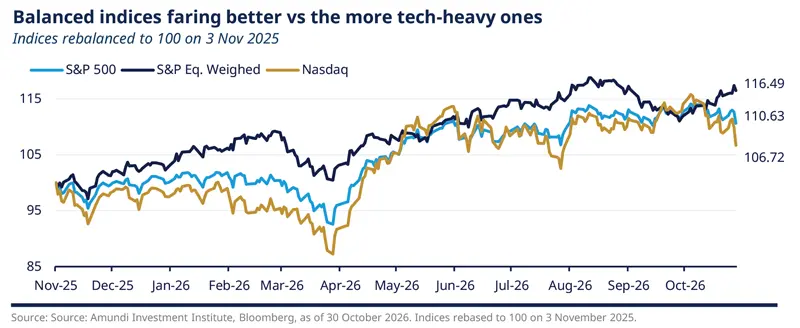
Global economic momentum has remained resilient, but fragilities persist. Concerns over heavy AI spending, sticky inflation and persistent geopolitical risks are some factors likely to shape trends in corporate earnings. This has led to higher volatility in rates and is affecting equities. In this environment, we aim to generate higher long-term returns through fundamental, bottom-up analysis.
We are avoiding expensive tech mega-caps, preferring to remain balanced. We favour markets such as Europe and Japan, which offer better risk-adjusted returns. While we favour EM over DM, returns are becoming increasingly selective, supporting the case for idiosyncratic opportunities.
Globally, we maintain a balanced approach, combining defensive sectors with industrials and materials. Europe is attractive in terms of valuations, and we are focusing domestically. But we remain alert to the risk of an energy shock
In Europe, the AI theme is broadening. Industrials and utilities are benefiting from capex in power infrastructure and rising AI-driven electricity demand. The tight supply of critical minerals needed for grids and networks is supporting higher mineral prices and benefiting the metals and mining sector. We are also exploring structural winners, such as selected French industrials, where current share prices do not reflect the true earnings potential.
In Japan, we like industrials exposed to supply-chain resilience, infrastructure and AI. Regional banks are attractive, as consolidation could act as a catalyst.
While we favour EM over DM, we recognise that US AI capex is becoming increasingly important for companies in some countries, leading us to be selective.
Over the long term, the digitalisation of global economies should benefit North Asia and South Korea also stands to benefit from expectations of strong dividend growth under the “Corporate Value-Up” initiative.
In China, where we are neutral, earnings remain uncertain due to overcapacity in many industries. If exports weaken, the government may adopt a more proactive fiscal policy. In Latin America, we are positive on Brazil, although President Lula’s victory was a surprise. We are now closely monitoring any early signs of pragmatism from the political leadership.
MULTI-ASSET
Rotation supported by earnings strength
Francesco SANDRINI CIO Italy & Global Head of Multi-Asset | John O’TOOLE Global Head - CIO Solutions |
The economic backdrop remains resilient, with growth holding up despite higher rates, sticky inflation and geopolitical uncertainty. Markets have repriced aggressively, particularly in rates, while credit spreads have widened. Although liquidity conditions have modestly deteriorated, they remain benign. We maintain a moderately pro-risk stance by remaining selective and seizing tactical opportunities created by excessive market moves. We have balanced this by adding protection in asset classes such as European bonds, which may be more susceptible to near-term newsflow.
In equities, while our overall views have not changed, we see opportunities to rotate away from Europe (downgraded to neutral) toward the US (upgraded) and Japan (upgraded). We believe the US could continue to perform if earnings and capex remain supportive, while Japan offers a more diversified sector mix than Europe, with less direct exposure to financials. We see a strong long-term case for Europe. while in EM, our stance is positive on LatAm.
We retain a constructive duration view in the US and Europe (Schatz and Bunds). We also like Italian BTPs, given the country’s fiscal deficit trajectory and strong domestic demand. EU IG credit is another area where underlying fundamentals remain strong. Elsewhere, EM bonds offer attractive carry and, we have upgraded our view. We are now constructive on a select group of local bonds following recent market moves and have turned more optimistic on EM spreads.
In FX, we are slightly cautious on the USD, but constructive on select EM FX, which offer attractive carry. In particular, we have turned more positive on BRL in the near term after the recent repricing. Finally, we now see potential for hedges in euro bonds and remain positive on gold.
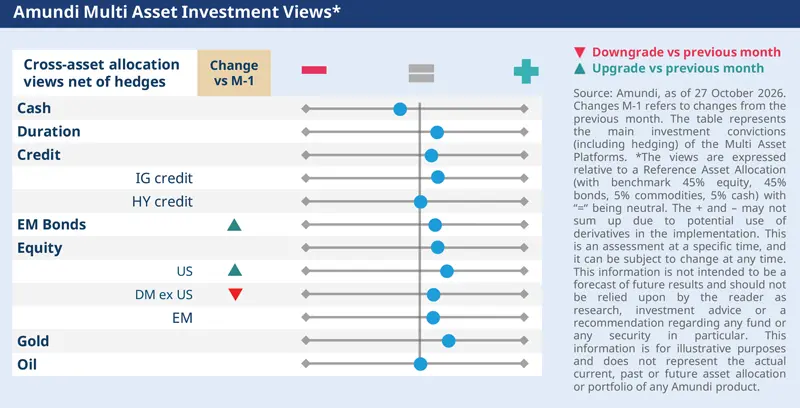
VIEWS
Amundi views by asset classes
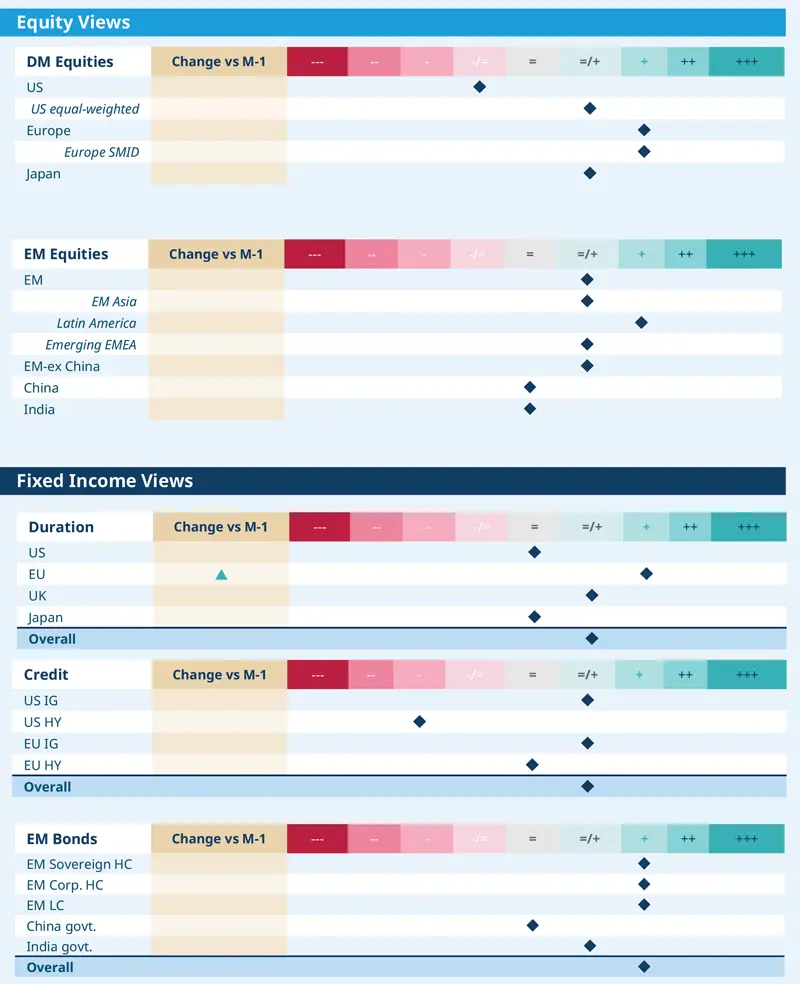
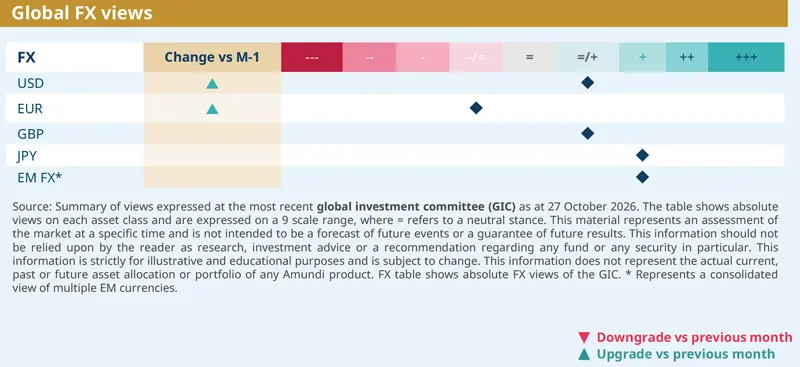
Definitions & Abbreviations
Currency abbreviations: USD – US dollar, BRL – Brazilian real, JPY – Japanese yen, GBP – British pound sterling, EUR – Euro, CAD – Canadian dollar, SEK – Swedish krona, NOK – Norwegian krone, CHF – Swiss Franc, NZD – New Zealand dollar, AUD – Australian dollar, CNY – Chinese Renminbi, CLP – Chilean Peso, MXN – Mexican Peso, IDR – Indonesian Rupiah, RUB – Russian Ruble, ZAR – South African Rand, TRY – Turkish lira, KRW – South Korean Won, THB – Thai Baht, HUF – Hungarian Forint.


Authors