
Summary
We think AI’s productivity benefits will accrue to the economy over the long term. Businesses that can demonstrate the profitability impact of their large capex and provide clarity on returns are likely to be better received by the markets.
The AI market has seen volatility over the past few months, suggesting some rotation that has favoured regions outside the US.
The key question is not whether AI matters, but which businesses will capture the economic gains. The market is shifting from enthusiasm for the theme to discipline around business models.
That usually means higher volatility in the near term, but a healthier and more durable investment landscape over time.
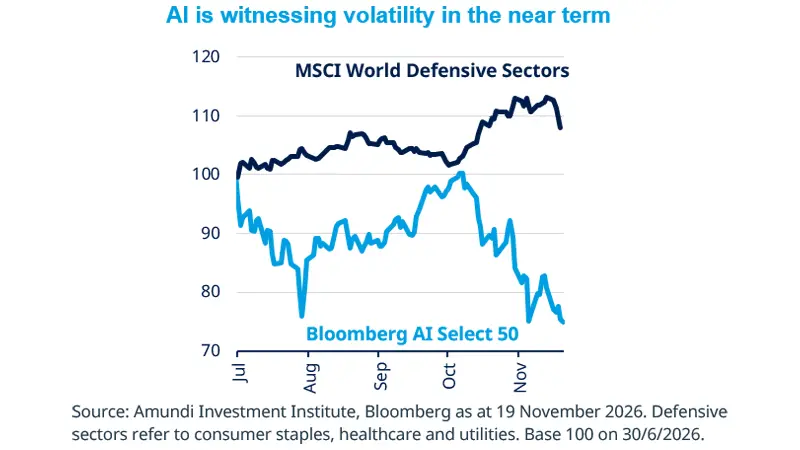
Earnings from a leading US semiconductor company and the IPO of another AI model developer have become an important test for the broader AI theme. The market is no longer treating AI as a simple growth story; it is now asking whether the heavy investment in chips, data centres and model training can generate attractive returns.
That shift helps explain the recent rotation away from some US AI favourites. In this context, the IPO matters because it gives markets a fresh valuation benchmark for a leading developer and shows whether private-market expectations can stand up to public-market scrutiny. This should not be taken as a rejection of AI itself. Over the longer term, AI remains a powerful productivity theme with the potential to improve efficiency across industries. But given the recent volatility, investors should consider maintaining a diversified equity stance across sectors.
This week at a glance
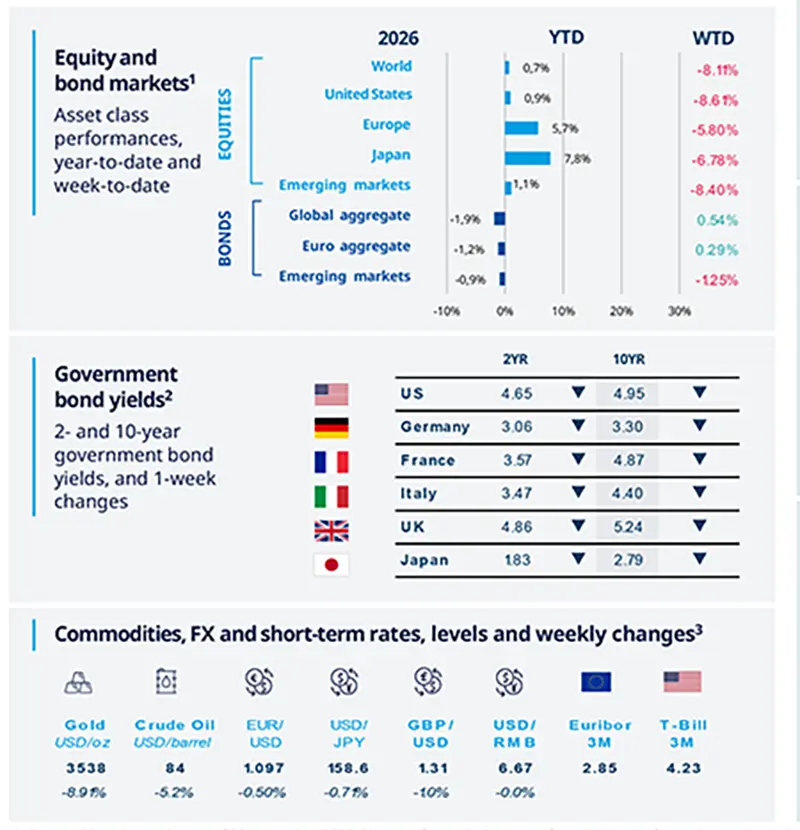
Equity markets fell sharply across all regions as an initial public offering of a leading AI developer failed to lift sentiment around technology stocks. Government bond yields declined amid a 'flight to safety’ move. In commodities, oil prices also fell sharply and gold continued its descent . FX moves were contained: the dollar firmed slightly against the euro and sterling, but weakened versus the yen.
1. Source: Bloomberg, data as of 20 November 2026. Please refer to the last page for additional information on the indices.
2. Source: Bloomberg, data as of 20 November 2026. The trend shown refers to 1-week changes. Please refer to the last page for additional information.
3. Source: Bloomberg, data as of 20 November 2026. Please refer to the last page for additional information on the indices.
Equity and bond markets (chart)
Source: Bloomberg. Markets are represented by the following indices: World Equities = MSCI AC World Index (USD), United States = S&P 500 (USD), Europe = Europe Stoxx 600 (EUR), Japan = TOPIX (YEN), Emerging Markets = MSCI Emerging (USD), Global Aggregate = Bloomberg Global Aggregate USD Euro Aggregate = Bloomberg Euro Aggregate (EUR), Emerging = JPM EMBI Global Diversified (USD).
All indices are calculated on spot prices and are gross of fees and taxation.
Government bond yields (table), Commodities, FX and short-term rates.
Source: Bloomberg, data as of of 20 November 2026. The chart shows the price of gold.
Diversification does not guarantee a profit or protect against a loss.
Amundi Investment Institute Macro Focus
Americas
US Consumers Keep Spending as Fed Stays Cautious
Retail sales rose in October, beating expectations, with the underlying measure excluding cars and fuel also showing a solid gain. Perhaps such strength in data is what's keeping Fed officials attentive to inflation risks, as indicated in the latest FOMC minutes. Resilient household demand and a cautious central bank describe an economy still supported by consumers, with inflation the main variable for policymakers.
Europe
Euro Area Inflation Up, Industry Stays Weak
Consumer prices rose 4% year on year in October, in line with expectations. Core inflation, which excludes food and energy, stood at 2.6%, slightly above forecasts, suggesting price pressures remain sticky. Meanwhile, euro area industrial output fell sharply on an annual basis in September, while German producer prices rose at their fastest pace in several years. Firm inflation and soft industry make for a challenging mix for the region's economy.
Asia
Japan's Economy Dips as Living Costs Weigh
Gross domestic product contracted by 0.1% in the third quarter compared with the previous quarter, the first decline in a year, as higher living costs weighed on household spending. On an annual basis, the economy still grew by 1.1%, well above expectations. This suggests the underlying trend remains positive, even though the near term picture has softened as consumers adjust to rising prices.
Key dates
Japan PMI Manufacturing, US Conference Board Consumer Confidence |
US GDP Growth, Personal Income & Spending, Initial Jobless Claims |
Japan Tokyo CPI ex-Fresh Food |

Authors