
Summary
AI has absorbed a disproportionate share of global capital, earnings growth, and investor attention. The returns debate is not new, but it should sharpen in 2027: as free cash flow thins and leverage rises, every additional dollar of investment will face greater scrutiny. The narrative is shifting from who can invest the most to who can capture the highest returns. EPS leadership and market leadership may increasingly diverge as valuations and expectations become more demanding. EPS concentration will not necessarily translate into equity performance: how companies will deliver relative to expectations is more crucial than ever.
Global earnings will depend more on AI
Although earnings breadth is improving, with more MSCI ACWI constituents expected to deliver higher net income in 2027 than in 2026, the IT sector will account for 70% of growth in net income across the entire index, up from around 40% in 2026, led by semiconductors and hardware. Energy and communication services are expected to detract from growth, and consumer discretionary is likely to make only a modest contribution. Several major US hyperscalers sit within communication services and consumer discretionary.
The cycle is past its early innings, but not over
The cycle is real, and supply constraints remain genuine, but warning signs are accumulating: leverage is rising along with huge off-balance sheet commitments, the hyperscalers’ core business results are coming under scrutinity as investors’ patience for return on investment wears thin, quality and cyclical names are starting to diverge, and the remaining funding pipeline will increasingly test capital markets’ capacity to absorb new issuance and be a real test for frontier-model economics.
The risk is not an abrupt end to the cycle, but a widening gap between capital deployed and returns generated. AI adoption may accelerate even as returns on AI infrastructure remain contested, particularly as the cost of external financing rises. Volatility is likely to stay, but three considerations make us believe the cycle is maturing and has further to run:
Public equity issuance is increasing, but it has not reached the excesses of past issuance-heavy cycles;
Hyperscalers’ AI revenue map is richer than the infrastructure-only framing suggests. As both enablers and adopters, they have monetisation levers that pure infrastructure plays lack;
Hyperscalers external financing and capital deployment are surging, but remain far below the levels seen in other market segments, like real estate and utility companies, thanks to high operating cash flows.
In 2027, the market will stop paying for capacity and start asking to be shown the returns.
From build-out to payback: own the bottlenecks, not the spending dependents
US hyperscalers’ free cash flow (FCF) is likely to trough in 2027, with capex above operating cash flow. The market will care more about why it recovers than when, demanding early evidence that the monetisation curve is bending upward. Renewed commitments would confirm the cycle has room, while any wavering on spending guidance or disappointing earnings risk a sharp re-rating of the entire AI infrastructure complex.
For us, being selective in 2027 follows a simple rule: limit exposure to industries requiring further commitments. Spending dependent names (above all neoclouds, data centre developers, and colocation REITs) may face direct revenue impairment if spending plateaus. Real infrastructure plays (power equipment, electrical grid, networking, chip fabrication) are more insulated, even though physical scarcity and technological disruption remain meaningful risks. Supply is constrained, backlogs extend beyond 2027, and physical bottlenecks remain.
Mind the middle: facilitators could see monetisation first
The market frames AI as a two-horse race between enablers, which build infrastructure, and adopters, which put it to use. That misses the middle layer. Facilitators, comprising the IT services and software firms that turn AI capacity into enterprise workflows, are structurally positioned to monetise earlier and face a much lower bar of expectations. While AI is simultaneously a revenue opportunity and a structural headwind (which translate into dispersion and limited optimism in aggregate), the transition to consumption-based pricing, the acceleration of agentic AI adoption, and the structural role of IT services as implementation partners point to a monetisation inflection that is closer and less priced in than that in the infrastructure layer.backlogs extend beyond 2027, and physical bottlenecks remain.
The challenger from the other bloc: China sits outside most portfolios, but inside the returns debate
Weaponised economic policy has split the AI supply chain into two blocs: a US-led network under the Pax Silica umbrella, and a Chinese ecosystem pushing for self-sufficiency as Washington restricts access to advanced compute. Chinese AI names have only a small weight in global portfolios, but their influence on the AI trade is far from marginal. Open-weight models compress frontier pricing power, parts of the stack are commoditising, and efficiency gains achieved under compute scarcity question the capex intensity the US build-out assumes. Of all the risks, this is the one that challenges the returns thesis itself, not just its timing.
China is not simply a challenger to US AI leadership; it offers a different economic model for AI deployment. Compute constraints and competitive open models will accelerate efficiency and adoption while putting pressure on monetisation across parts of the global AI value chain. Opportunities may extend beyond model developers into industrial automation and production beneficiaries.
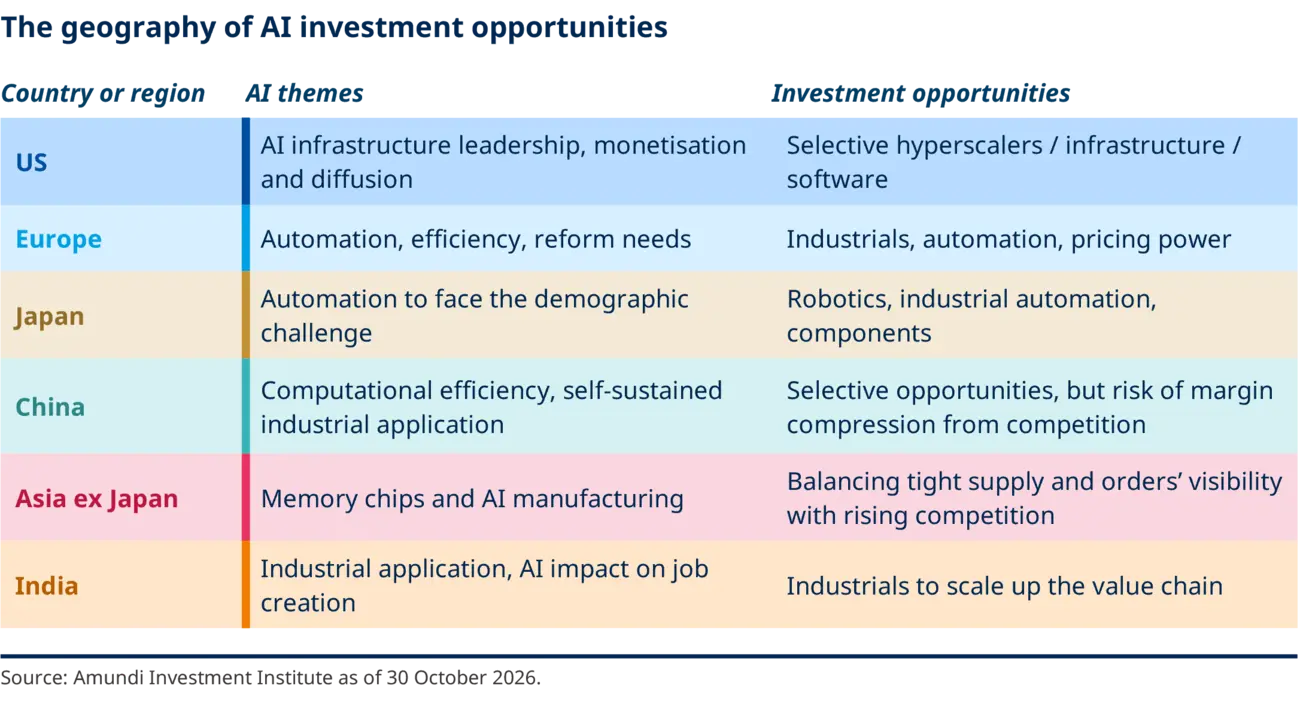
As AI investment becomes more capital intensive, financing structures will matter as much as tech leadership. The goring involvement of debt and private capital creates new transmission channels between AI valuations, credit conditions and investment spending.
Diversifying AI risks with a greater focus on dividends and on selecting corporates with evident return of investment
AI exposure remains vulnerable to a range of risks that could affect returns before fundamentals have time to differentiate, from concentration and valuation risk to funding stress, which would first hit spending-dependent names. In addition, physical constraints such as power shortages, grid bottlenecks, packaging limits, and permitting delays could push payback further out. Policy and security risks, including export controls, tariffs, or even a major cyber incident, could also disrupt supply chains, margins, and adoption.
As AI investment shifts from capacity expansion to return generation, portfolio construction should place greater emphasis on cash flow visibility, capital discipline, valuations and sustainability of profits in semiconductors.
Dividend income and attractive valuations can provide complementary returns, particularly if market leadership broadens beyond the capital-intensive segments of the AI trade. This can help dampen volatility and provide a steadier return stream, including in a sticky inflation environment, while also diversifying sector exposure.
Key Investment Implications
Selective exposure, taking into account physical bottlenecks, power equipment, grid infrastructure, and selected semiconductor supply-chain names.
Emerging opportunities in AI facilitators that show monetisation and attractive valuations.
Broadening potential into industrial automation and productivity beneficiaries across Europe, Japan, and China.
Caution on spending-dependent infrastructure businesses and highly leveraged operators.
Portfolio diversification through quality cash flow, sustainable dividends, and selective equity exposure.
Explore the 2027 Outlook

| Our 2027 outlook, “The Price of Power”, focuses on the costs and trade-offs of a macro regime shaped by five powerful forces and what they mean for investors. |
Authors