
Summary
The reform plus fiscal package is genuinely large and potentially a regime change, but not yet an unqualified “buy Germany/Europe” signal. The principal upside risk is a confidence-led private capex cycle. The key downside risk is implementation failures and higher bond yields, which could turn a productive investment programme into a less equity-friendly fiscal expansion. Depressed confidence, reform leverage and limited FX tailwinds nevertheless all argue for clear relative winners and losers. We favour German domestic and small- and mid-cap stocks over large international exporters; the European reindustrialisation supply chain over China-geared and defensive exporter cohorts; and expect momentum in the Periphery to continue. The near-term complication, an Iran/Hormuz energy shock pushing the ECB toward hikes rather than cuts, may argue against a broader market rerating, but does not yet alter the relative framing.
Germany is gradually moving from fiscal restraint and external dependence towards an investment-led economic model
The German package and the channels supporting stocks
Germany is gradually moving from fiscal restraint and external dependence towards an investment-led economic model. The reforms can improve both the level and quality of growth, and the public-private interaction makes the package more equity-relevant than a normal fiscal stimulus, because it affects both demand and supply and thus has the potential to crowd in private capex rather than merely create a temporary fiscal multiplier. Importantly, the infrastructure and defence spending is not a traditional one-off stimulus; it changes the government’s borrowing trajectory and the visibility of industrial demand; “Agenda 2030” reforms add tailwinds to an existing base.
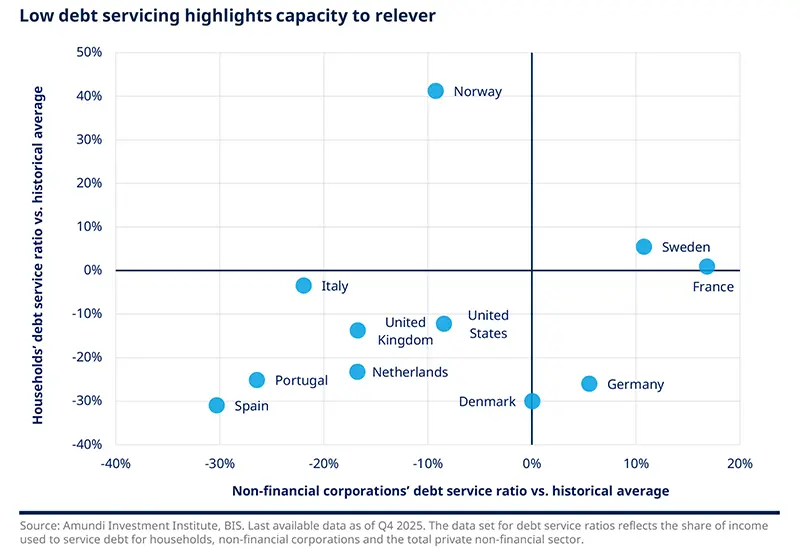
Credit and balance sheet capacity also matter. The BIS measures the proportion of household and corporate (the private sector) income used for interest and principal payments. In the case of Germany (as well as the Periphery in Europe and the UK) the limited rise in the private sector’s debt service ratio relative to its historical level translates into capacity to re-lever. This capacity is latent and gated (the gate being banks’ risk appetite, and what opens it being energy de-escalation and an end to ECB tightening), but it could further broaden the credit cycle, extending growth beyond current assumptions.
The longer-term results remain uncertain: they depend on whether companies will alter their investment, wage and capital-allocation behaviour, whether banks accelerate lending, and whether returns on investments prove attractive. For now, the confidence channel is what has the potential to become the real transmission valve; and a change in confidence breadth is a more powerful trigger than just its level. With business and consumer confidence at multi-year lows and only just turning (the war in Iran and the rise in energy prices had an impact), the reforms are not yet reflected in sentiment. Any confidence rebound, while geopolitically contingent, is the real source of optionality.
The mechanics: earnings and equity risk premium are the driving forces
At a high level, equity price returns are driven by changes in earnings expectations and changes in valuation, usually expressed through the Price-to-Earnings (P/E) ratio. The P/E ratio typically moves inversely with the risk-free rate and the equity risk premium (ERP)*, while benefiting from positive revisions in long-term growth assumptions.
In Germany, the combination of supply-side reforms and the fiscal package favours companies whose earnings revisions arrive early, rather than long-duration equities that rely almost entirely on valuation expansion.
Here we explain why:
Earnings revisions are the most reliable leg. The package likely raises revenues and operating leverage, while stimulating productivity. German equities have high operational gearing, so a given GDP increase can translate into an outsized increase in EPS for domestic cyclicals. The bar for a 2026 EPS beat is high (expectations are elevated and Agenda 2030 will not affect the reporting season), but (1) ex-energy EPS growth remains in the low single digits and (2) the breadth of 2027 consensus revisions among domestic stocks is still missing. The reform is therefore likely to favour domestic names.
The impact on multiples (P/E) is more mixed. Any further re-rating from here has to come from ERP compression, net of limited fall in the risk-free rate, which makes the setup less supportive, at the margin, than in 2024/25.
ERP leg: reform credibility, political stability and lower tail risk can all reduce the premium investors demand. This is where “depressed confidence turning” does its work: it’s optionality, not yet in the price.
Risk-free leg: The recent energy shock has flipped the ECB narrative from cutting to hiking, which limits P/E expansion. While we believe the ECB will not deliver what is priced in the market, any upside surprise in growth would likely prevent aggressive cuts later in 2027.
*ERP = expected equity return - risk-free rate.
| Investment implications: how to position within Germany and across Europe |
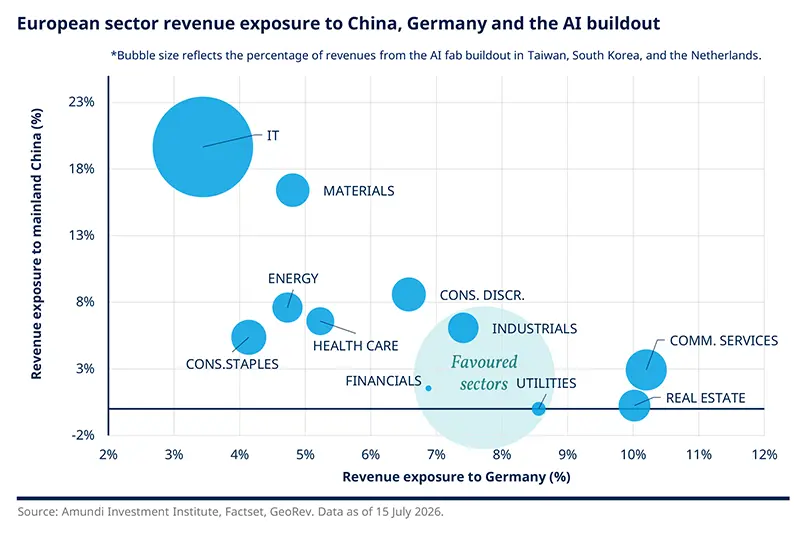
For us, the most attractive first-order exposure combines high revenue dependency on Germany, low relative dependency on the old German/European model (export-oriented businesses reliant on cheap energy, Chinese demand, and a weak exchange rate), and strong diversification benefits in the event of a disappointing AI build out.
|



Authors