
The new regime might well witness fiscal dominance, rising inflation, trade tensions and pronounced volatility.
Introduction and aims
Value trap or a value opportunity?
This question has come to the fore as the swirling clouds of geopolitical events have elevated the role of dynamic asset allocation (DAA). They have challenged the timehonoured primacy of strategic asset allocation (SAA), with fixed weights for different asset classes with long-term return targets. This rigid set-it/forget-it approach worked well in the longest bull run after the 2008 global financial crisis.
Since 2022, however, concerted steep rises in interest rates by key central banks to curb the inflation spike have ushered in a new era of volatility. The mispricing of assets is widespread, leaving investors a choice in this new regime: adjust the asset mix as markets rise and fall, or leave potentially good returns on the table, duly taking into account the downsides of DAA.
Investors are now buffeted by conflicting signals on key macro return drivers such as economic growth, interest rates and inflation. Capital markets are moving to a new regime as the US seeks to reshape global architecture on trade, finance and defence. The new regime might well witness fiscal dominance, rising inflation, trade tensions and pronounced volatility.
For their part, ever more pension plans are advancing into their run-off phase, as the largest cohort of Baby Boomers are advancing in their golden years.
They are keen to minimise that infamous portfolio killer, the sequence of returns risk – the uncertainty that a portfolio might lose value just as the plan needs to rely on it to make pension pay-outs.
Sizeable negative returns can leave less time for losses to recover, erode the power of compounding and shrink the asset base that reduces benefits from subsequent market recoveries.
Worse still, the percentage gain needed to recoup losses rises non-linearly with the size of the loss. For example, a 25% drop in portfolio value during periods of market ructions requires a recovery of 33% to restore the loss. A 50% drop requires 100% recovery. Conversely, good returns in the drawdown phase can extend the longevity of a portfolio.
Aims
Hence, interest in DAA has gained traction lately, as changing market conditions and policy regimes create time-varying risk premia, requiring a more nimble approach.
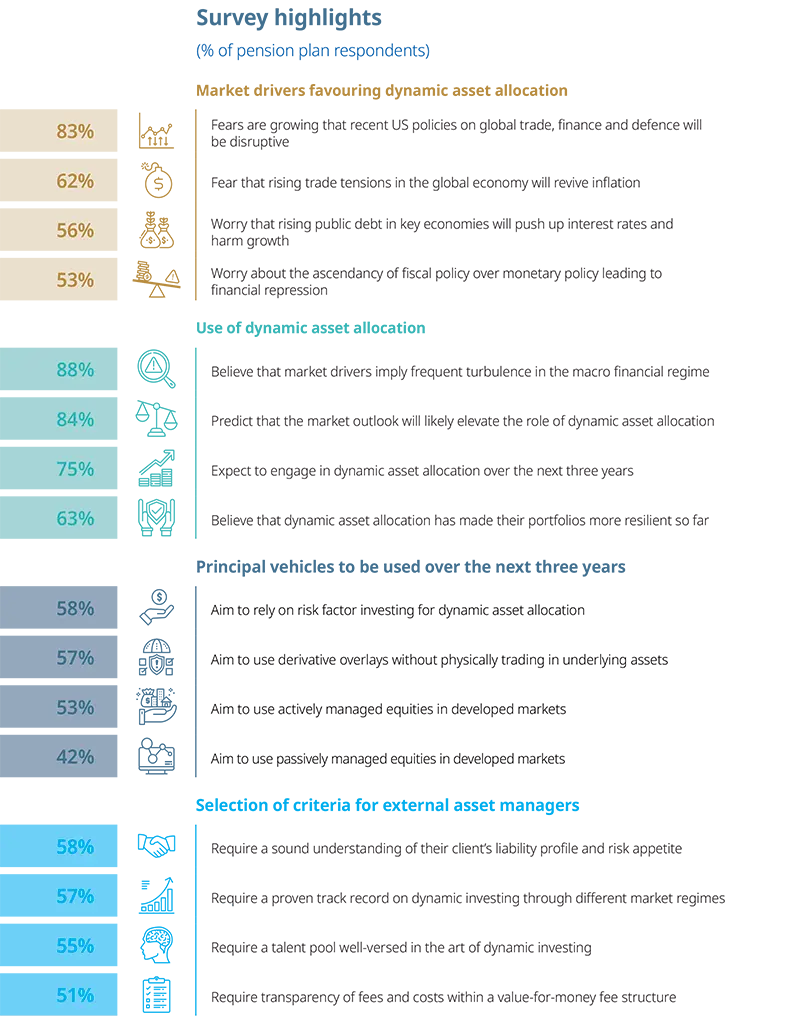
Accordingly, the 2025 Amundi–CREATE Survey aims to perform a stock-take by pursuing four questions:
How do pension investors define DAA and why is it currently on the rise?
What have been the outcomes so far and which contributory drivers have been at work?
Which approaches are likely to be used in DAA in the near future?
What criteria are being used when selecting asset managers as pension plans deviate from their SAA?
Our survey method had two strands: a survey of 158 pension plans, followed up with structured interviews with senior executives in 30 respondent organisations. Based in 14 pension jurisdictions, they had a collective AuM of €2.9 trillion. Fuller details are given in the Appendix.
The survey provided the breadth of subject coverage, the interviews the depth of analysis. Together, they offered insights into current status and future trends.



Authors