
Summary
We will remain in an environment of heightened geopolitical risk in 2026. This is a result of various megatrends still playing out, including: the transition to multipolarity, economic warfare, US–China competition, as well as the arms and technology race underway. The war in Ukraine and tensions in the Middle East are additional factors. As geopolitical risk remains elevated, so is the likelihood of downside surprises and tensions flaring up. However, geopolitics also defines trends that bring opportunities. While uncertainty will prevail, geopolitics in 2026 will bring both upsides and downsides for investors.
From ‘Great Diversification’ to ‘Controlled Disorder’
Over the past year, diversification efforts by governments, central banks and investors saw the USD weaken, gold prices rally, and new trade and security deals emerge. As governments aim to bring order into a factious world, more tactical bilateral and multilateral agreements are likely, ensuring trade and investment flows continue.
The ‘Controlled Disorder’ emerging is a by-product of the new multipolar world order. Alternative alliances allow an escape route from economic friction by re-routing, but they also add risk because countries can be confrontational. Multiple alliance-building increases distrust, encouraging countries to hedge their bets and re-arm.
More protectionism, export controls and sanctions are likely as countries protect their interests and exert pressure on rivals. The US will continue to use tariffs as a tool for various goals, while China will leverage control over rare earths and other chokepoints. Other countries are introducing measures to protect industries (e.g., recent EU steel tariffs).
The more hostile global environment forces governments to reduce overreliances. Countries with resources others depend on (food, energy, rare earths) will have the upper hand. Efforts to reduce exposure to China’s rare earths will accelerate; new agreements between the US, Australia and Japan are examples. Greater self-sufficiency will take years, however.
Questions over US exceptionalism will linger as the political uncertainty and ‘democratic backsliding’ intensify ahead of the mid-term elections. This uncertainty and high debt levels will contrast with ongoing spending in AI and deregulation.
US foreign policy will remain volatile, marked by Trump’s beliefs, business interests and US strategic priorities. For example, Trump cares about US influence in Latin America. After having been ignored by previous US administrations, allowing China to make economic and diplomatic inroads, US involvement in Latin America will likely intensify at a time of important elections in the continent (e.g., Brazil).
Both the US and China realised their mutual dependencies in 2025. The US now understands that it can’t do much without Chinese rare earths, while China’s economic performance and social contract (political control in exchange for prosperity) depends on global trade. There is a limit to how much the US-China relationship will deteriorate in 2026. Tactical deals remain possible, but a material change in the relationship is unlikely.
The Great Power Competition will continue to fuel investments into the AI race — a contemporary iteration of the tech and space race witnessed during the Cold War. Control over AI, quantum computing and high-end chips is seen by the US and China as essential to securing superpower status. Investing in AI is therefore about power and survival. The AI race will likely also redraw and reinforce geopolitical alliances as access to energy becomes critical. Recent AI deals between the US and UK and the Gulf to host data centres are examples.
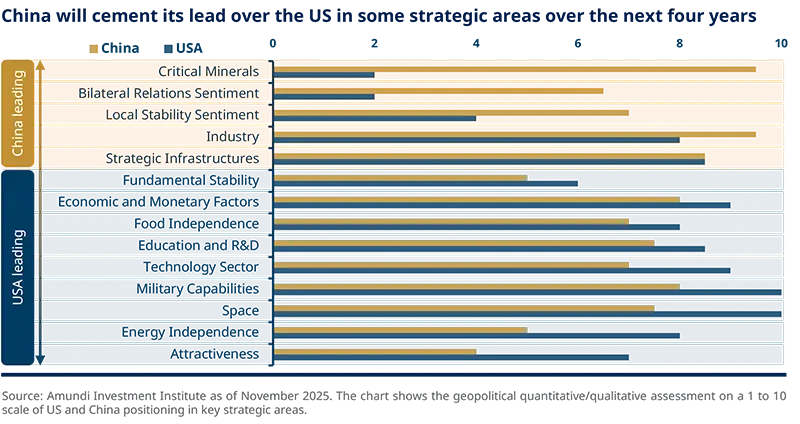
Questions over Taiwan’s political status will grow as the US reduces its military deterrence and support for Taiwan, and China expands its influence and geopolitical power. China’s new confidence on the global stage will continue to make it less likely to bow to US demands. It will continue to try and position itself as the ‘grown-up in the room’ as the US remains fickle. It will woo countries to join China-led initiatives, while shoring up preparedness for competition with the US. The party recently doubled down on its national priority of developing a modern industrial system — a key advantage over the US’s struggling industrial base.
The Russia–Ukraine war will likely see hybrid warfare intensify in Europe. Russia wants to erode morale and support for Ukraine. Conversely, European NATO countries will have to up their deterrence, increasing the likelihood they will shoot down Russian objects in European airspace, raising the escalation risk. The latter will also increase should the US decide to provide Ukraine with the ability to strike deeper into Russian territory. We do not anticipate an end to the war for the next several months. The goals of the various parties do not overlap. Russia believes time is on its side and seeks the demilitarisation of Ukraine, while for Ukraine and Europe, a heavily armed Ukraine is essential. The US doesn’t have the leverage to end the war without imposing economic hardship on Russia. It is unlikely that recent US sanctions will succeed in increasing economic pain sufficiently. But they could put pressure on Russia’s economy over the medium term, forcing Putin to be more open to making concessions.
Despite the many risks facing Europe, there are some positive signs. European leaders managed to convince Trump to align with European security interests. The EU also made major progress in diversifying trade relations, while investments in defence are happening. The difficult backdrop is paving the way for reforms that could make the EU more competitive. For example, Germany’s chancellor recently signalled support to unify the bloc’s capital markets. While the implementation of major reforms remains difficult, political momentum seems to be shifting. With no major election in 2026 (apart from Hungary), EU internal cohesion will likely prevail. For example, Bulgaria will adopt the euro in January.
The Middle East will see ongoing political uncertainty. Efforts to conclude the war in Gaza will face hurdles when it comes to demilitarising Hamas, while the re-emergence of Iran–Israel tensions is likely. The picture will be further complicated with elections in Israel in October. A different story is unfolding in the Gulf, where AI investments, diversified security agreements and close relations to the US paint better prospects.
To conclude, geopolitical trends will continue to impact the economy and markets. National security priorities are increasingly intertwined with company valuations, in some strategic sectors, and expectations for productivity and economic growth. Geopolitics will continue to put pressure on public finances and inflation — the current environment makes it hard for governments to stop spending on AI and defence, while geopolitical diversification is about national security, not only efficiency. In this environment, gold will still benefit.
Get the full picture

| A spirit of endurance has characterized the market rally of the past year. |
Get more insights
|

|

| ||
Fixed income in the new policy order | Think global beyond the tech race | A new regime calls for a new mindset | ||
| Read the article → | Read the article → | Read the article → |
Authors