
Summary
Bond markets are under pressure now, but as yields rise, opportunities for investors to benefit from higher income are opening.
Bond yields on the rise again
- Global bond yields have risen across all maturities, with longer-dated bonds reaching multi-year highs.
- A mix of factors is driving the rise: central bank policy uncertainty amid fears of sticky inflation, funding needs and a lack of fiscal discipline.
A global and flexible approach can help investor adapt to a volatile economic and market landscape.
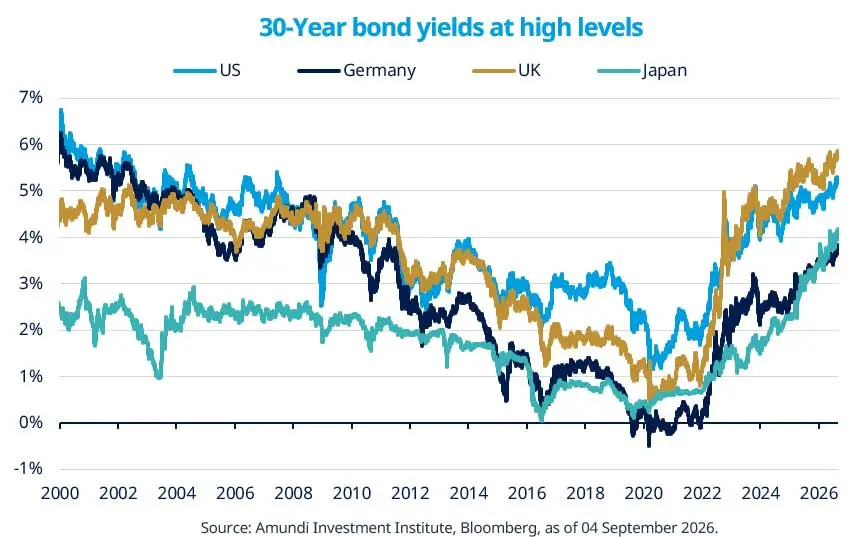
Global fixed income markets have seen significant moves in bond yields over the summer, particularly at the long end of the curve. In the US, 30-year Treasury yields reached the highest level in almost two decades, while 10-year yields climbed to levels not seen since before Trump returned to office. The rise in longer-maturity bond yields partly reflects the change in economic conditions, including stronger-than-expected real growth, supported by capex spending, and sticky inflation. But it also reflects the higher compensation required to hold longer-dated bonds as debt levels remain elevated and debt issuance among governments and businesses continues to increase.
For investors, this environment may provide an opportunity as interest rate levels are becoming increasingly attractive. That said, it remains essential to adopt a diversified and dynamic approach.
This week at a glance
Global equities were supported mainly by emerging markets, while in other regions concerns about central bank rate hikes weighed on stocks. Yields continued to rise. The US labour market report at the end of the week reinforced expectations of Fed rate hikes. Oil rose on renewed US-Iran hostilities, which heightened concerns over disruptions to energy flows. The yen gained after hawkish comments from Governor Ueda.
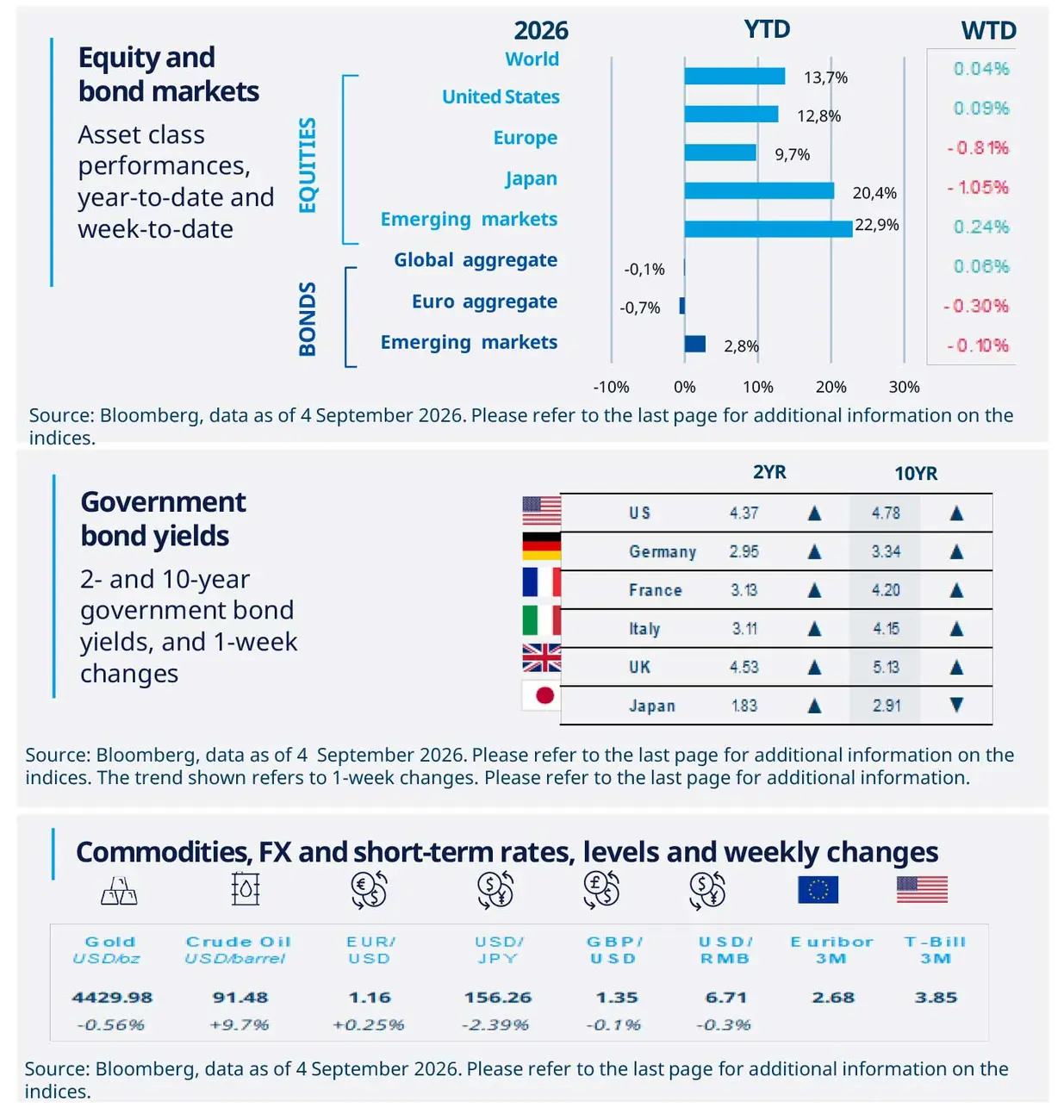
Equity and bond markets (chart)
Source: Bloomberg. Markets are represented by the following indices: World Equities = MSCI AC World Index (USD) United States = S&P 500 (USD), Europe = Europe Stoxx 600 (EUR), Japan = TOPIX (YEN), Emerging Markets = MSCI Emerging (USD), Global Aggregate = Bloomberg Global Aggregate USD Euro Aggregate = Bloomberg Euro Aggregate (EUR), Emerging = JPM EMBI Global Diversified (USD).
All indices are calculated on spot prices and are gross of fees and taxation.
Government bond yields (table), Commodities, FX and short-term rates.
Source: Bloomberg, data as of 4 Septembre 2026. The chart shows the price of gold.
Diversification does not guarantee a profit or protect against a loss.
Amundi Investment Institute Macro Focus
Americas
Services strength sustains US momentum
The latest ISM reports showed that US business activity remained in expansionary territory in August. The Manufacturing index eased, marking the eighth consecutive month of expansion despite a modest slowdown. Meanwhile, the Services index rose, recording its strongest reading in six months. Taken together, the data suggest an economy in very good health, with broad-based momentum and continued expansion across both manufacturing and services.
Europe
Euro Area activity remains on a firm footing
The Eurozone Composite PMI held steady at 52.0 in August, signalling continued growth across the private sector. Manufacturing strengthened to a four-year high, while services eased marginally, but remained firmly in expansion territory. The resilience across both sectors supports the view that the Euro Area is, for now, weathering the rise in energy prices better than expected.
Asia
India growth stronger than expected
India’s Q2 GDP was higher than expected, confirming once again that countries identified as the most vulnerable to the Middle East conflict have performed better than anticipated, as was also the case in Europe. The main drivers were exports and investment, suggesting that global trade has not weakened despite renewed geopolitical tensions, while investment cycles continue to support economic activity.
Key Dates
South Korea GDP, Japan GDP, US Small Business Sentiment |
Germany CPI, Italy industrial production, ECB policy rate |
Japan PPI, UK industrial production, US CPI and federal budget balance |


Authors