
Summary
The strong rotation fuelled by the US mid-term election results and investor scrutiny of massive corporate capex, is a reminder of the need to diversify outside the AI theme across regions and sectors.
Over the past few weeks, we have seen a rotation away from US tech due to scrutiny of the massive capex and results of the US mid terms.
By contrast, global defensive sectors and some regions such as India posted gains.
This rotation underscores the importance of a global, diversified approach that avoids concentration in US tech.
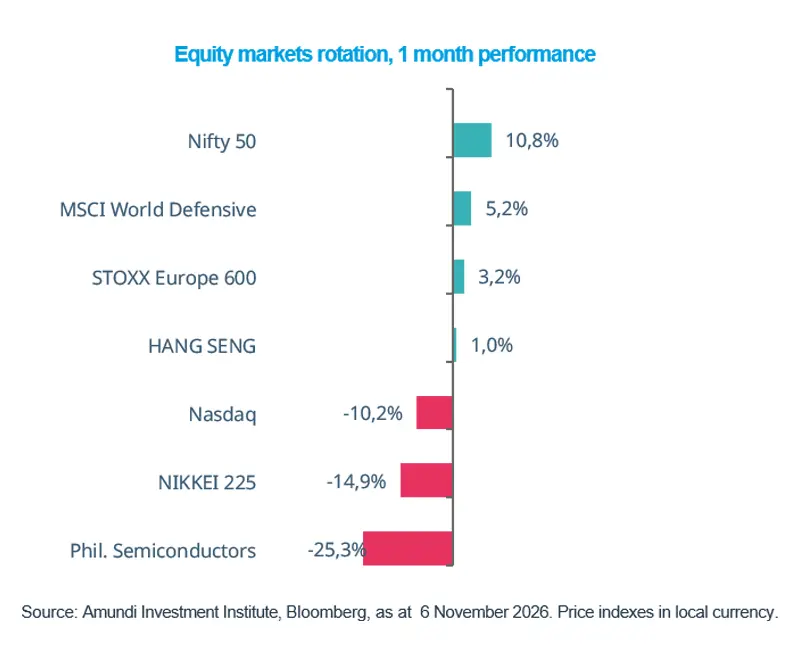
The US midterm elections delivered a Democratic sweep of Congress, and markets responded with a dramatic rotation. The shift was swift and decisive: investors moved out of high-growth, technology-heavy businesses into areas of the market that had long been overlooked. The clearest losers were semiconductor and AI-linked stocks, as investors worried about increased regulation in the sector and demanded more clarity on the massive spending plans of large technology companies. The Japanese market, heavily exposed to the global technology supply chain, was also caught in the sell-off. By contrast, European equities held their ground, and the Indian market posted strong gains, reflecting a broader search for alternatives to the US. Defensive global equities — think utilities, healthcare, and consumer staples — quietly outperformed. The message from the markets seems to be that the era of undisputed US technology dominance is being questioned.
This week at a glance
Global equities declined following the US mid-term elections, led by falls in technology stocks. Europe, however, was broadly flat. Bond yields declined across major regions as markets sought safer assets. In commodities, oil prices dropped sharply on expectations of diplomatic progress in the Middle East conflict, while gold rose.
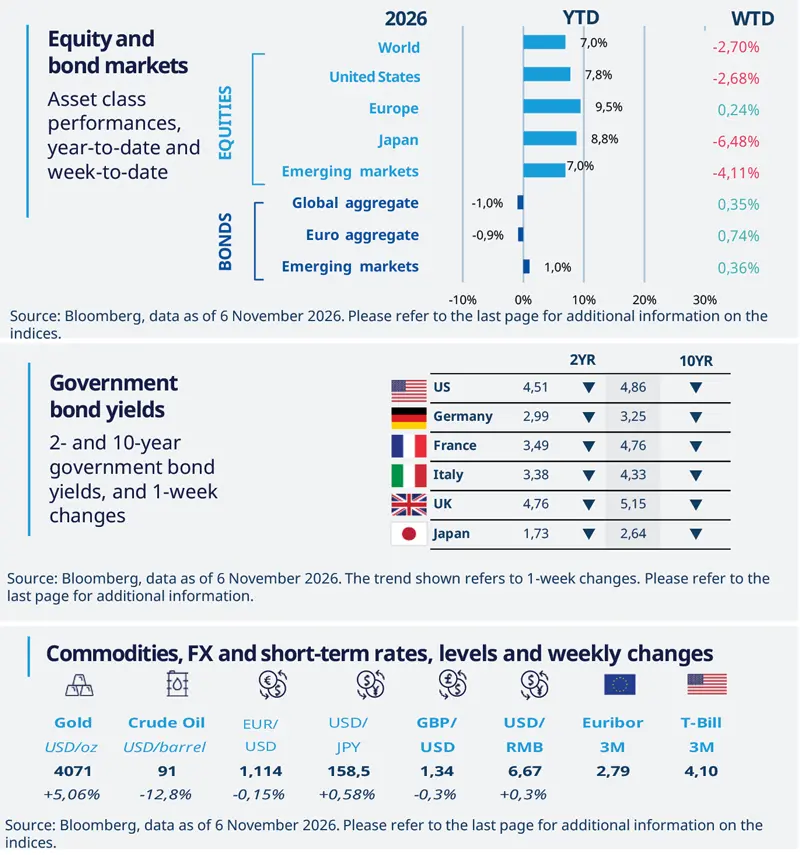
Equity and bond markets (chart)
Source: Bloomberg. Markets are represented by the following indices: World Equities = MSCI AC World Index (USD), United States = S&P 500 (USD), Europe = Europe Stoxx 600 (EUR), Japan = TOPIX (YEN), Emerging Markets = MSCI Emerging (USD), Global Aggregate = Bloomberg Global Aggregate USD Euro Aggregate = Bloomberg Euro Aggregate (EUR), Emerging = JPM EMBI Global Diversified (USD).
All indices are calculated on spot prices and are gross of fees and taxation.
Government bond yields (table), Commodities, FX and short-term rates.
Source: Bloomberg, data as of of 6 November 2026. The chart shows the price of gold.
Diversification does not guarantee a profit or protect against a loss.
Amundi Investment Institute Macro Focus
Americas
US Factory Activity Gains Momentum
The Institute for Supply Management's manufacturing index rose to 55.5 in October, above expectations and its second-highest level in over four years. Production reached its best level in several years, a sign of robust industrial momentum. On the labour market front, latest private-sector hiring and weekly jobless claims points to a resilient labour market that supports the broader economic expansion.
Europe
BoE Raises Rates as Inflation Outlook Worsens
The Bank of England raised its key interest rate by a quarter of a percentage point to 4% on Thursday — its first increase since August 2023. Governor Andrew Bailey signalled that a further increase is more likely than not if energy costs remain elevated, with the Bank now forecasting inflation could reach close to 5% in the second quarter of next year — well above its 2% target.
Asia
Japan's Wages Grow at Fastest Pace Since 1997
Nominal wages rose 4.6% year on year in September, the fastest pace in decades. After adjusting for inflation, real wages grew 2.2%, well above economists' expectations. These figures reinforce the view that the wage-growth cycle is becoming more durable, which supports household purchasing power and is a key factor the Bank of Japan monitors when assessing its monetary policy.
Key dates
China Exports, Japan Current Account Balance, US CPI |
Japan PPI, India CPI, US Initial Jobless Claims |
US PPI, India Trade Balance |

Authors