
Summary
While high government debt does not dictate Fed policy, it does raise the macro stakes, with higher interest rates compounding already elevated debt-servicing costs. Combined with high inflation, this means volatility in bond markets is likely to persist, underscoring the need for a diversified approach.
Bond markets are contending with elevated uncertainty, driven by factors such as a high fiscal deficit, elevated debt levels and persistent US inflation.
This, together with expectations of further Fed rate hikes, has contributed to a rise in Treasury yields, with the US 10-year once again reaching the 5% level last week.
Overall, we believe this reinforces the case for a flexible, diversified investment approach with a global focus.
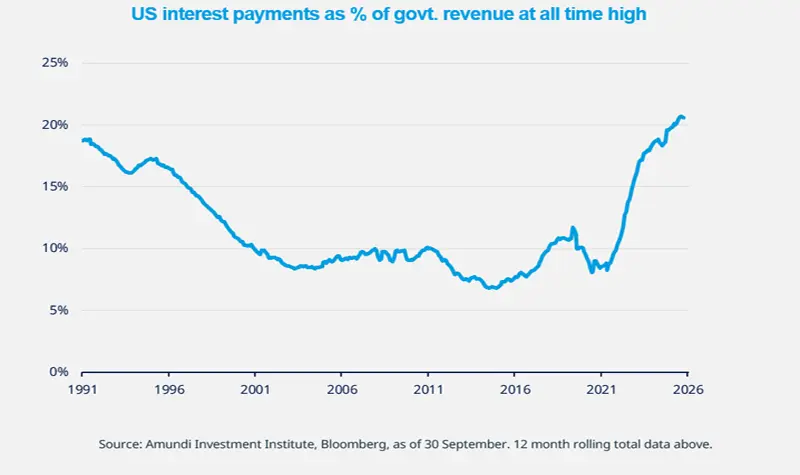
With US bond yields rising this year, government finances have become an important topic for capital markets. High debt levels, interest payments on debt, and elevated fiscal deficits — the excess of expenditure over revenue — are some of the key yardsticks markets are tracking. US interest payments as a share of government revenues reached an all-time high of close to 20%, as shown in the chart. In fact, interest payments have been one of the main drivers of the increase in expenditure for the Federal government in the fiscal year ended 30 September. Looking ahead, this expense is likely to increase further.
We think this complicated fiscal backdrop, along with high inflation, will create more uncertainty in bond markets. The latest October CPI came in above expectations at 0.4% month on month, and confirms our view that the Fed will raise rates in the near term.
This week at a glance
Global equities rose on the back of positive corporate earnings in the US and Japan. Renewed optimism in the AI sector also helped lift sentiment, despite an abrupt leadership change at a leading technology company. European markets also reached new highs. In fixed income, bond yields rose due to elevated US inflation and expectations of rate hikes by central banks. As a result, gold prices fell. Gold is a non-yielding asset, and higher interest rates reduce the appeal of the yellow metal.
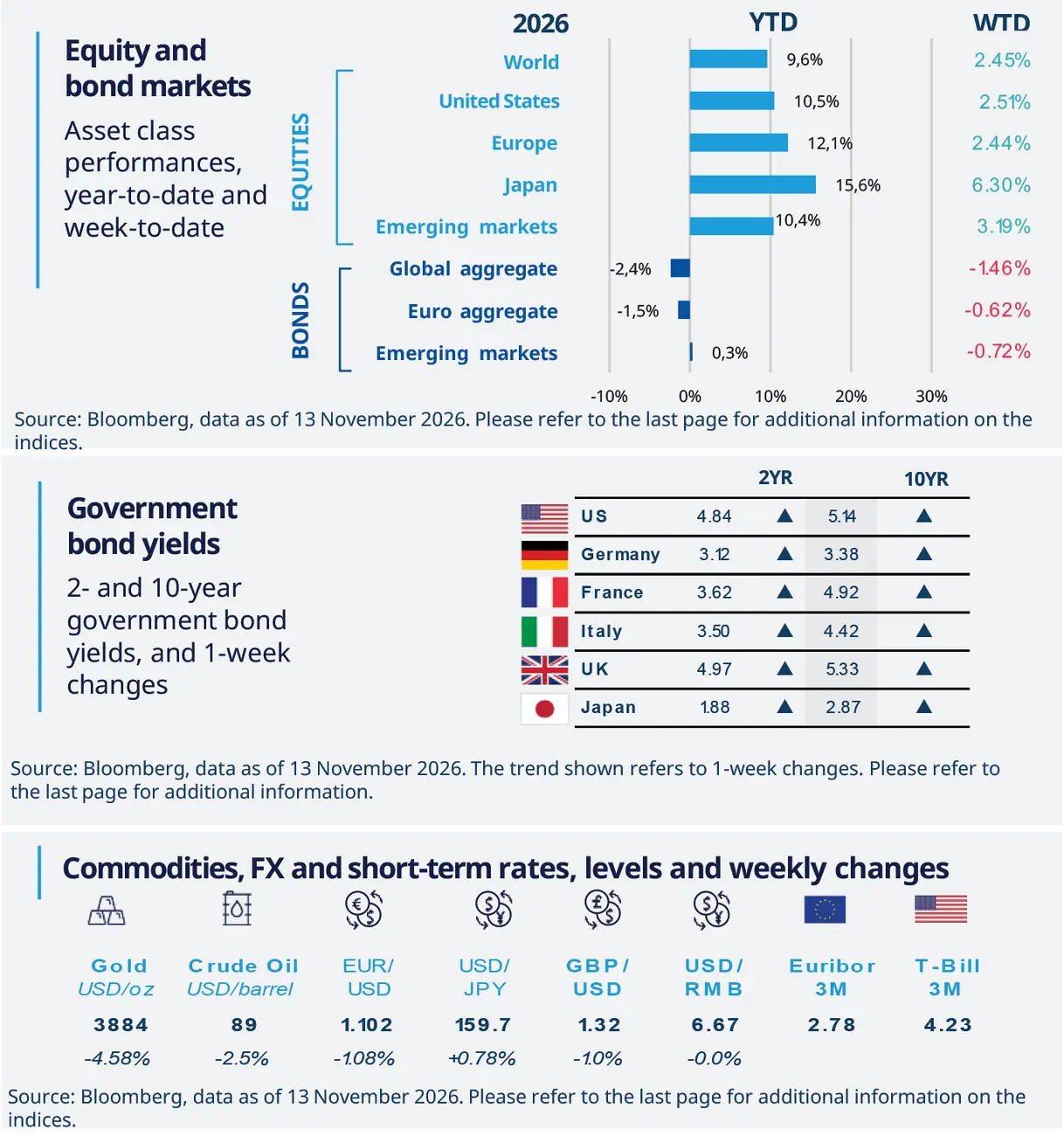
Equity and bond markets (chart)
Source: Bloomberg. Markets are represented by the following indices: World Equities = MSCI AC World Index (USD), United States = S&P 500 (USD), Europe = Europe Stoxx 600 (EUR), Japan = TOPIX (YEN), Emerging Markets = MSCI Emerging (USD), Global Aggregate = Bloomberg Global Aggregate USD Euro Aggregate = Bloomberg Euro Aggregate (EUR), Emerging = JPM EMBI Global Diversified (USD).
All indices are calculated on spot prices and are gross of fees and taxation.
Government bond yields (table), Commodities, FX and short-term rates.
Source: Bloomberg, data as of of 13 November 2026.
Diversification does not guarantee a profit or protect against a loss.
Amundi Investment Institute Macro Focus
Americas
Persistent inflation raises the stakes for December
US consumer prices rose 0.4% in October from September, above expectations. Core prices rose 0.3%, beating forecasts for a third straight month and signaling persistent price pressures. Grocery prices rebounded, while expensive diesel threatened to keep distribution costs high. The data strengthened expectations of a Fed rate rise in the near term.
Europe
UK growth firms at the end of Q3
GDP grew 0.2% in September after a flat August, beating expectations for no growth. Output expanded 0.7% in the third quarter, in line with forecasts. Services contributed most to quarterly growth, while construction contracted. Industrial production and manufacturing both exceeded expectations in September. The breadth of the monthly gains suggests the economy ended the quarter on a firmer footing, even as elevated inflation continued to weigh on household purchasing power.
Asia
Food prices shape the inflation outlook in India
Consumer price inflation rose to 6.09% yoy in October, the highest in two years, and slightly above expectations, breaching the upper limit of the Reserve Bank of India's tolerance band. Food prices were the main driver, rising nearly 9% yoy. The acceleration in food inflation was evident in both rural and urban areas, adding to pressure on household budgets and keeping food costs central to the near-term outlook. Core Prices keep rising to, reaching 4.7% from 4.5%. The RBI is likely to hike rates again.
Key dates
Japan GDP, EZ industrial production, China retail sales |
EZ Zew Survey, US retail sales and industrial production |
EZ consumer confidence, University of Michigan inflation expectations, Mexico retail sales |

Authors