
Summary
Bond yields are increasingly attractive, but volatility is likely to stay high, calling for a flexible approach to bond investing.
Long-term bond yields remain near multi-year highs across major countries, alongside increased volatility.
The move reflects a combination of forces: persistent inflation in several major economies, monetary policy uncertainty, concerns about government finances, and geopolitical tensions affecting energy prices.
For investors, the key implication is the need for a more flexible approach in fixed income and stronger diversification.
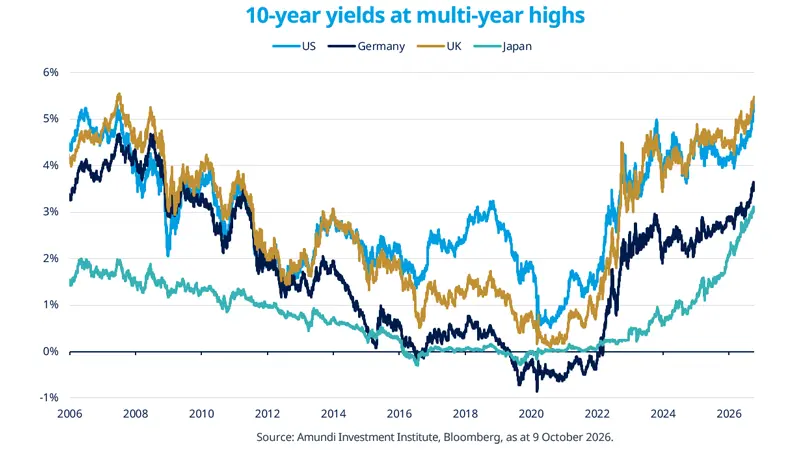
Government bond yields across major developed economies have risen to levels not seen in years. The move has been accompanied by increased volatility, as markets have become more sensitive to macroeconomic data and policy expectations. US 10-year yields reached their highest level since 2002 before easing, as oil prices fell and following a well-received bond auction. Meanwhile, UK 10-year yields climbed to their highest level since the Global Financial Crisis, while German and Japanese yields have also risen sharply over the past few weeks. The move reflects several overlapping forces. Geopolitical tensions in the Middle East have kept oil prices elevated and added to inflationary pressure, while stronger US activity data and heavy corporate issuance linked to the AI build-out have pushed long-term yields higher. European bonds have also come under pressure from concerns over energy prices, inflation and a degree of fiscal and political uncertainty.
This week at a glance
Rising government bond yields dominated the week, with multi-decade highs reached in the US and UK before a recovery, following strong auction demand in the US. Equity markets came under pressure before recovering on renewed AI optimism and falling oil prices. Brent crude retreated in the first part of the week amid news of productive discussions between the US and Iran, before recovering. Gold continued to attract demand as a store of value.
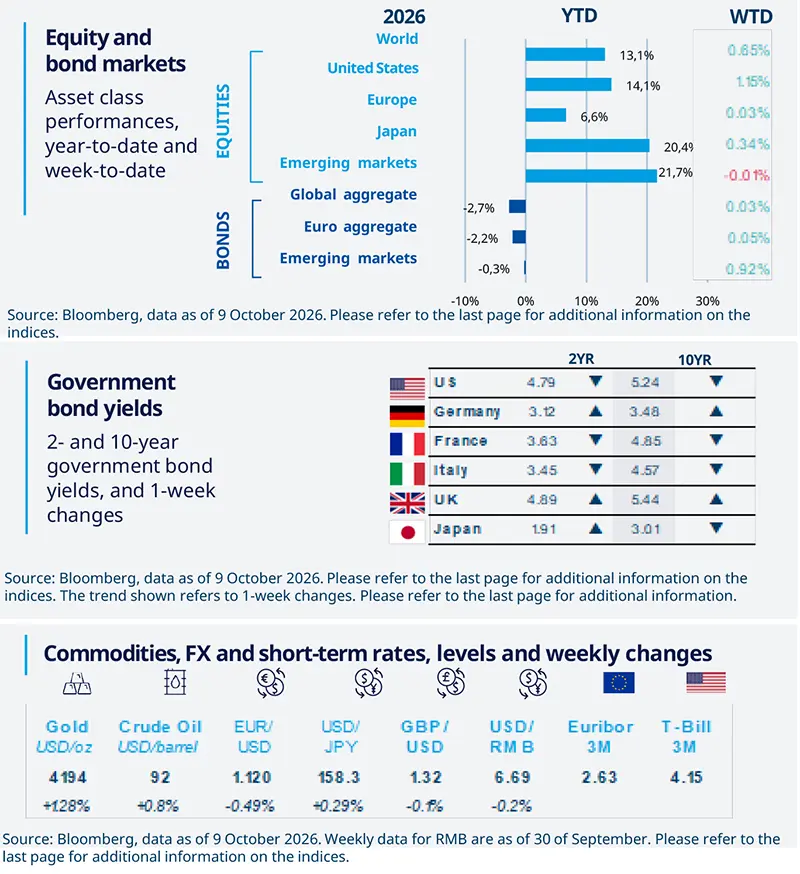
Equity and bond markets (chart)
Source: Bloomberg. Markets are represented by the following indices: World Equities = MSCI AC World Index (USD) United States = S&P 500 (USD), Europe = Europe Stoxx 600 (EUR), Japan = TOPIX (YEN), Emerging Markets = MSCI Emerging (USD), Global Aggregate = Bloomberg Global Aggregate USD Euro Aggregate = Bloomberg Euro Aggregate (EUR), Emerging = JPM EMBI Global Diversified (USD).
All indices are calculated on spot prices and are gross of fees and taxation.
Government bond yields (table), Commodities, FX and short-term rates.
Source: Bloomberg, data as of 9 October 2026. The chart shows the price of gold.
Diversification does not guarantee a profit or protect against a loss.
Amundi Investment Institute Macro Focus
Americas
US Services Activity Holds Up
US services-sector activity remained resilient in September, with the ISM Services Index at 54.9, just below 55.4 in August and marginally below expectations. As readings above 50 indicate expansion, the data suggest the sector is still growing, albeit at a slightly slower pace. Separately, a survey of New York households showed one-year inflation expectations rose to 3.9% in September from 3.6% the previous month.
Europe
Germany Sharply Upgrades Growth Outlook
Germany’s Economy Ministry has more than doubled its 2026 growth forecast to 1.3% from 0.5% in April, the fastest pace since 2017. The 2027 outlook was also raised to 1.1% from 0.9%. The revision reflects resilient exports and stronger government spending on infrastructure and defence, despite subdued consumer activity. Separately, the Bundesbank President said growth of around 1% could be possible this year, a more cautious view than the Ministry’s forecast.
Asia
India’s central bank raises rates
India’s central bank raised its key policy rate to 5.50% on Tuesday, as expected, to help keep inflation in check. In its Monetary Policy Report, the central bank noted that inflation risks remain elevated, particularly from food and energy prices, while the outlook for growth is still supported by domestic demand and investment but vulnerable to external shocks, including geopolitical tensions, higher oil prices, tighter global financial conditions and weather-related disruptions.
Key dates
13 Oct India CPI, Japan PPI, US Small Business Optimism and Existing Home Sales |
14 Oct China CPI, PPI, Export and Import, USA CPI and Real Earnings |
15 Oct Japan Industrial Production and Machine Orders, USA Retail Sales and PPI, Euro Area Industrial Production |


Authors