
Summary
Global central banks are striving to balance economic growth and inflation expectations driven by factors such as the war in the Middle East and AI capex. Accordingly, the Fed and the ECB kept policy rates unchanged as they await the effects of previous tightening to show up in the data.
The Fed, the ECB and the Bank of Japan (BOJ) kept rates on hold at their October policy meetings.
This decision to wait allows the Fed and the ECB to assess additional data before acting in December.
Uncertainty over their future policy decisions remains high, as central banks would like to tame price pressures without crippling economic activity.
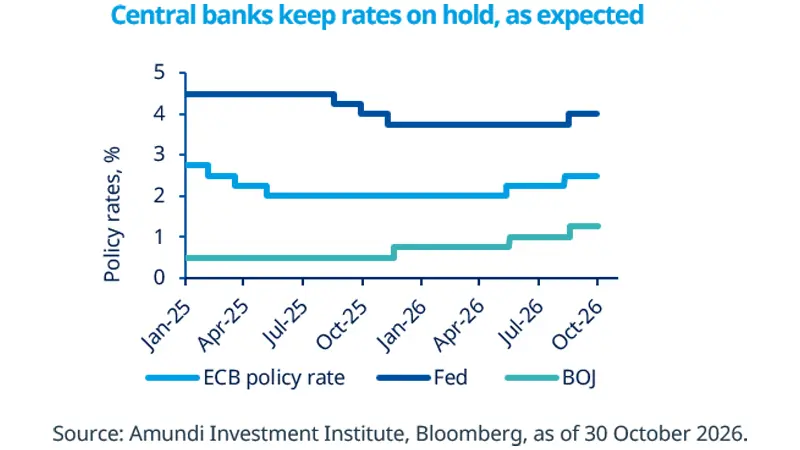
Major central banks, including the Fed, ECB and BOJ, kept their benchmark rates unchanged last week. The Fed seems to be assessing the effects of its rate hike in September and believes financial conditions are tighter today than they were previously. However, Chair Warsh was categorical in saying that conditions are not tight, the economy is strong and inflation is “too high”. We think the Fed is buying time and has left the door open for a hike in December this year, although it declined to provide any forward guidance. We also think that one of the reasons the US economy is staying strong is AI and related investment. In the long term, this should improve productivity across the economy, but in the short term all that heavy spending is creating strong demand for AI products and infrastructure, which may be pushing up inflation. The ECB also kept rates steady and believes financial conditions have tightened. Higher energy prices, along with the risk of second-round effects from energy prices and wage pressures, both of which are contained for now, will drive the bank’s decisions in December and next year.
This week at a glance
US equities fell amid weak corporate earnings, as markets appeared to question companies’ massive spending on artificial intelligence. By contrast, European stocks gained. In fixed income, the appeal of bonds as safe havens increased in this environment, and yields fell. Markets also digested the latest policy decisions from central banks. Meanwhile, gold prices declined. Overall, investors are now looking ahead to the outcome of the US mid-term elections.
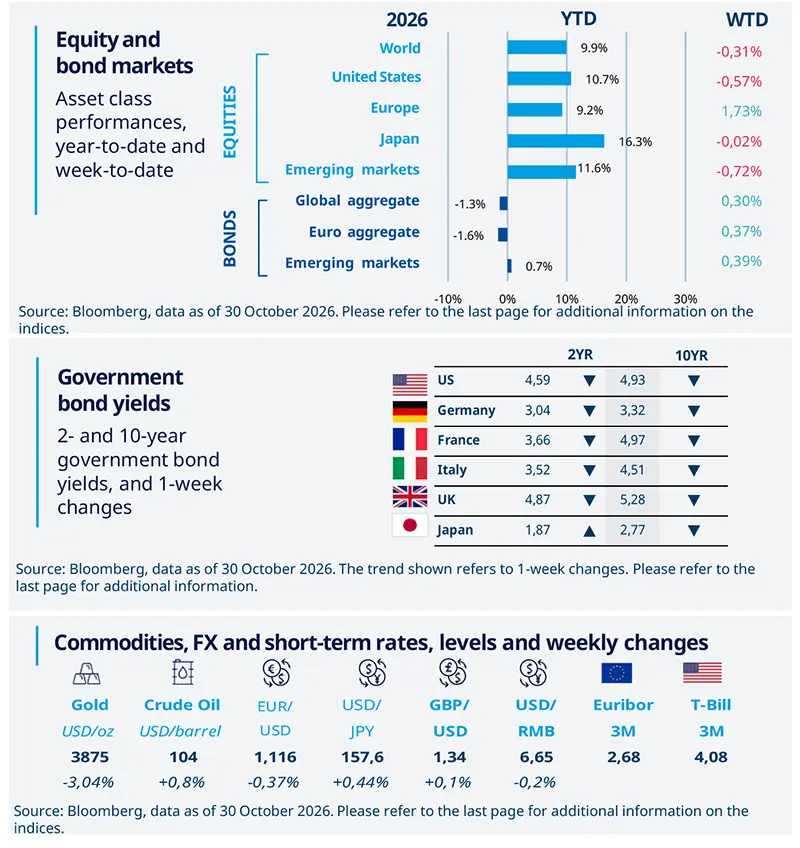
Equity and bond markets (chart)
Source: Bloomberg. Markets are represented by the following indices: World Equities = MSCI AC World Index (USD), United States = S&P 500 (USD), Europe = Europe Stoxx 600 (EUR), Japan = TOPIX (YEN), Emerging Markets = MSCI Emerging (USD), Global Aggregate = Bloomberg Global Aggregate USD Euro Aggregate = Bloomberg Euro Aggregate (EUR), Emerging = JPM EMBI Global Diversified (USD).
All indices are calculated on spot prices and are gross of fees and taxation.
Government bond yields (table), Commodities, FX and short-term rates.
Source: Bloomberg, data as of 30 October 2026. The chart shows the price of gold.
Diversification does not guarantee a profit or protect against a loss.
Amundi Investment Institute Macro Focus
Americas
Domestic demand offsets trade headwinds
US GDP grew by 3.4% QoQ in Q3, above the 3.2% consensus, confirming an economy on solid footing. Consumer spending and strong AI-related investment drove domestic demand, with capex also strengthening beyond technology, despite a large drag from net exports. Further growth remains likely, albeit at a slower pace, as current spending contributions may prove hard to sustain. Elevated energy prices and low savings could weigh on consumption heading into 2027.
Europe
Underlying growth remains modest
Eurozone GDP rose by 0.4% QoQ in Q3, beating expectations, but the preliminary reading was flattered by volatile Irish data. Excluding Ireland, growth was 0.2%, pointing to a moderate underlying pace despite the energy shock. German business confidence rose for a sixth month, led by manufacturing, while services sentiment weakened. October surveys suggest modest growth ahead, although elevated energy prices and tighter financial conditions leave risks tilted to the downside.
Asia
Mixed data from Japan
Japan's industrial production rebounded by 2.2% mom in September, led by vehicles and machinery, pointing to firmer factory activity. Retail sales, however, fell by 0.7%, signaling softer household demand. AI-related exports and business investment remain supportive, but high energy costs weigh on consumers and firms, leaving the recovery uneven.
Key dates
Japan PMI Manufacturing, India PMI Manufacturing, US ISM Manufacturing |
US ADP Employment, China PMI Services, India PMI Services |
US Nonfarm Payrolls, Unemployment Rate, and University of Michigan Consumer Sentiment |

Authors