
Summary
In the US, AI is likely to have a sequential impact on inflation. Strong demand will push inflation higher first, while productivity gains should become more disinflationary over time. Together with geopolitical and energy pressures, this is likely to keep inflation above central bank target.
The IMF raised its 2026 global growth forecast to 3.1%, up slightly from July, with 3.4% projected for 2027 — driven largely by the AI investment boom.
Resilience is still the key message, but it is not unlimited. The IMF suggests a shift from coping to rebuilding, with a focus on supply-side resilience, fiscal repair and price stability.
Looking ahead, supply resilience and policy discipline will drive growth, inflation and asset allocation.
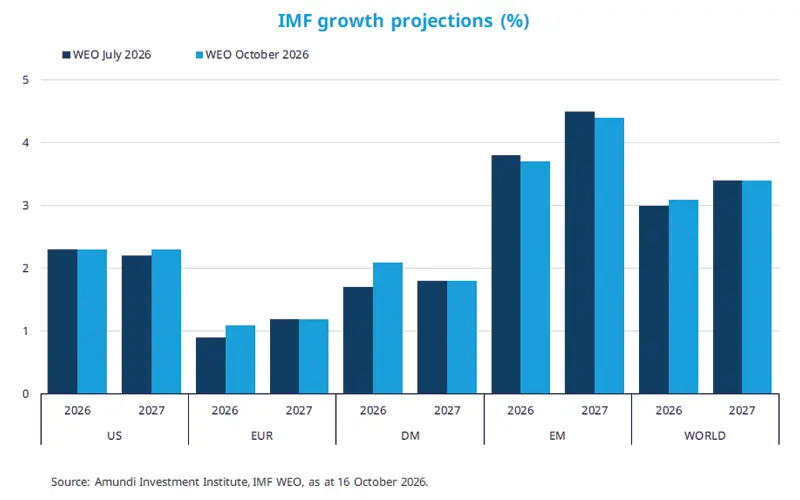
The IMF held its Annual Meetings in Bangkok this week, releasing its World Economic Outlook. The Outlook highlights that the global economy has remained resilient, albeit unevenly, but the room for further adjustment is now more limited. Potential constraints could emerge in energy and other commodities, which have benefited so far from rerouting, substitution and efficiency gains, as well as technology-related investment. This could lead to more persistent inflation. Looking ahead, the IMF stresses the need to move from coping to rebuilding, in terms of supply-side resilience, restoring fiscal space and keeping monetary policy focused on price stability. It also warns that the financial system needs to be reinforced to create buffers against future shocks. Over the medium term, the IMF suggests that greater resilience will require more technological and trade diversification, as well as stronger supply buffers in critical sectors such as energy.
This week at a glance
Global equities had a mixed week as investors rotated away from the AI trade. Among emerging markets, Indonesia suffered on Friday after MSCI proposed removing the country from its EM classification. Bond yields fell despite a hotter-than-expected US inflation report mid-week. Oil rose for a second consecutive week on Middle East supply concerns, while gold posted a weekly loss. The dollar softened late in the week as concerns about further rate rises eased.
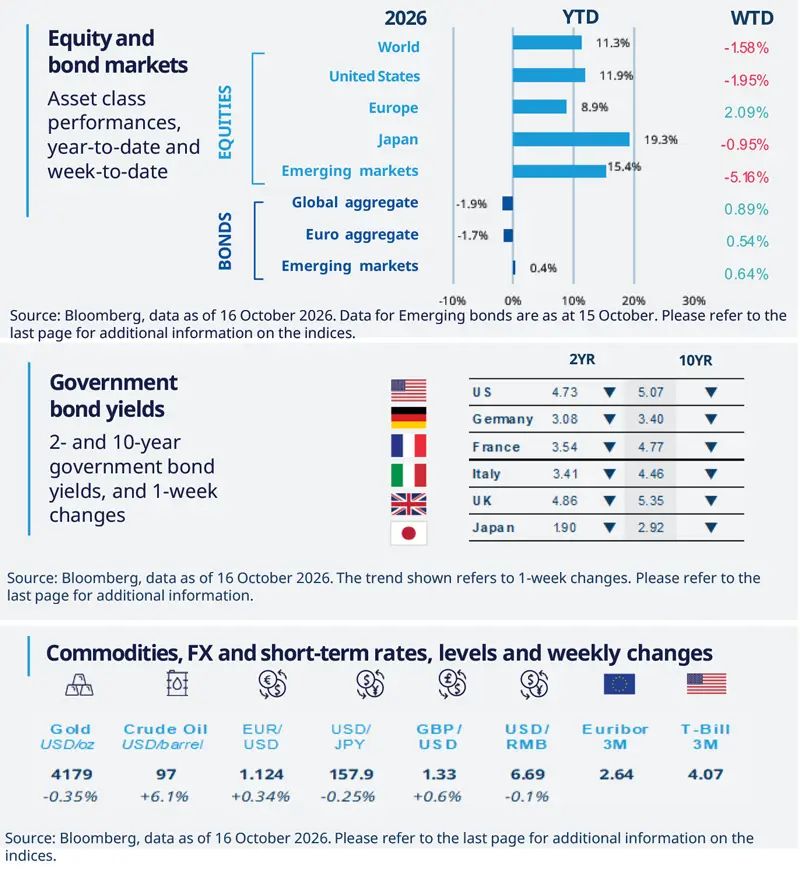
Equity and bond markets (chart)
Source: Bloomberg. Markets are represented by the following indices: World Equities = MSCI AC World Index (USD), United States = S&P 500 (USD), Europe = Europe Stoxx 600 (EUR), Japan = TOPIX (YEN), Emerging Markets = MSCI Emerging (USD), Global Aggregate = Bloomberg Global Aggregate USD Euro Aggregate = Bloomberg Euro Aggregate (EUR), Emerging = JPM EMBI Global Diversified (USD).
All indices are calculated on spot prices and are gross of fees and taxation.
Government bond yields (table), Commodities, FX and short-term rates.
Source: Bloomberg, data as of 16 October 2026. The chart shows the price of gold.
Diversification does not guarantee a profit or protect against a loss.
Amundi Investment Institute Macro Focus
Americas
US inflation surprises to the upside
Consumer prices rose 3.7% year on year in September, reaccelerating and surprising to the upside. The increase was partly driven by energy prices, as expected, but core inflation also picked up, with the index rising 2.6% year on year. Strength was relatively broad-base across both core goods (vehicles, both new and used, recreation goods, and apparel) and core services (driven by shelter). Overall, the report leaves the Fed questioning how much progress is being made on underlying inflation, keeping further rate hikes on the table.
Europe
ECB Keeps the Door Open to Rate Hikes
Several members of the European Central Bank’s Governing Council, speaking at the IMF meetings in Bangkok this week, indicated that further interest rate rises may be necessary. Germany’s Bundesbank president said another move cannot be ruled out, while Belgium’s central bank governor said the ECB will “probably” have to hike again. ECB President Lagarde noted that energy-driven inflation has not yet spread broadly through the wider economy.
Asia
MSCI proposes stripping Indonesia of its emerging market status on a standalone position
This would be a double downgrade that would bypass frontier status entirely — citing persistent concerns over market transparency, suspected coordinated trading, and weak enforcement of reforms. The announcement triggered Indonesia's worst stock market session in nearly three decades on Friday, with the Jakarta benchmark index falling more than 11%. MSCI will decide by end-June 2027. Consultations could be launched after the mid-November review.
Key dates
China GDP, Retail sales and Industrial production, US Housing Market Index |
UK CPI and PPI, Indonesia policy rate |
Japan CPI and PMI, India PMI, Euro Area PMI, ECB inflation expectations, US PMI and Consumer Confidence |

Authors