
Summary
Key takeaways
China’s sustainability agenda is a comprehensive national strategy, not just a decarbonisation effort. China’s sustainability agenda should be understood as more than a decarbonisation effort. It reflects a broader ambition centred on energy security, industrial competitiveness and geopolitical resilience, that integrates decarbonisation, electrification, industrial policy, supply-chain resilience and geopolitical influence into a single national strategy. The result is a transition that increasingly rewards system integration, value-chain control and enabling infrastructure, rather than capacity alone.
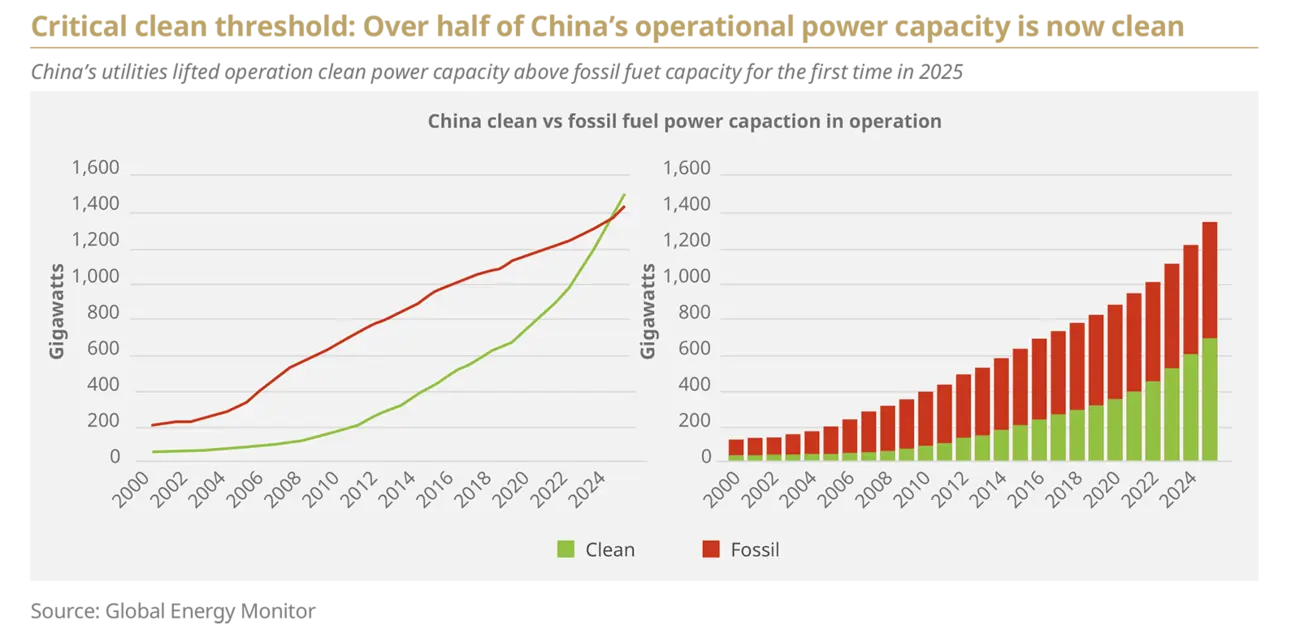
China’s power sector is already reflecting this strategic shift, with clean energy now dominant. China’s power sector already illustrates this shift. By end-2023, clean energy accounted for more than half of the country’s total installed power capacity for the first time, with solar as the primary driver. The 15th Five-Year Plan reinforces this trajectory, with continued strong emphasis on renewables, non-fossil energy, domestic energy security and strategic control over critical inputs.
China’s energy security efforts have proven a meaningful buffer against geopolitical and market volatility. Recent geopolitical tensions have further highlighted China’s relative resilience to external energy shocks. As volatility in oil and gas markets ripples through global supply chains, China’s energy self-sufficiency, strategic petroleum reserves and rapid renewable build-out appear to have cushioned its economy relative to many peers. Despite continued reliance on imported oil and gas and heavy coal use, China’s energy security efforts are visible in expanded renewables and EV deployment, larger strategic oil stockpiles and increasingly diversified supply routes.
For investors, China’s transition represents a broad, policy-backed industrial opportunity across the full value chain. China’s sustainability transition is a multi-dimensional, policy-backed industrial theme spanning power, transport, storage, grids, digital infrastructure and critical minerals. Clean energy in China should therefore be viewed as both a climate theme and a policy-backed industrial and strategic priority, creating opportunities across the full value chain, while also embedding its own dependency risks for other regions.
Why sustainability in China is about energy security
China’s sustainability strategy is best understood through the lens of energy security. Energy self-sufficiency rose to 85% in 2024¹, up from around 80% a decade earlier, and is likely to rise further as domestic resources develop and renewable capacity scales. Even so, China remains materially reliant on imported oil and gas, keeping the transition to a “new-type power grid” high on the strategic agenda to optimize the energy structure with more integration of renewable energy.
The dual objective of the strategy is embedded in the policy framework. Sustainability supports emissions reduction, while strengthening supply security, industrial resilience and policy control over strategic parts of the economy. The 15th Five-Year Plan makes the green transition a whole-of-economy priority, anchored by carbon peaking and neutrality targets. It calls for tighter emission controls, carbon management across regions and sectors, and expanded carbon footprint standards, labelling and monitoring. At the same time, state-led market design is improving demand visibility. Green power trading, green certificates, power market reform and the national carbon market are strengthening offtake visibility and price discovery by demand from electrification, data centres, and industrial upgrading. The key issue is how effectively China can convert structural demand into bankable clean-energy cash flows.
China’s climate strategy is built around its dual carbon goals of peaking CO₂ emissions before 2030 and reaching carbon neutrality by 2060. Its latest 2035 NDC pledges a 7 to 10% reduction in GHG emissions from peak levels. China has also made rapid gains in renewables and EVs, while implementation continues to face grid bottlenecks, renewable curtailment, and weaker emphasis on near-term emissions cuts.
China’s 15th Five-Year Plan places climate and sustainability at the centre of its policy agenda, aiming to achieve the dual carbon goals al. By 2030, China aims to cut carbon intensity by 17% from 2025 levels and lift non-fossil energy to 25% of total energy consumption, supported by a ten-year doubling of non-fossil energy, expanded wind, solar, hydro and nuclear deployment, and offshore wind capacity of more than 100 GW. The plan also targets lower PM2.5 concentrations, improved water quality and higher forest coverage, underscoring that sustainability is being treated as both a climate and broader economic priority. Implementation priorities include heavy-industry upgrades, coal reduction and clean substitution, low-carbon transport, building retrofits, zero-carbon industrial parks and climate adaptation.
Launched in 2021, China’s National Carbon Market is the world’s largest by covered emissions, covering around 8 billion tCO2, or roughly 60% of China’s CO2 emissions. It was designed as a key policy tool to support China’s carbon-peaking and carbon-neutrality goals, while improving emissions control across major industrial sectors. The system expanded in 2025 from the power sector into steel, cement and aluminium smelting, bringing hard-to-abate industries into scope for the first time. As of June 2026, 100% allowances are still allocated for free on an output-based basis, and enterprises can achieve economic benefits by trading emission reductions obtained through measures such as energy conservation, emission reduction, and management optimization in the market as surplus quotas, while high-emission enterprises must pay costs to purchase quotas to fulfil their compliance obligations. Whilst this still limits the economic incentive of decarbonisation. Latest policy guidance set out a roadmap to move toward an absolute cap and further sector expansion in 2027².
China’s transition is also becoming more institutionalised. Carbon governance, disclosure standards and green finance frameworks are moving from policy signalling toward operational implementation, making the transition easier to measure, compare and embed across sectors. The result is a shift from broad ambition to a more structured and investable transition.
China’s transition is also becoming more institutionalised. Carbon governance, disclosure standards and green finance frameworks are moving from policy signalling toward operational implementation, making the transition easier to measure, compare and embed across sectors. The result is a shift from broad ambition to a more structured and investable transition.
Financing the transition: policy-led capital allocation and market design
China’s clean-energy transition is supported by a financing model that combines policy direction with market-based instruments. A key element is the 2025 Green Finance Endorsed Project Catalogue, which seeks to unify China’s sustainable finance market across green finance products. China’s broader “market-driven, government-guided” framework coordinates financial policy across central and local authorities to steer capital toward renewables and other low-carbon assets.
The People’s Bank of China plays a central role through green collateral, macroprudential incentives and targeted relending tools, including the Carbon Emission Reduction Facility, which lowers the cost of capital for renewable projects. State-owned enterprises and state-capitalised funds reinforce the system by creating demand for clean technologies and providing risk capital for emerging ones. China’s cumulative aligned green, social, sustainability and sustainability-linked bonds issuance reached over US$500bn by end-2024³. Green bonds remain dominant, while social and sustainability-linked issuance has grown, supported by policy reforms, taxonomy development and cross-border alignment initiatives.
China’s clean-energy demand is increasingly shaped by market design rather than broad consumer subsidies. This is the backdrop to China’s power-system challenge: as demand becomes more complex and more distributed, the transition is moving from capacity build-out toward system flexibility.
Power system transformation: from capacity to flexibility
China’s power transition is entering a new phase. The key constraint is no longer how much renewable capacity can be added but integrating it reliably at scale. In other words, the investment focus on transition towards a flexible power system.
China has a structural advantage in ultra-high-voltage (UHV) transmission, including ultra-high-voltage alternating current (UHVAC) and ultra-high-voltage direct current (UHVDC) lines, as well as transformers, switchgear and associated grid equipment. This matters because much of the country’s renewable resource base is located far from demand centres, requiring long-distance transmission from inland provinces to coastal load hubs. Chinese firms have deep capabilities in power electronics, which are increasingly essential as the grid becomes more intermittent and distributed.
The key investment theme is the ongoing build-out of grid, storage and digital infrastructure. Total national investment in power grids reached 639.5 billion yuan in 2025⁴, as heatwaves, industrial load growth and higher renewable penetration increase pressure on grid flexibility and transmission capacity. In some regions, renewable build-out has outpaced grid expansion, contributing to curtailment and limiting the ability to move clean power to high-demand eastern provinces.
In response, it is developing a more resilient system in which renewables, storage, transmission, digital controls and demand management work together to support reliability and industrial growth.
The key point is that China’s clean-energy opportunity is moving up the value chain. The best opportunities are likely to sit in grid expansion, storage, digital control systems, power conversion equipment and flexibility services. Success will depend on grid readiness, storage deployment, curtailment management and the ability to convert policy support into bankable cash flows.
Transport electrification at scale: EVs, commercial vehicles and charging ecosystems
China’s sustainability transition is being driven by demand-side electrification, especially in transport. The country’s EV leadership rests on a fully integrated ecosystem spanning batteries, materials, manufacturing, charging infrastructure and downstream deployment. This end-to-end structure has enabled faster cost reduction, tighter supply-chain integration and more rapid commercial scaling than in most other markets.
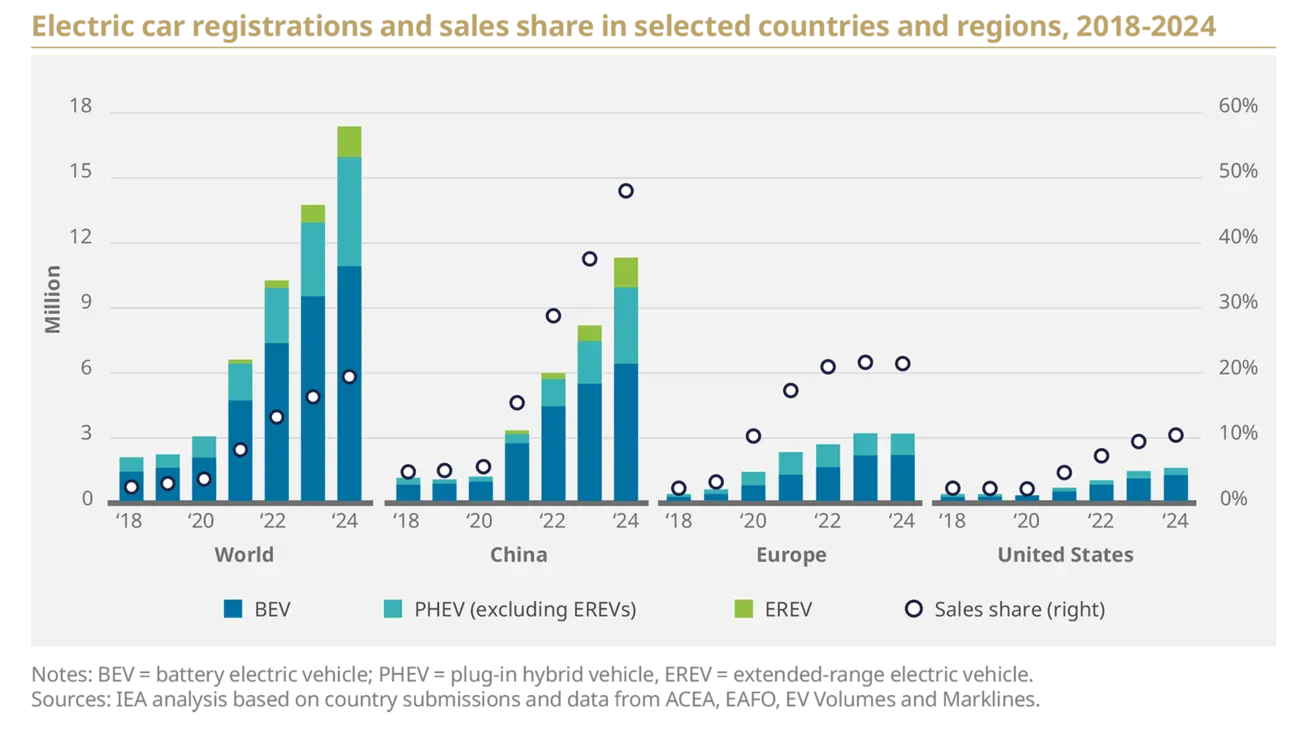
EVs accounted for almost half of car sales in 2024, helped by lower prices across the market. China is the world’s largest EV market and production base, accounting for nearly two-thirds of global EV sales, more than 70% of production and around 40% of exports⁵.
The next leg of growth is increasingly infrastructure-led. China is the main testbed for ultra-fast charging, battery swapping and grid-integrated charging. Charging points account for about 65% of the global total, and China led fast-charger growth again in 2024⁶. In parallel, commercial vehicle electrification is gaining traction, particularly in medium- and heavy-duty vehicles, supported by lower-cost battery chemistries, dedicated charging infrastructure and battery swapping.
Industrial advantage: China’s clean-tech manufacturing base
China’s green energy strategy is an industrial strategy. Rather than importing the technologies of the energy transition, China is manufacturing them at scale and embedding them into energy-security planning. The result is a clean-tech manufacturing base that shapes pricing, deployment and supply-chain risk across global markets.
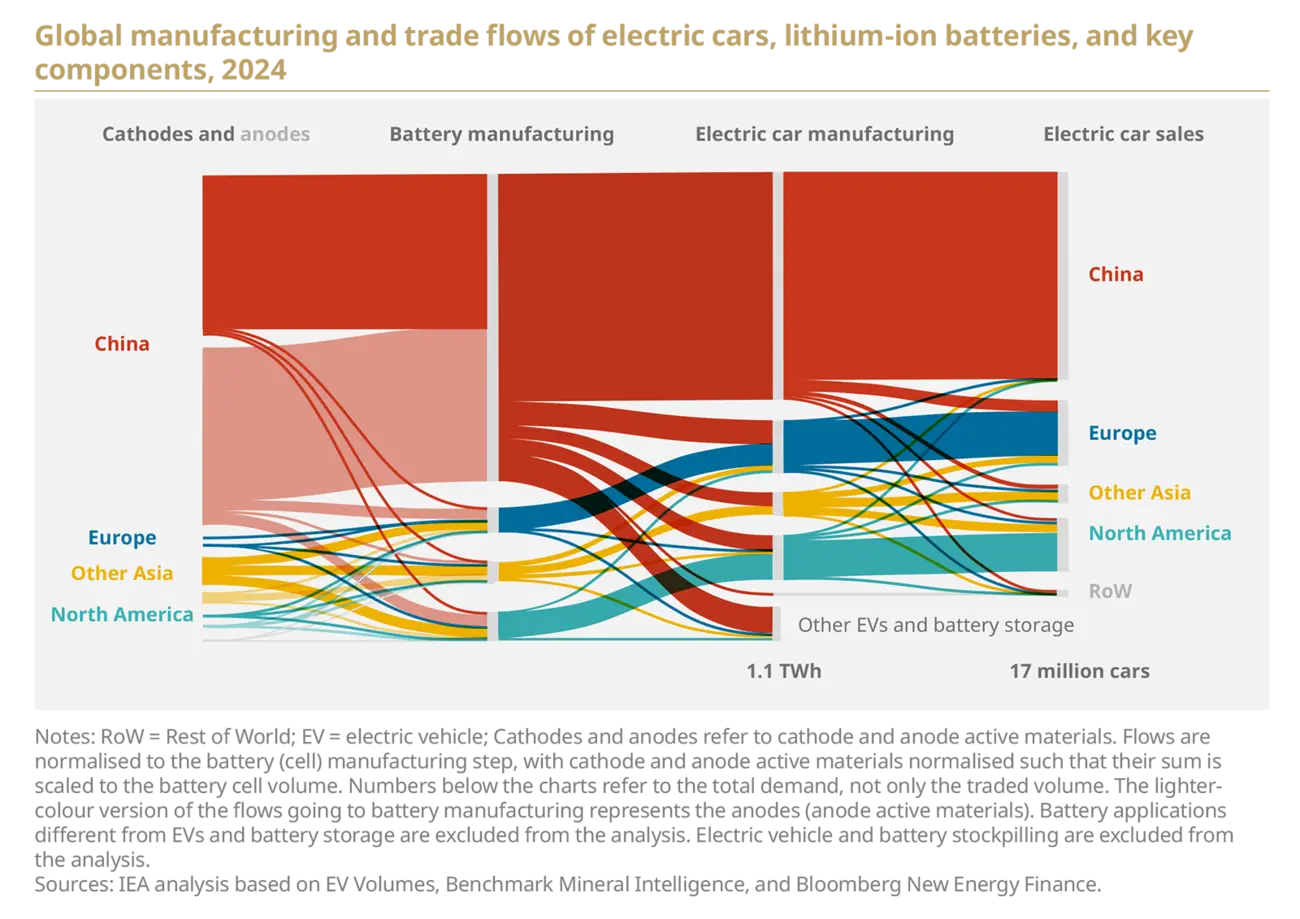
Concentration is striking. Although raw material extraction is geographically distributed, processing and manufacture are concentrated in China. China accounts for around 85% of solar and 80% of lithium-ion battery supply-chain capacity, rising to roughly 95% for PV wafers and 97% for anode materials⁷. This scale gives domestic producers a clear cost advantage and leaves global clean-energy markets vulnerable to supply disruption and trade policy risk.
Solar is the clearest example. China dominates the full value chain from polysilicon to modules and has driven costs down by more than 80% over the past decade, making solar the cheapest new-build power source in many markets. Periods of constrained polysilicon supply have shown how quickly upstream bottlenecks can reshape pricing and margins across the sector.
Batteries. China has developed an integrated value chain spanning raw materials, refining, precursor chemicals, cell manufacturing and pack assembly. Its position in LFP chemistry is particularly important, given rising demand from EVs and stationary storage. China accounts for nearly all global LFP production, and LFP now dominates both EV battery deployment and stationary storage. The next phase of innovation is to leverage the capacity of battery chemistry and battery design for product innovation, such as Na-ion and Sodium-ion, which is moving from pilot production toward early commercialization and could become strategically relevant for storage and lower-cost mobility.
Wind power. China is the world’s largest wind market and manufacturing base and holds strong positions in blades, towers and nacelles. Its role in rare earth mining, refining and magnet production gives it control over critical inputs for wind turbines.
China’s clean-tech manufacturing base is both a source of competitive advantage and a structural concentration risk for global energy-transition markets.
New demand frontier: data centres and digital infrastructure
Data centres are emerging as a new source of electricity demand in China, alongside EVs and industrial electrification. As digitalisation and AI workloads expand, they are becoming a new structural load on the power system, adding to demand for grid investment and decarbonisation. China accounted for about 25% of global data centre electricity consumption in 2024⁸, and data centres are expected to be the fastest-growing source of power demand in the country through 2030⁹.
The policy response is defined by efficiency and clean-power integration. Data centre development is a key part of China’s 15th Five-Year Plan, which combines efficiency targets with renewable integration. New large and mega data centres must achieve a power usage effectiveness of 1.25 or lower, while projects in national computing hubs face a stricter 1.2 threshold. Data centres in national computing hubs are expected to source at least 80% of electricity from renewables. This is being supported by the “Eastern Data, Western Computing” strategy, which shifts resource-intensive, latency-tolerant workloads from eastern coastal hubs to western computing centres such as Gansu, Ningxia and Guizhou. Greater use of green power procurement, direct renewable sourcing and local clean generation support the shift.
The investment opportunity extends beyond computing capacity to the enabling infrastructure around it. Liquid cooling, power management systems, backup batteries, optical transceivers, grid connectivity and local clean-power sourcing are likely to benefit as AI and other compute-intensive applications rise.
Critical minerals and supply chains: China’s upstream leverage
A central dimension of China’s green transition is its leverage over critical mineral processing and related supply chains. The country’s strength lies in the refining, processing and conversion stages upstream of batteries, EVs and renewable energy systems, giving it strategic leverage over the pace, cost and resilience of the global energy transition.
This advantage is most evident in graphite, rare earths, lithium processing, battery-grade materials and related chemical processing. In many cases, the key bottleneck is the ability to refine and convert materials into usable industrial inputs rather than ore extraction itself. Processing capacity is harder to replicate than mining capacity, creating vulnerability across global supply chains despite geographically diversified extraction.
The reach extends across the clean-tech value chain. Graphite is critical for battery anodes, while rare earth processing is essential for the permanent magnets used in wind turbines and EV motors. China’s position in these materials gives it influence over both the cost base of clean-tech manufacturing and the pace of supply-chain localisation elsewhere.
Diversification should support upstream producers outside China, especially where governments are backing local processing and strategic stockpiling. China’s position in critical minerals and processing means the clean-energy transition will be shaped by upstream supply-chain structure, affecting pricing, localisation and capital allocation.
Investment views – China and the critical minerals value chain The accelerating deployment of renewable energy infrastructure and rising EV penetration are generating structural demand for critical minerals, providing a compelling investment rationale for those seeking exposure to the cleaner segments of the energy value chain. China is well positioned to benefit from this through its comprehensive lithium processing capacity, reinforcing its dominant position in battery value chain. China’s strategic footprint in the global lithium battery market is enviable for both its technology and scale. CATL, the world’s largest battery manufacturer held a 39.2% global power battery market share in 2025, while its energy storage battery shipments led the global market for the fifth consecutive year. On the ESS front, growth has consistently outpaced market expectations: although China’s removal of the ESS mandate for renewable projects was initially viewed as a headwind from the second half of 2025, province-level policies (e.g. baseload charging mechanisms, market-based pricing) have incentivised higher and better quality deployment. Yet, the current situation reinforces a paradoxical reality: China remains heavily dependent on imported raw materials to sustain that position, such as lithium from Australia, Africa, and Latin America. Resource-rich countries are increasingly seeking to capture a greater share of the value added within their borders rather than exporting raw ores at low margins. Zimbabwe illustrates this trend: it banned exports of unprocessed lithium ore, mandating that refining and beneficiation occur domestically. This shift creates friction for Chinese processors dependent on upstream raw material flows, and reflects a broader wave of resource nationalism reshaping global mineral trade dynamics. Further supply-side constraints complicate the outlook. Despite robust demand, expanding domestic mining production remains difficult, notably due to rising permitting hurdles. CATL’s suspension of its Jiangxiawo lithium mining operation after regulators revoked the site’s environmental approval illustrates growing regulatory risks. For investors, these dynamics creates both risk and opportunity: the concentration of processing capacity in China introduces supply chain vulnerability for the rest of the world, while the tightening of mineral supply and the rise of resource nationalism globally increase the value of companies and jurisdictions offering reliable, responsibly sourced critical-mineral exposure. Jatinder Goel, Senior Global EM Materials Analyst |
Investment implications and conclusion
China’s sustainability case should be framed around resilience, industrial policy and system integration rather than emissions reduction alone. China’s sustainability economy is driven by much more than decarbonisation, even as climate remains central.
The key takeaways are:
– Policy support is durable. Clean energy is strategically important, supporting continued capital allocation into renewables, storage, grids and electrification.
– Concentration is both an advantage and a risk. China’s dominance across the energy transition supply chain is a double-edged sword. On one hand, it has driven the scale and cost efficiencies that underpin the global buildout. On the other, it creates meaningful exposure to trade friction, regulatory shifts, and geopolitical shocks. Crucially, these dynamics operate on different timescales and are unlikely to manifest with equal intensity, making concentration a risk that is easy to underestimate until it materializes.
– The transition is moving from generation to integration. Grid equipment, power electronics, digital infrastructure and flexibility solutions are becoming increasingly important.
– Electrification is broadening. Heavy-duty transport, industrial processes and data infrastructure are now relevant demand drivers.
– Critical minerals are a bottleneck. Upstream refining and processing matter as much as mining and final manufacturing.
The most attractive opportunities span the full energy transition stack, from grid equipment and transmission through storage, charging infrastructure, and fleet electrification, to high-quality renewable developers, power electronics, industrial software, and selective upstream materials where supply diversification is already underway. These opportunities are to be balanced against risks from policy shifts, overcapacity and margin compression, supply-chain concentration, and geopolitical disruption to materials, logistics, and export markets.
China’s sustainability agenda is a matter of national resilience. The green transition is supporting energy security, industrial competitiveness and lower vulnerability to external shocks for China. Clean energy in China should be viewed as a strategic policy framework linking power generation, electrification, industrial upgrading, digital infrastructure and critical minerals.
For investors, this creates a more complex and compelling opportunity set. China is a key centre of clean-tech manufacturing and deployment, but the next phase is no longer about capacity alone. It is about system integration, supply-chain control, grid modernisation and strategic resource management. While electrification lowers vulnerability to traditional fossil fuel cartels for other regions, it also risks creating new techno-economic leverage points controlled by Beijing. In an uncertain geopolitical environment, China’s sustainability transition will continue to shape global clean-tech markets.
1. The State Council of the People’s Republic of China. (2024, December 14). Nation set to boost energy security
2. Ministry of Ecology and Environment of the People’s Republic of China. (2026, February 9)
3. Climate Bonds Initiative. (2025, July 4). China’s sustainable debt market hits key milestones
4. National Energy Administration of the People’s Republic of China. (2026, July 17)
5. International Energy Agency. (2025). Global EV Outlook 2025
6. International Energy Agency. (2025). Global EV Outlook 2025
7. International Energy Agency. (2026). Energy Technology Perspectives 2026
8. International Energy Agency. (2026). Energy and AI
9. International Energy Agency. (2026). Energy and AI




Author