
Summary
Central banks and AI in the driving seat
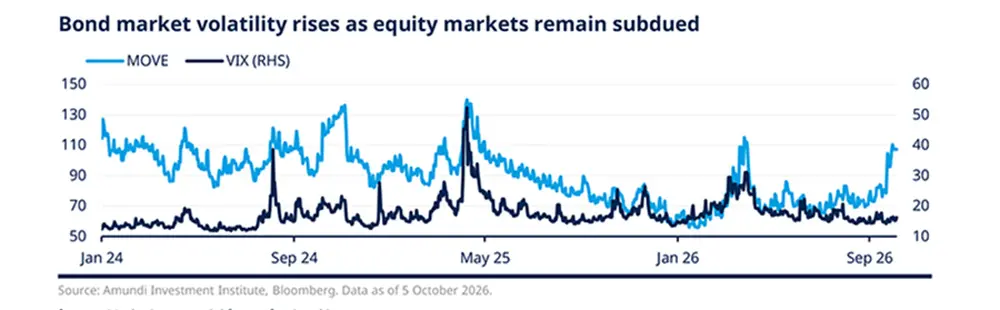
In September, global bond markets came under pressure amid inflation concerns and hawkish shifts by central banks, while equity markets remained relatively calm, supported by strong economic data and earnings, alongside renewed optimism around AI.
In fixed income, the average yield on global government debt has moved close to 4% – its highest level since 2007. Central bank tightening and a hawkish tone increased expectations for further rate hikes, pushing the short end of the curve higher and flattening yield curves. Rising funding needs among governments and corporates are also keeping long-end yields elevated.
Oil prices remain news-flow driven. Brent rose to $105 before easing. Understanding whether rerouting efforts in the Middle East will be sufficient is becoming increasingly important for commodity markets.
Equity markets proved less volatile, as higher-rate headwinds were partially offset by renewed optimism on the AI-theme for new product launches, continued infrastructure spending and positive earnings data.
Looking ahead, we focus on the following themes:
Geopolitical developments and inflation expectations. Tensions in the Middle East have increased, and the risk of a short-term regional escalation remains. Looking ahead, Brent is expected to ease towards $80 by early 2027. Gas remains a separate risk, as LNG supply, inventories and rerouting capacity are more constrained. Europe faces greater growth risks if gas inventories are not rebuilt, given its import dependence and limited alternative routes. The effects of conflicts in the Middle East and Russia/Ukraine remain closely intertwined, with implications for refined products. Disruption to grain exports from Russia and Ukraine adds to concerns about food prices, alongside the potential impact of a Super El Niño on crops. Under this scenario, we expect inflation to prove more persistent.
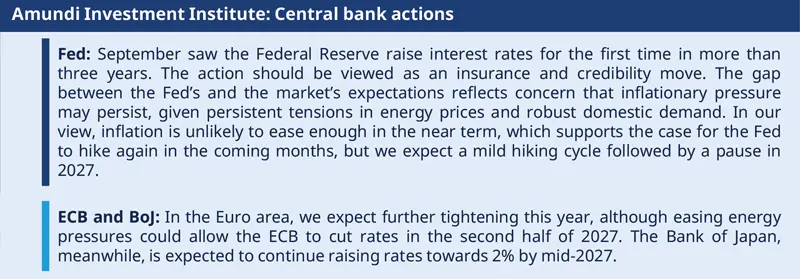
Central bank reaction function. Renewed pressure on energy prices has made inflation more persistent, prompting major central banks to raise policy rates with a hawkish tilt. This reflects a broader effort by major central banks to tackle persistent inflation and reinforce their credibility. We do not expect a prolonged tightening cycle in the different areas, but uncertainty remains high. Looking ahead, we think that a reassessment of the central bank’s reaction function is required across three dimensions: inflation persistence and indirect/second-round effects; growth resilience and the threshold at which central banks would respond to weakening demand, including the implications for investments and AI-related capital spending; and financial conditions, taking into account tightening at the long end of the curve and in credit conditions, rather than looking at the policy rate in isolation.
Rising scrutiny on capex monetisation. The higher-for-longer rate environment and competition for capital make investment discipline crucial. Upcoming IPOs will be a key test. The US remains the main pipeline, Hong Kong issuance is already ahead of last year and competing with China, while Europe remains quiet. Listings are increasingly concentrated in semis, power and data-centre infrastructure, as well as businesses already converting AI demand into revenue. Credit supply is also high. US IG issuance has surged this year, led by AI-related capex, and we expect it to remain strong and broaden into Europe. In the near term, the leverage ratio should remain broadly stable, as earnings growth should partially offset the increase in net debt. Overall, this suggests an increasingly selective approach to AI, even if credit spreads are likely to remain relatively stable in the near term.
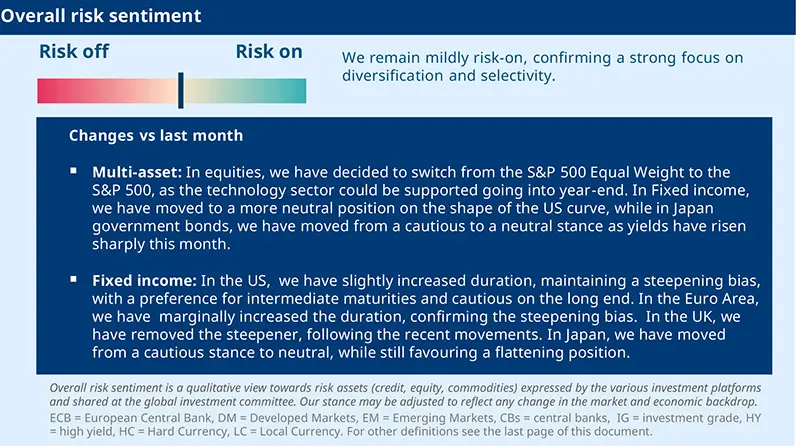
In this environment, we maintain a strong focus on diversification and selectivity within a mildly risk-on stance overall.

Monica DEFEND
The recent actions by major central banks reflect a broader effort to tackle persistent inflation and reinforce their credibility. We do not expect a prolonged tightening cycle everywhere, but uncertainty remains high.
Below we have outlined our views on asset classes:
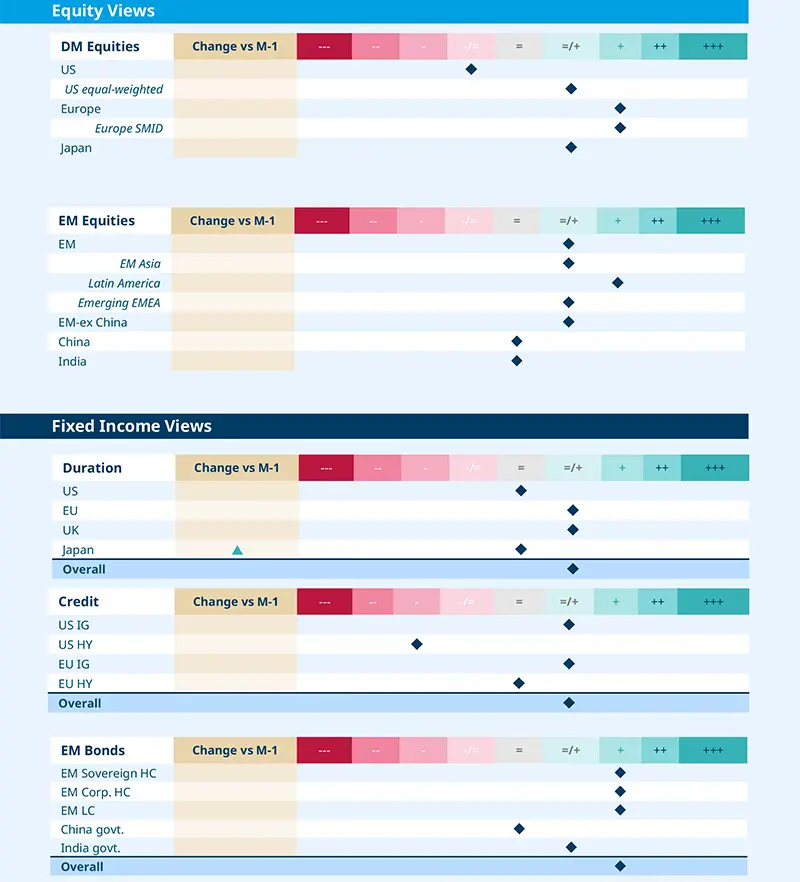
In fixed income, we confirm a close to neutral stance on US duration, maintaining the preference for the intermediate maturity bonds while remaining cautious further out the curve. In the EMU, we remain constructive on duration, favouring peripherals over core and also confirm steepening. In the UK, we confirm a mild positive stance on duration, with a neutral position on curve shape while in Japan we have removed the cautious stance, moving to neutral. In credit, we remain mildly constructive overall, with a preference for Global IG.
In equities, we continue focusing on resilient sectors and balance sheet growth. Strategically, we remain cautious on the US while we maintain our long-term positive view on Europe, which looks attractive on earnings, valuation and diversification. We are constructive on Japan, given strong earnings growth and reasonable valuations. We remain constructive on EM, even if we note the importance of AI capex momentum for equity indices. In a market shaped by AI, energy price uncertainty and re-routing, we believe that Latin American equities can offer diversification supported by attractive valuations and improving policy dynamics.
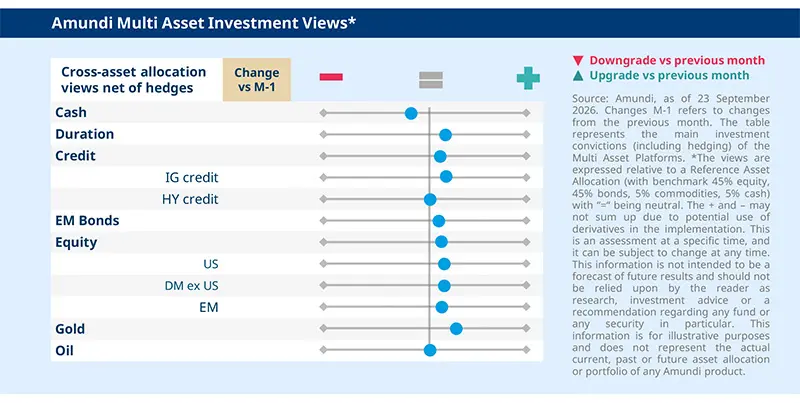
In multi-asset, we remain mildly pro-risk, with a preference for regional diversification, selectivity and carry rather than strong directional positions. On equities, we confirm a mildly positive view, supported by strong earnings growth, a resilient global growth backdrop, and our expectation of a mild, not prolonged tightening cycle. In FX, we continue to favour higher-carry EM currencies. In commodities, we confirm our positive view on gold, as medium to long term supportive factors remain in place, including expansionary fiscal policies, debt sustainability concerns, reserves diversification.
Higher borrowing costs and growing competition for funding make investment discipline more important. We look for businesses with the potential to withstand higher rates and generate sustainable earnings.
FIXED INCOME
More nuanced positioning
Amaury D’ORSAY |
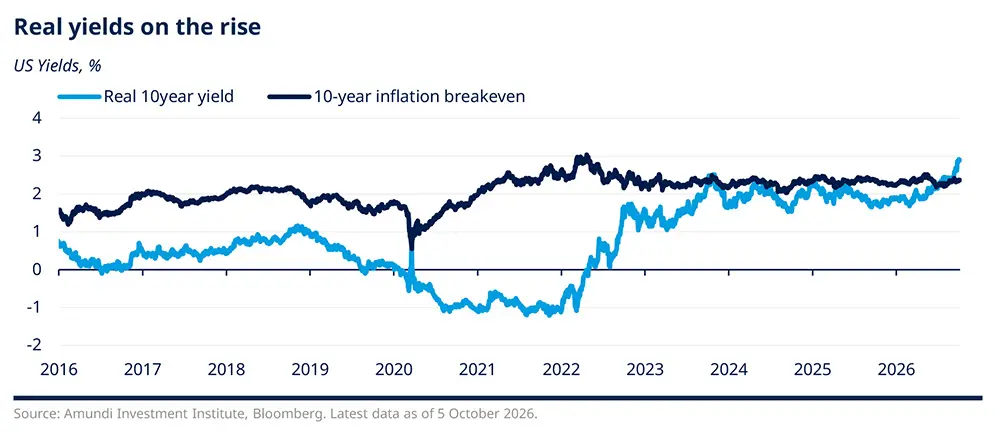
September saw major central banks take action. After a period of hawkish rhetoric, the Fed finally raised rates, alongside similar moves by the ECB and the Bank of Japan. Markets reacted by lifting interest rate expectations and pushing up short-term rates. On top of this, the long end continued to come under pressure amid economic resilience and issuance pressures, which have pushed real rates to attractive levels.
Looking ahead, we remain selectively constructive on duration, preferring short- to medium-term maturity bonds while remaining cautious on the long end.
In the US, we have slightly increased duration, maintaining a preference for intermediate-maturity bonds while remaining cautious further out the curve. In the euro area, we have marginally increased duration, continuing to favour curve steepening and peripherals.
In the UK, we have removed the steepener, following recent performance.
In Japan, we have moved from a cautious stance to neutral, maintaining our flattening bias as monetary policy and term-premium normalisation continue.
We remain mildly constructive on this asset class, as credit continues to be supported by demand for yield and high-quality bonds.
As supply is expected to remain elevated and dispersion is increasing, investment discipline and selectivity are becoming crucial.
We are positive on global IG, with a slight preference for EUR IG, mainly through subordinated over HY. We favour short-dated bonds.
At sector level, we prefer financials and, among non-financials, telecom, tech and pharmaceuticals.
We are constructive on EM debt, but, in a global environment of higher yields, we confirm that selectivity remains paramount.
We maintain a positive stance on Corporate Hard Currency and Sovereign Hard Currency, where we favour Latin America and Sub-Saharan Africa. In Local Currency bonds, we favour Brazil, Hungary and South Africa.
In EM currencies, we favour LatAm and Central-Eastern Europe over Asian currencies, while awaiting a clearer dollar direction before adding conviction.
EQUITIES
Earnings support equity opportunities
Barry GLAVIN |
Equity markets were resilient amid hawkish central bank actions, inflation fears and rising bond yields. Indeed, these factors were partly offset by renewed enthusiasm on AI. Looking ahead, as earnings remain strong, the key question is how far equity valuations could be compressed in a rising-yield environment. Hence, our focus is on resilient, non-disrupted business models with balance sheet strength.
Across regions, we continue to favour areas outside the US as they offer lower concentration and valuation risks. Europe looks attractive relative to the US on earnings momentum, valuation and diversification. We remain positive on Japan, given robust earnings growth and reasonable valuations. EM offer opportunities to diversify across different themes, including energy, technology and structural demand drivers.
Globally, we focus on resilient sectors such as consumer staples and healthcare, alongside high-quality cyclical stocks within industrials and materials. We are positive on financials but believe the broad “beta trade” is over and that stock selection is now key.
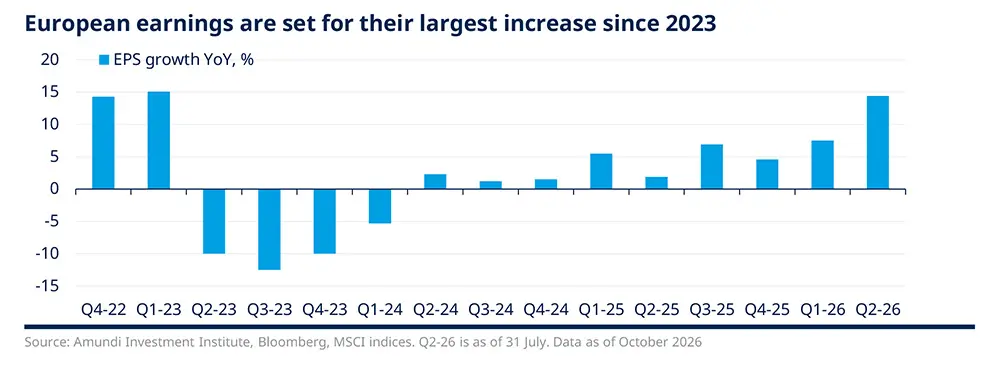
Europe remains attractive relative to the US on earnings momentum, valuation and diversification. We see opportunities in technology, and among businesses benefiting from AI adoption. Industrials should benefit from demand growth, amplified by AI, which is boosting demand for equipment and electricity. Utilities are also linked to AI growth, as data-centre electricity demand drives grid expansion.
In Japan, we like industrials and small- and mid-cap stocks tied to supply-chain resilience, AI and infrastructure. Domestic industrials also look attractive where valuations lag fundamentals.
Earnings are robust, driven by digitalisation. Taiwanese and Korean suppliers are benefiting from the AI boom, with US tech spending underpinning demand despite concerns about returns and Chinese competition. In South Korea, the Corporate Value-Up reforms should also be supportive for stock valuations.
In China, higher corporate taxes are weighing on cash flow. However, as long as exports keep growing, we do not expect more proactive fiscal support. Overcapacity clouds the earnings outlook, and policy efforts to reduce it will take time.
Latin America is supported by attractive valuations and the prospect of an improving policy mix, boosting macro stability and the reform outlook. The area is positively geared to global geopolitical frictions and has a competitive advantage in soft and critical commodities.
MULTI-ASSET
Diversification, selection and carry
Francesco SANDRINI CIO Italy & Global Head of Multi-Asset | John O’TOOLE Global Head - CIO Solutions |
The broader macro view remains mildly pro-risk, with a preference for regional diversification, selectivity and carry. While growth remains resilient but uneven, inflation appears more persistent and is starting to look more broad-based. Central banks are reacting to this, with markets beginning to price in more rate hikes.
In fixed income, we retain a constructive duration bias in the US and euro area, as rates are becoming more attractive in absolute terms and the market seems to be pricing in too many central bank hikes. In the US, we maintain a preference for the intermediate part of the curve, as the market appears to be pricing in too many Fed hikes, but we have moved to a more neutral position on curve shape, removing the steepening bias for risk management purposes. In Japan, we have moved from a cautious to a neutral stance, as yields have risen sharply this month. Finally, we remain constructive on euro IG credit and confirm our positive view on EM bonds.
On equities, we maintain a constructive view. In the US, we have decided to switch from the S&P 500 Equal Weight Index to the S&P 500, as the technology sector could remain supported into year-end.
In commodities, we maintain a positive stance. While recent moves have been driven primarily by shifting expectations around Fed policy and rising yields, several supportive factors remain in place over the medium to long term, including expansionary fiscal policies, debt sustainability concerns and reserve diversification.
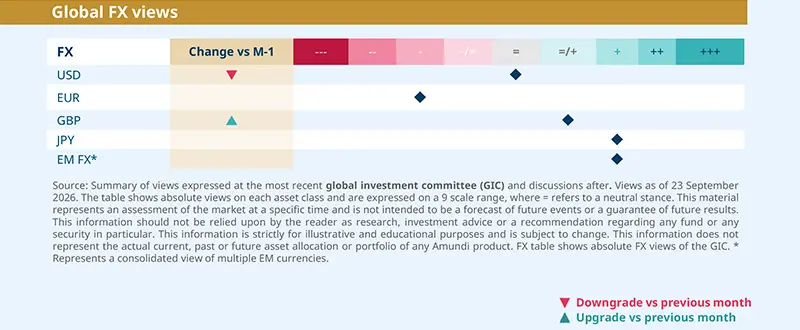
In FX, overall, we have a cautious stance on the USD and a preference for currencies that offer attractive carry, such as AUD and NOK among G10 currencies, and TRY among EM currencies.
VIEWS
Amundi views by asset classes
Definitions & Abbreviations
Currency abbreviations: USD – US dollar, BRL – Brazilian real, JPY – Japanese yen, GBP – British pound sterling, EUR – Euro, CAD – Canadian dollar, SEK – Swedish krona, NOK – Norwegian krone, CHF – Swiss Franc, NZD – New Zealand dollar, AUD – Australian dollar, CNY – Chinese Renminbi, CLP – Chilean Peso, MXN – Mexican Peso, IDR – Indonesian Rupiah, RUB – Russian Ruble, ZAR – South African Rand, TRY – Turkish lira, KRW – South Korean Won, THB – Thai Baht, HUF – Hungarian Forint.



Authors