
Summary
Diversification and selectivity could help navigate a period of increasing scrutiny over policymakers’ credibility and the sustainability of earnings in the AI ecosystem
Iran conflict: Diversification at play
In the six months since the start of the Iran war, global growth has remained resilient, while inflation has stayed above target.
Equities rose on earnings and AI optimism, while bonds suffered on fears of fiscal slippage and higher supply.
A European diversified portfolio delivered strong returns, offsetting bond weakness and benefiting from the equity rally.
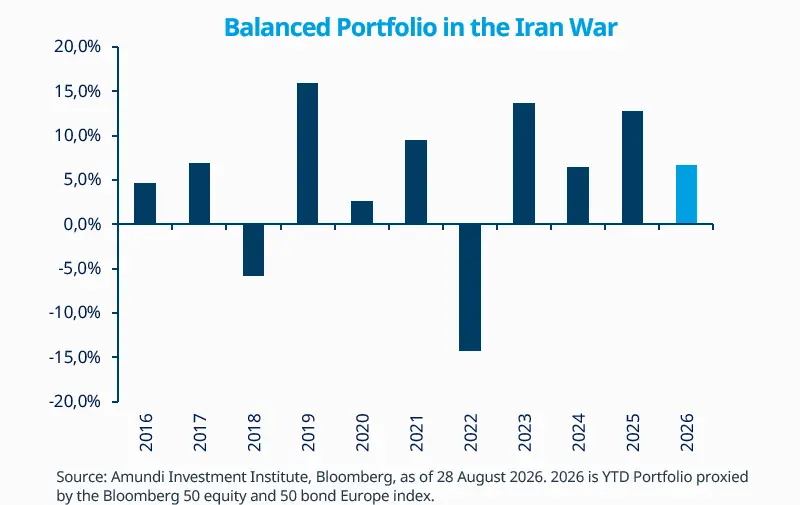
Six months after the conflict in the Middle East began, the macroeconomic backdrop has proved more resilient than expected, particularly in the Eurozone where we are seeing stronger Q2 data and improving leading indicators. Inflation is expected to peak at lower levels, but remain above target in major economies with geopolitical tensions and climate patterns still posing risks to energy and food prices. Meanwhile, earnings growth has remained solid, broadening beyond technology and across countries, while yields have risen, amid fiscal and supply concerns, as well as shifting monetary policy expectations.
Looking ahead, a diversified approach across regions and asset classes could help navigating a period in which the credibility of policymakers and the fundamentals of companies, particularly in the artificial intelligence ecosystem, will come under increasing scrutiny.
This week at a glance
Equity markets gained after fresh earnings data reinforced confidence in the AI boom and helped restore investor sentiment. In fixed income, shorter-dated US yields moved higher after new Fed Chair Kevin Warsh struck a hawkish tone at Jackson Hole, causing the curve to flatten. Oil fell on renewed optimism around diplomacy with Iran, while gold retreated as markets priced in further central bank rate hikes. In FX, the US dollar edged slightly higher.
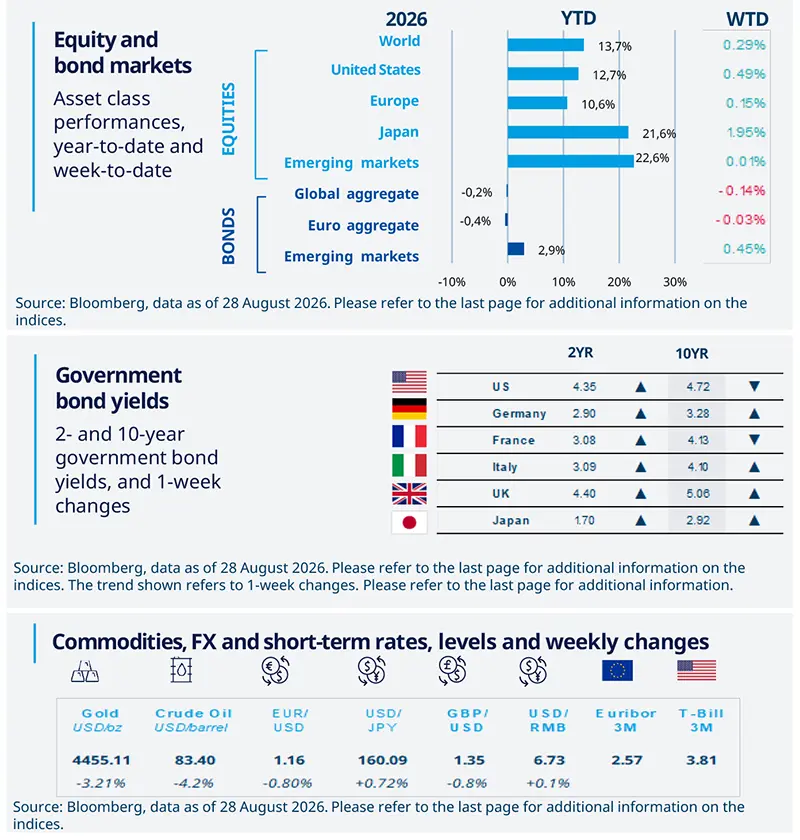
Equity and bond markets (chart)
Source: Bloomberg. Markets are represented by the following indices: World Equities = MSCI AC World Index (USD) United States = S&P 500 (USD), Europe = Europe Stoxx 600 (EUR), Japan = TOPIX (YEN), Emerging Markets = MSCI Emerging (USD), Global Aggregate = Bloomberg Global Aggregate USD Euro Aggregate = Bloomberg Euro Aggregate (EUR), Emerging = JPM EMBI Global Diversified (USD).
All indices are calculated on spot prices and are gross of fees and taxation.
Government bond yields (table), Commodities, FX and short-term rates.
Source: Bloomberg, data as of 28 August 2026. The chart shows the price of gold.
Diversification does not guarantee a profit or protect against a loss.
Amundi Investment Institute Macro Focus
Americas
US inflation persists at a high level
The PCE price index increased slightly on a monthly basis and remained at 3.7% YoY, slightly above the expected 3.6%; core PCE remained at 3.3%. There has been no further significant acceleration, but inflation remains too high, supporting a Fed hold in September. On the consumption side, US personal spending rose 0.2% MoM, but adjusted for inflation it remained flat. Spending has been concentrated in essential and asset-price-linked services rather than discretionary demand.
Europe
France’s inflation rises, driven mainly by energy
In France, inflation rose in August, from 2.4% to 2.7%, with a monthly increase of 0.8%. The rise was driven primarily by energy prices, particularly petroleum products. Meanwhile, food prices increased slightly, while inflation in the services sector slowed. As a result, the signal on core inflation is less concerning than the headline figure suggests. Rising oil and gas prices pose an upside risk to inflation and a downside risk to growth, which is likely to keep the ECB cautious.
Asia
Bank of Korea raises interest rates
The Bank of Korea raised its policy rate by 25bp to 3%, while signaling a low pace of tightening from here in its six-month dot plot. A preemptive response was deemed necessary to prevent inflation pressures from broadening, while financial-stability risks still required attention. The BOK raised its 2026 growth forecast to 3.3% from 2.6% but kept inflation at 2.7%, as the AI-chip boom and stronger domestic demand may offset disinflation from lower oil prices and a firmer currency.
Key Dates
Brazil GDP, Eurozone Manufacturing PMI and CPI, US ISM Manufacturing |
Eurozone Services and Composite PMI, Eurozone PPI , US ISM Services |
Eurozone retail sales, US Nonfarm payrolls and unemployment rate |



Authors