
Summary
Markets are no longer convinced by AI spending alone. Investors now want evidence of cash flow and profitability. This is driving rotation into attractively priced, dividend-generating sectors that can also enhance diversification.
Technology stocks’ H2 performance underscores a clear market demand for greater visibility on capital expenditure.
In this environment, companies that consistently return cash to shareholders are likely to stay in demand.
While AI should deliver a productivity boost in the long term to the economy, markets will increasingly distinguish the winners from the losers in the sector.
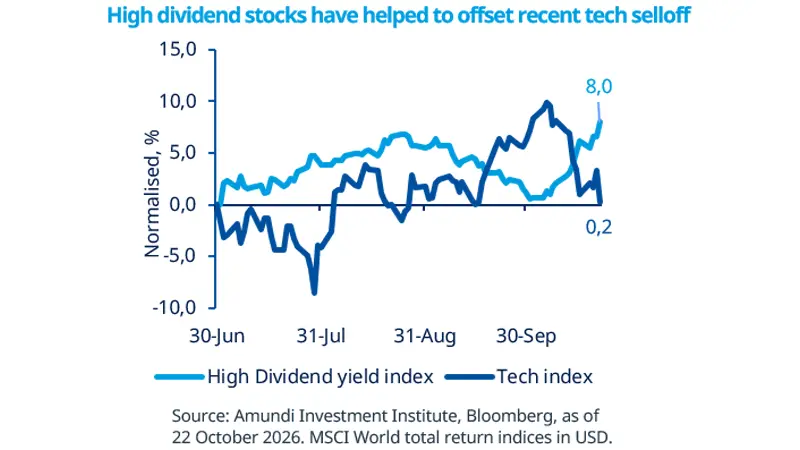
Confidence in the artificial intelligence theme has weakened in recent weeks, with the MSCI World Technology Index giving back all of the previous month’s gains. This was likely driven by a combination of mixed corporate earnings and renewed concerns about AI-related capital expenditure. We think markets have now moved beyond the phase in which the mere mention of an AI roll-out could excite investors. Markets are now increasingly demanding clarity on cash generation from these sizeable AI investments. By contrast, the MSCI World High Dividend Yield Index gained 8% in the second half of the year as markets sought steadier ground, typically found in sectors such as consumer staples, healthcare and utilities — the traditional home of dividend-paying companies — which held up well as the broader market came under pressure. This suggests diversification* opportunities through more attractively valued sectors with strong, stable businesses.
* Diversification does not guarantee a profit or protect against a loss.
This week at a glance
Global equity markets came under pressure, led by a reversal in technology stocks that spread more broadly. Bond yields in some countries, such as the US, declined amid safe-haven demand, whereas fiscal concerns in other countries pushed yields higher. In commodities, the oil price was affected by a flare-up in Middle East tensions. Gold prices declined amid concerns that persistent inflation could prompt central banks to raise interest rates.
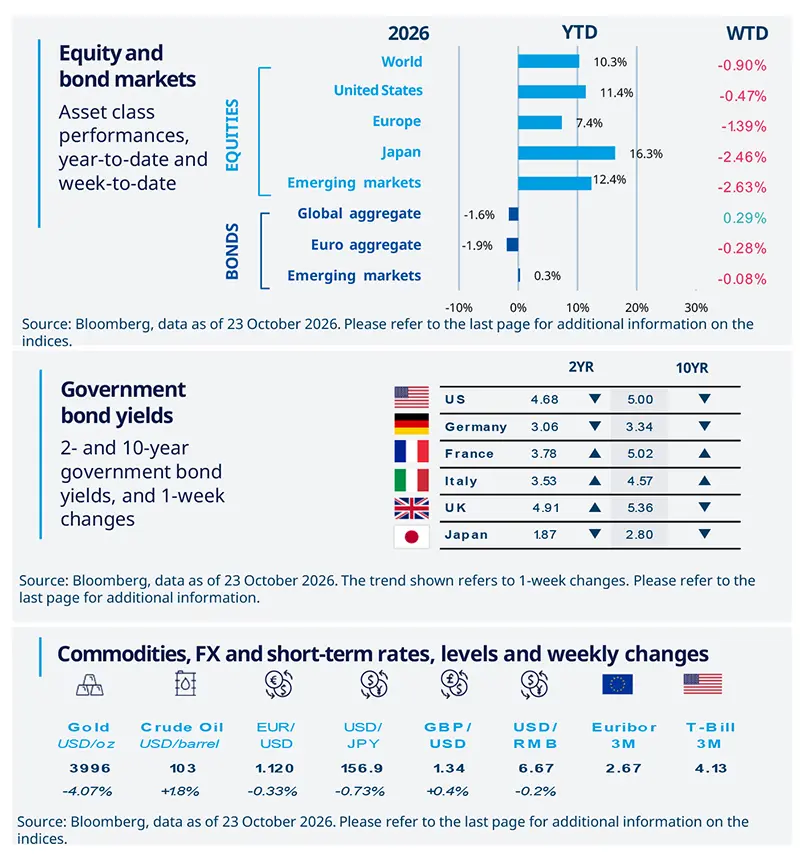
Equity and bond markets (chart)
Source: Bloomberg. Markets are represented by the following indices: World Equities = MSCI AC World Index (USD), United States = S&P 500 (USD), Europe = Europe Stoxx 600 (EUR), Japan = TOPIX (YEN), Emerging Markets = MSCI Emerging (USD), Global Aggregate = Bloomberg Global Aggregate USD Euro Aggregate = Bloomberg Euro Aggregate (EUR), Emerging = JPM EMBI Global Diversified (USD).
All indices are calculated on spot prices and are gross of fees and taxation.
Government bond yields (table), Commodities, FX and short-term rates.
Source: Bloomberg, data as of 23 October 2026. The chart shows the price of gold.
Diversification does not guarantee a profit or protect against a loss.
Amundi Investment Institute Macro Focus
Americas
US labour market holds firm, housing stays under pressure
Initial jobless claims fell to 194,000 in the week ending 17 October, below expectations and consistent with a firm labour market. The housing sector, however, continues to struggle: September housing starts fell to an annualised 1.22 million units, sharply below forecasts and down from the prior month. The releases point to a divided economy, with elevated borrowing costs continuing to weigh on builders and buyers, leaving residential construction under pressure despite labour market resilience.
Europe
Eurozone growth momentum slows in October
The EZ’s preliminary business activity reading for October came in below expectations, signalling a modest loss of momentum. The composite PMI index fell to 51.9 from 53.1 in September, as both services and manufacturing slowed. All three readings remain above the 50 threshold separating expansion from contraction, but the pace of growth is clearly decelerating. Weaker investor and consumer confidence also point to growing caution about the near-term economic outlook.
Asia
Japan inflation rises
Japan's inflation excluding fresh food and energy rose to 2.4% in September, above expectations and up from August, signalling renewed underlying price pressures. Meanwhile, the auction of 20-year government bonds drew record demand, while domestic investors increased purchases in the first half of the fiscal year, reflecting stronger appetite at elevated yields.
Key dates
US Fed policy rate, Bank of Canada policy rate |
ECB policy decision, EZ economic confidence, US GDP |
EZ GDP, BOJ target rate, South Korea industrial production |

Authors