
Summary
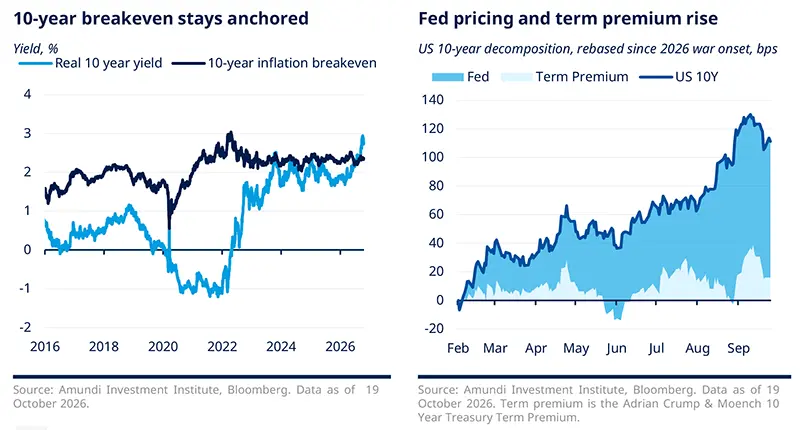
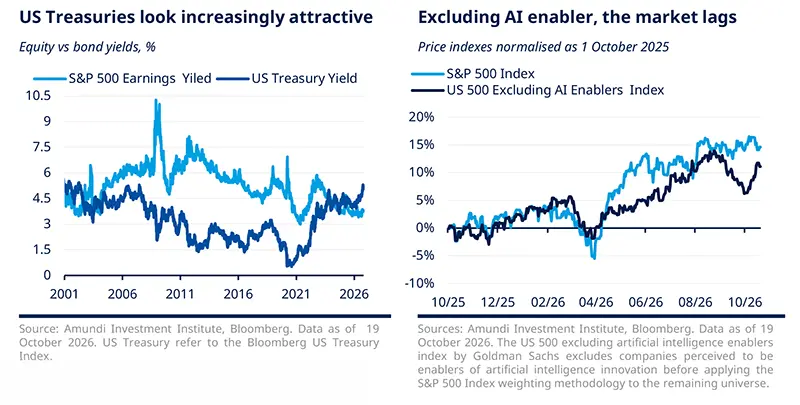
Ten-year Treasury yields moved above 5% on 15 September, just ahead of the Fed hike, and have stayed there, reaching 5.3% on 5 October. That is the highest level in almost 25 years. Yet equity markets have remained resilient, with the S&P 500 and the Nasdaq setting new highs. So, the key question is not just where yields go next, but what is driving them and how they will impact markets.
The cycle is still being supported by investment, but supply shocks are also biting. Energy remains the key near-term constraint, while AI is the bigger structural story. Energy determines how much tightening is needed. AI determines how much the economy can absorb. The Fed sits between the two.
The Fed reaffirmed its commitment to price stability at the latest FOMC meeting, but calibration is now the harder task.
Tightening too much could discourage the productive investment that may eventually help ease inflation. Tightening too little could allow inflation pressures to build again after a long period of missed targets. That uncertainty is itself a risk premium, and it helps explain why bond volatility remains high.
Higher rates are also a capital-allocation story. AI, digital infrastructure, power generation, the energy transition, defence, strategic autonomy and public deficits all require substantial funding. Public and private borrowers are competing more directly, pushing yields higher across the market. Heavy issuance is also changing the marginal Treasury buyer, with the market relying more on private investors, asset managers and hedge funds. These are more price-sensitive buyers, which adds to rate pressure. The investment boom is therefore creating both the growth that supports markets and the cost of capital that tests them.
The yield curve movements support this reading. Ten-year breakevens suggest inflation expectations remain anchored, while higher real yields point to persistent investment demand and stronger real growth, which also helps explain the resilience of equity markets.
Multiple scenarios ahead: From repricing to credit stress
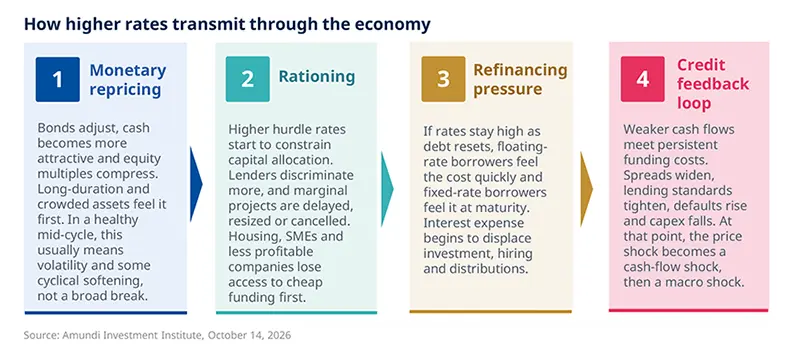
Historically, higher rates usually work through four stages (see sequence below), but the process is neither automatic nor linear. It begins with market repricing, then rationing, then refinancing pressure, and finally credit stress if the shock persists. The transmission of higher yields can be amplified by leverage and liquidity mismatches in nonbank financial intermediation, even before broad corporate credit conditions deteriorate. Today, the evidence is still closer to repricing and selective pressure than broad stress. Spreads have widened only modestly; liquidity is orderly and large-company balance sheets remain resilient. A sustained move into broader stress would show up in wider spreads, tighter lending standards, weaker earnings revisions, lower capex and refinancing failures.
What is most vulnerable and what is most resilient
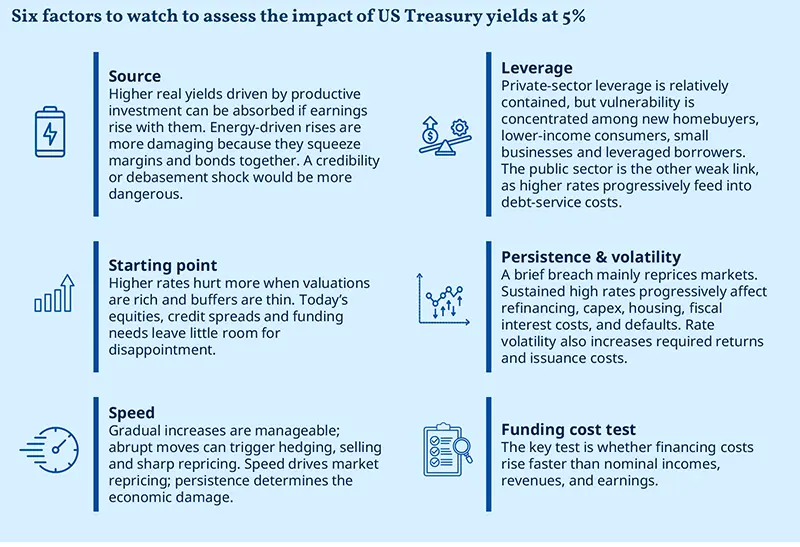
The key question is not how far rates rise, but why. Different shocks move different parts of the curve and hit different assets. Monetary uncertainty tends to hurt shorter- and medium-term assets. An energy shock impacts mostly growth equities, duration and corporate margins. A term-premium shock hits long-duration assets. Overtightening can eventually spread from housing and weaker consumers into equities and credit. When the regime is unclear, correlations become less reliable and vulnerabilities widen.
Today, equities are more rate sensitive, but not evenly. Real estate, utilities, homebuilders, materials and capital-intensive AI infrastructure and power are among the most exposed because of their long-dated cash flows and funding needs. By contrast, companies with strong pricing power and higher earnings growth should prove more resilient. In that group, selected communication services, semiconductor, hardware, memory and networking exposures still look better placed.
Credit is sensitive, but less so than in the past. Investment grade is exposed through its longer duration, while high yield becomes more vulnerable if higher rates weaken growth and widen spreads. Leveraged loans offer the most initial protection because of floating coupons, although prolonged high rates eventually weaken borrowers’ interest coverage.
The dollar will likely remain a resilient asset, even when higher rates reflect Fed uncertainty or stronger US real yields. Oil is resilient in an inflationary or geopolitical shock, but vulnerable to de-escalation.
AI will largely determine where rates land
The investment cycle will determine whether today’s high-rate environment is sustainable. AI spending raises demand for capital, while productivity gains should lift growth. But it also creates near-term pressure through power, equipment and labour bottlenecks. Higher rates raise AI hurdle rates, financing costs, and scrutiny of distant monetisation. As the buildout broadens from cash-rich hyperscalers toward corporate borrowers, infrastructure providers and private credit, it becomes more dependent on utilisation, revenue quality, and refinancing conditions.
AI therefore supports the higher-rate backdrop, but it also becomes more exposed to it. Recent volatility in AI related credit underscores that continued investment alone is not sufficient: earnings visibility and sustainable financing conditions will be critical to market resilience. If monetisation disappoints, capex and valuations could fall while the debt remains, hurting growth and putting pressure on equities. That is the main risk case.
For now, though, the base case is absorption rather than rupture. Nominal growth remains supportive, inflation expectations are anchored, credit markets are orderly and investment is still strong. In the context of higher inflation and an unstable bond-equity correlation, the Treasury remains a key diversifier in case of a growth disappointment shock. This argues for a selective risk-on stance, a careful approach to duration and greater diversification, including gold and private assets.



Authors