
Summary
The ongoing US earnings season confirms a broadening of earnings growth across sectors, although scrutiny remains on data and quality of guidance beneath the headline numbers. Overall, this reinforces the importance of diversification and selectivity
Strong US earnings growth continues
Earnings growth for Q2 has been strong, with a high proportion of companies beating expectations.
Although Technology and tech-adjacent sectors continue to drive earnings growth, other areas are also contributing, with AI-related demand supporting earnings more broadly.
Investors have been selective in rewarding earnings beats, suggesting a focus on data and guidance beyond the headline numbers.
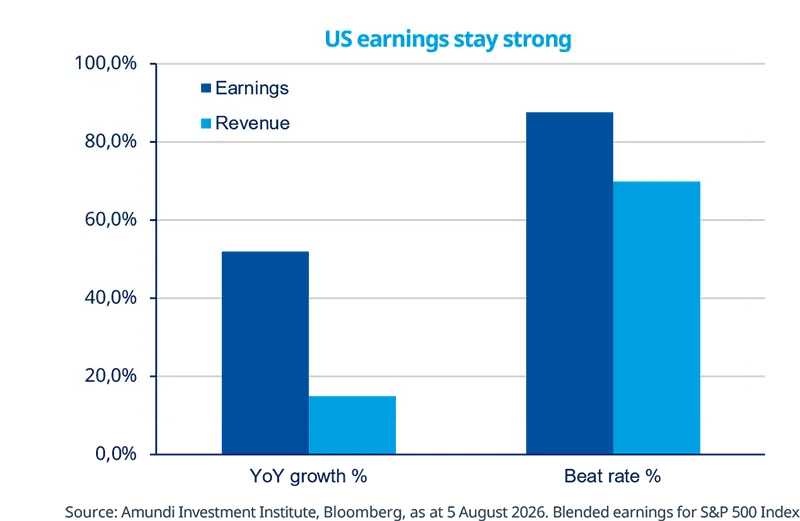
With around 80% of S&P 500 companies having reported, the US is on track for another strong earnings season for Q2, with blended (actual earnings of companies that have reported results plus estimated earnings of those yet to report) earnings growth of about 52% YoY. As in the previous quarter, the headline figure has been boosted by “other income” items linked to investment gains from stakes in private companies held by some Big Tech names, but earnings growth remains robust even on an adjusted basis. A high rate of companies that have reported (above 80%) have beaten earnings expectations, the highest in 5 years. Technology and tech-adjacent sectors remain the main driver of earnings growth, but other sectors are contributing as well, with notable surprises in Energy, Financials, Industrials and Materials. In Europe, blended earnings growth stands at 26%. Energy is a major driver, but ex-Energy growth remains solid, with Financials still strong while Consumer Cyclicals continue to be a drag.
This week at a glance
Equities rose across regions except in EM as investors turned their focus to strong earnings and hopes of easing tensions in the Middle East pushed oil sharply lower. US equities outperformed as the AI-trade resumed. Oil fell on expectations of increased traffic through the Strait of Hormuz. Treasury yields fell and gold advanced as markets scaled back expectations of further interest-rate hikes.
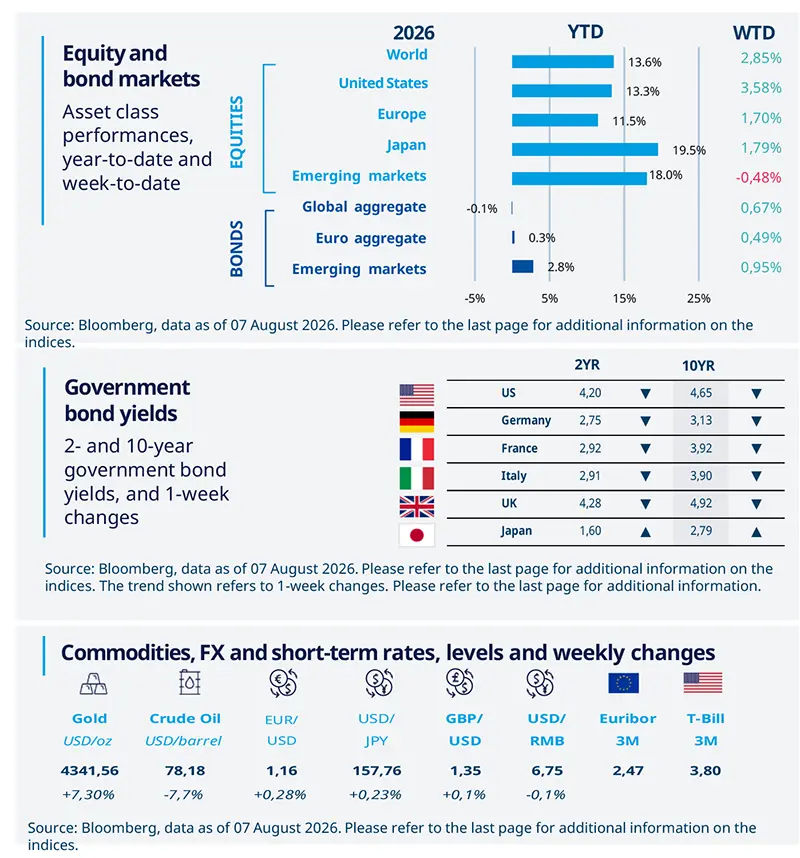
Equity and bond markets (chart)
Source: Bloomberg. Markets are represented by the following indices: World Equities = MSCI AC World Index (USD) United States = S&P 500 (USD), Europe = Europe Stoxx 600 (EUR), Japan = TOPIX (YEN), Emerging Markets = MSCI Emerging (USD), Global Aggregate = Bloomberg Global Aggregate USD Euro Aggregate = Bloomberg Euro Aggregate (EUR), Emerging = JPM EMBI Global Diversified (USD).
All indices are calculated on spot prices and are gross of fees and taxation.
Government bond yields (table), Commodities, FX and short-term rates.
Source: Bloomberg, data as of 7 August 2026. The chart shows the price of gold.
Diversification does not guarantee a profit or protect against a loss.
Amundi Investment Institute Macro Focus
Americas
US economic activity gains momentum
US manufacturing activity remained in expansion territory in July, with the ISM Manufacturing index rising to 55.6 and recording its strongest factory expansion in recent years. Output and new orders accelerated, while employment returned to growth and cost pressures eased. The ISM Services index edged up to 54.1, signalling continued growth in the sector as activity and orders improved and concerns over tariffs and the Middle East eased. However, employment slipped back into contraction and price pressures increased.
Europe
Eurozone activity returns to expansion
The Eurozone Composite PMI was revised slightly higher to 52 in July, up from 50 in June and moving back into expansion territory for the first time since March. The broad-based improvement points to a solid start to the third quarter: services returned to growth, with a strong pickup, while manufacturing output continued to expand and remained resilient. Inflationary pressures also eased, as both input costs and output prices increased at a slower pace during the month.
Asia
India’s central bank remains on hold
The Reserve Bank of India kept the policy repo rate unchanged at 5.25%, maintaining a patient, data-dependent stance while awaiting clarity on inflation. The RBI modestly upgraded its growth outlook and lowered its headline inflation projection, viewing current price pressures as temporary, non-generalised supply shocks. Recent declines in global oil prices and a narrowing south-west monsoon deficiency are easing immediate pressures, reducing the need for unnecessary policy tightening.
Key Dates
India CPI, Italy and Germany CPI, US CPI |
Japan PPI, UK GDP Q2, EZ Industrial production, US PPI |
India PPI, EZ GDP Q2, US retail sales and Consumer Confidence |



Authors