
Summary
As the Fed moves to reduce policy guidance, uncertainty over the short-rate path is likely to rise, creating additional volatility along the yield curve
Fed on hold, markets in action
The Fed left interest rates in the range of 3.5% - 3.75%. The decision was not unanimous, with 3 dissenters in favour of a hike, revealing divisions within the FOMC.
Fed Chair Warsh reiterated the Fed’s commitment to restoring price stability, while emphasising efforts to rethink the Fed’s framework for inflation analysis.
Two-year yields fell as investors scaled back expectations of near-term hikes, while 30-year yields rose to a 19-year high, pointing to a higher risk-premium.
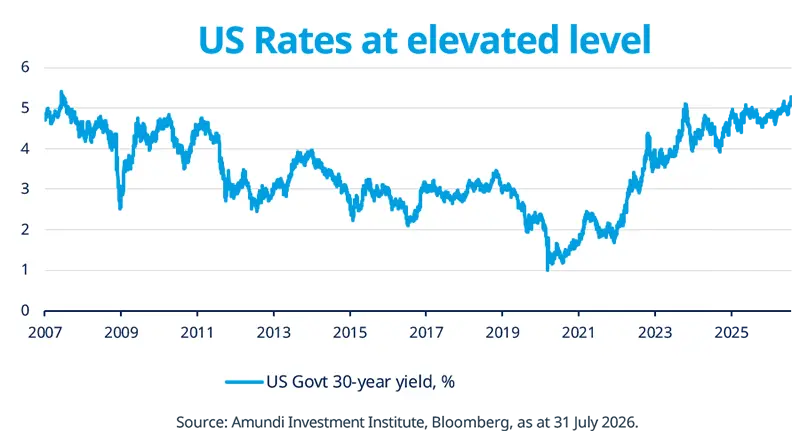
The Fed left interest rates unchanged at Kevin Warsh’s second meeting as Chair, reinforcing our view that his hawkishness remains stronger in rhetoric than in action. Warsh described the stance as “watchful thinking”, rather than “watchful waiting”, suggesting a more active assessment of the economic backdrop. He also noted that financial conditions have tightened materially as yields have risen, framing markets as an important source of information, while reiterating plans to reduce policy guidance. Recent benign inflation data likely gave the Fed room to stay on hold, but Warsh’s description of the economy as solid and inflation still above target has left investors sceptical. Bond-market movements in the immediate aftermath of the meeting highlighted uncertainty over the short-rate path and inflation dynamics. In our view, the Fed is likely to remain on hold until Q2 next year, before easing resumes as inflation normalises amid softer demand and lower tensions in the Middle East.
This week at a glance
Equity markets in aggregate found relief at the end of the week after robust earnings have reduced worries about valuations and profitability of AI-related investments. In fixed income, yields were mixed, with long-term yields rising while shorter yields fell in reaction to the FOMC’s decision to leave rates unchanged. Oil fell amid hopes of easing tensions in the Middle East. In FX, the yen strengthened on speculation of official intervention.
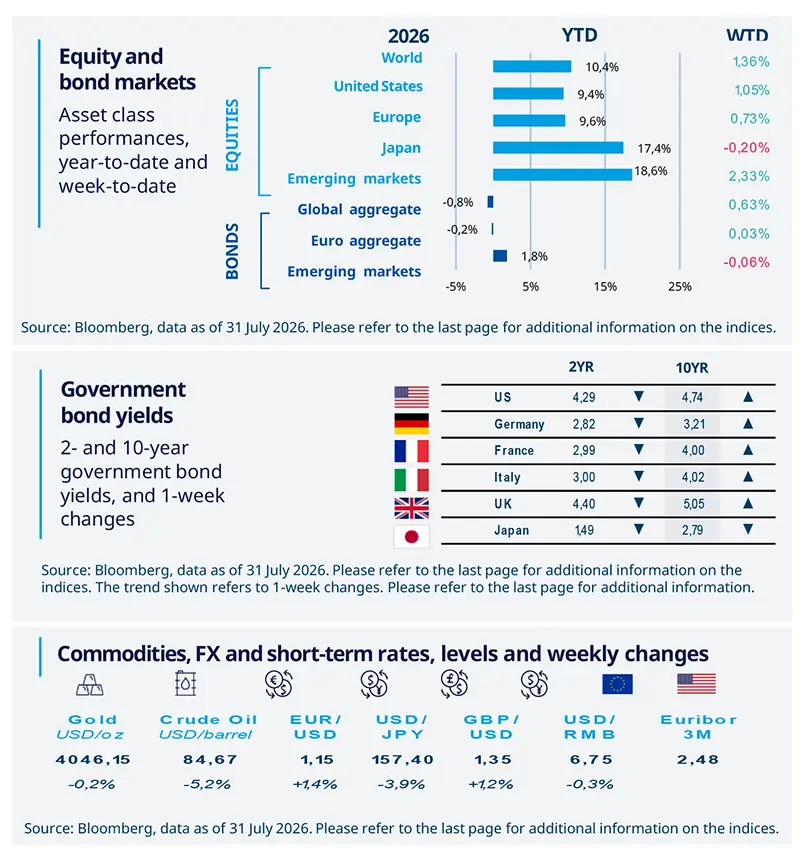
Equity and bond markets (chart)
Source: Bloomberg. Markets are represented by the following indices: World Equities = MSCI AC World Index (USD) United States = S&P 500 (USD), Europe = Europe Stoxx 600 (EUR), Japan = TOPIX (YEN), Emerging Markets = MSCI Emerging (USD), Global Aggregate = Bloomberg Global Aggregate USD Euro Aggregate = Bloomberg Euro Aggregate (EUR), Emerging = JPM EMBI Global Diversified (USD).
All indices are calculated on spot prices and are gross of fees and taxation.
Government bond yields (table), Commodities, FX and short-term rates.
Source: Bloomberg, data as of 31 July 2026. The chart shows the price of gold.
Diversification does not guarantee a profit or protect against a loss.
Amundi Investment Institute Macro Focus
Americas
US growth underpinned by strong domestic demand
US GDP expanded at an annualised pace of 1.5% in Q2, down from 2.1%, but the headline slowdown masks a strong underlying composition. Consumer spending (3.2%) was supported by fiscal stimulus in the first half of the year. Non-residential fixed investment (8.4%) was supported by industrial and transportation equipment, and software investment. Housing investment (1.5%) posted its first quarterly increase since Q4 2024. Overall, we confirm our view of an economy which grows at 2% or marginally above, and that is not particularly affected by the energy shock.
Europe
Euro Area growth proves resilient
Euro Area GDP expanded by 0.4% in Q2, higher than expected. However, excluding Ireland, growth is in line with our expectations at 0.2%, with Germany, France and Italy all posting the same rate, and Spain growing higher. The steady growth in the Euro Area economy highlights that households and businesses have not significantly reduced spending despite tensions in the Middle East. Looking ahead, barring further rises in energy prices, the Euro Area might continue to growth below potential, avoiding a more severe slowdown.
Asia
China signals more proactive policy support
China’s policymakers signalled a shift towards more proactive economic support as growth momentum slowed in the second quarter, and headwinds intensified. While stopping short of a major stimulus pivot, the leadership called for stronger countercyclical adjustment and faster deployment of fiscal resources, aiming to reverse the contractionary policy stance of recent months. It also prioritised more balanced trade development, likely in response to elevated trade tensions with the EU.
Key Dates
China PMI Manufacturing, EZ PMI Manufacturing, US ISM Manufacturing |
China PMI services, EZ PMI Services, US ISM Services, India policy rate |
EZ Retail sales, US Nonfarm Payrolls |



Authors