
Summary
Key takeaways
The Russia-Ukraine war, the rise of tariffs and, most recently, the energy crisis are all triggers of a new geo-economic regime, where the forces shaping markets are broader and more structural.
As energy security, defence and industrial policy move to the centre of national strategy, the investment landscape also evolves. Global efficiency matters less; domestic resilience and regional dynamics matter more.
Fiscal dominance will also be a major market driver in the next years, particularly for fixed income markets, as rising debt and pressure to support growth are likely to increase the need for domestic absorption of government debt.
In this environment, investors should reassess their regional exposure. US assets remain central to the global financial system, but their weight in portfolios should be reassessed. This applies not only to US equities, but also to US Treasuries and the US dollar, which are increasingly challenged as anchors of stability.
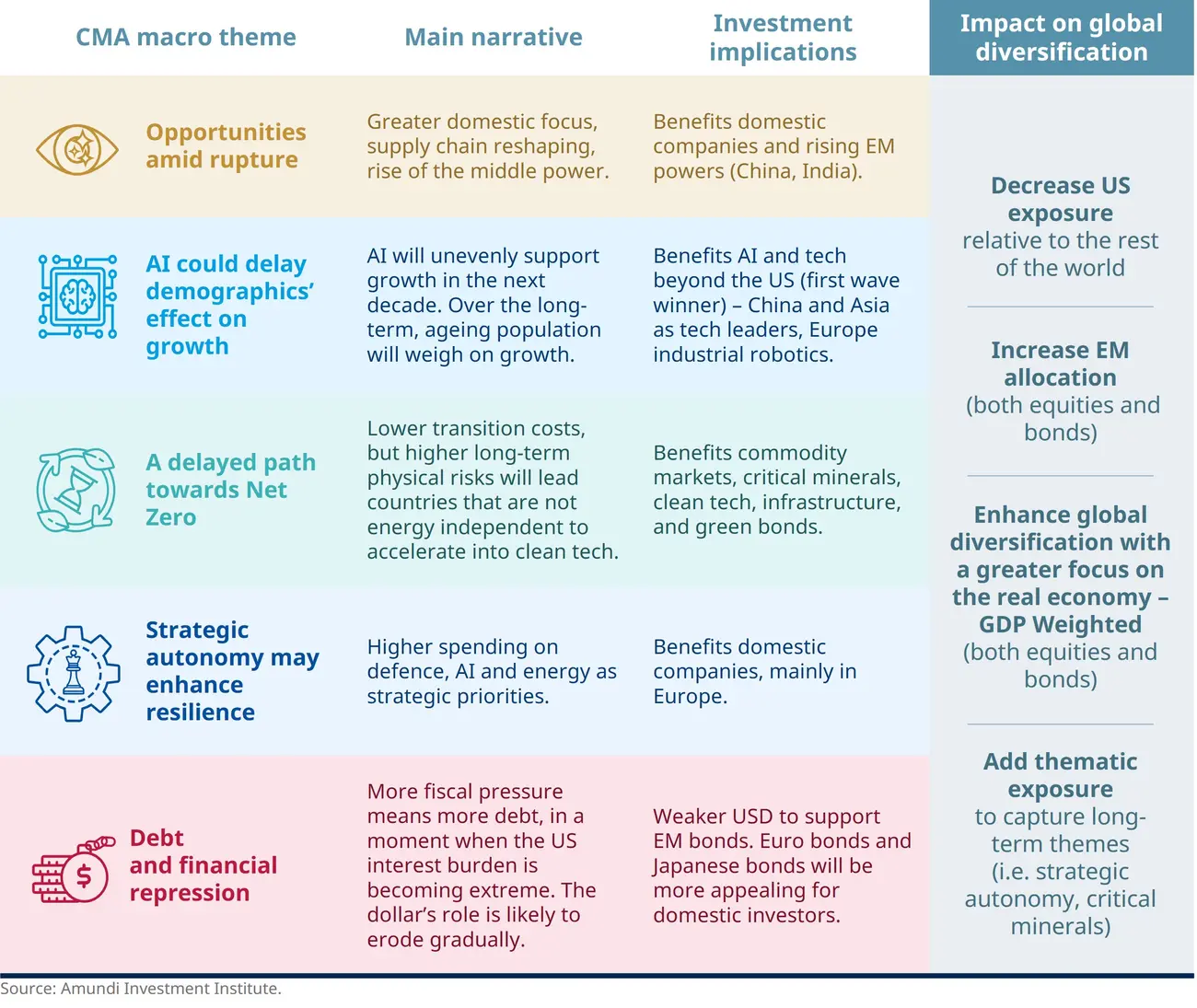
This means diversification will need to go beyond traditional market capitalisation to capture opportunities, particularly over the next five years. Structural market drivers are now more complex, so diversification must also consider currency, region, and sector, as well as supply chain exposure and energy security — in short, dependency risks. That is where a larger role for Europe, Asia or different diversification approaches tilted towards the real economy becomes increasingly compelling for investors.

Monica DEFEND
The US market remains key for investors, but as concentration risks loom, it’s time to rethink global diversification around the real economy, FX and geopolitics.
Divergence at a turning point
The unprecedented market concentration in the US along with the extreme divergence from the real economy, are now reaching a turning point.
Looking ahead: a greater focus on the real economy
Investors must position for a world of more volatile economic cycles and greater regional differentiation.
Rethinking global diversification
While the market capitalisation approach is based on past winners, an era of rupture calls for a greater focus on the real economy to capture future opportunities.
Structural themes and the future of diversification


Authors